Cold plasma. Machine learning. A small Bay Area company asking factories to stop guessing what's inside their materials - and start measuring it, live, without breaking a thing.
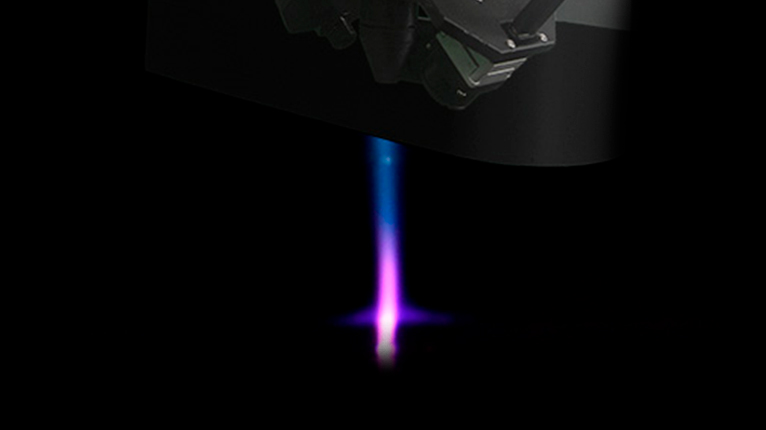
It is a Tuesday morning at a battery pilot line. A coated copper foil unspools at a meter per second. Somewhere along that ribbon is a coating defect the operator will not see for four hours. A SirenOpt instrument, mounted overhead, fires a thin plume of cold atmospheric plasma at the foil. Light scatters. Models run. A signal appears on a dashboard. The defect is flagged before it leaves the room.
That is the whole pitch, more or less. SirenOpt - based in San Leandro, born in a Berkeley lab in 2022 - builds an instrument and a software stack called PlasmaSens that fingerprints advanced materials in real time. The instrument does not touch the material. It does not destroy a sample. It does not require a clean room or a microscope. It is, by deep-tech standards, almost suspiciously practical.
The team's bet is that the gap between what factories can measure and what they need to measure has quietly become the most expensive problem in advanced manufacturing. Batteries, semiconductors, aerospace alloys, flexible electronics - all of them ship with blind spots. SirenOpt thinks plasma plus machine learning can close them.
SirenOpt's platform splits into a factory-grade product and a lab-grade one. The factory tool, PlasmaSens, is built to live above a moving production line - roll-to-roll for electrodes and membranes, piece-to-piece for wafers and components. Its job is to inspect, characterize, and feed a decision-making model continuously. Resolution is at the micron scale.
The lab tool, PlasmaSmart, runs offline. It is intended for R&D, qualification, and process development - the slower, more curious work that decides what eventually rolls down the line.
Both share the same underlying idea: a stream of cold atmospheric plasma interacts with the surface of a material, and the resulting signals - optical, electrical, spectral - are fed into physics-informed machine learning models. The output is what SirenOpt calls a material fingerprint. Each one is multilayered and (the founders argue) uniquely distinctive.
Factory-integrated platform for in-line, non-destructive inspection and real-time process control. Designed for roll-to-roll and piece-to-piece manufacturing.
Off-line characterization for R&D, qualification, and process development. Same plasma + ML core, different deployment.
Lithium-ion electrode inspection and quality control - the wedge market, funded in part by the California Energy Commission.
Wafer-to-wafer analysis, aerospace alloys, flexible electronics, membranes, packaging materials. All built around the same fingerprint idea.
Walk into most advanced-materials factories and you will find a quiet ritual: a small fraction of finished product is pulled off the line and ruined - cut, etched, X-rayed, dissolved - so engineers can find out what they made. The rest ships and hopes. It is a system designed for an era when in-line measurement was either impossible or absurdly slow.
SirenOpt's argument is that this is no longer the only option. Cold atmospheric plasma is gentle enough to leave sensitive coatings alone. Machine learning is fast enough to turn its scattered signals into useful answers in milliseconds. Put them together and you can, in principle, measure every meter of every roll. Whether it pencils out in dollars per defect avoided is the question every prospective customer is now running.
PlasmaSens uses cold atmospheric plasma combined with machine learning and predictive analytics, delivering micron-level resolution and integrating into roll-to-roll and piece-to-piece production lines.- TechFundingNews, Oct 2025
SirenOpt was spun out of UC Berkeley's Chemical Engineering Department in 2022. Two of its three co-founders are still tenured professors. The third runs the company.
PhD in chemical engineering from UC Berkeley. Cyclotron Road / Activate fellow. Investigated learning-based methods to characterize and control advanced materials manufacturing.
Associate Professor of Chemical Engineering at UC Berkeley. Long-running research program on model-based control of plasma processes.
Associate Professor at the University of Wisconsin-Madison. Works on data-driven optimization for chemical and materials systems.
Strategic backer with deep industrial reach across battery, energy, and infrastructure customers.
Jaguar Land Rover's venture arm. Useful for automotive and battery supply chain conversations.
Climate-focused early backers. Led the 2024 seed and returned for the 2025 round.
Spin-out IP relationship and ongoing research connection.
Funded the PlasmaSens battery electrode deployment with a $2.4M grant.
The LBNL-based hard-tech fellowship that helped move the technology from paper to factory.
Inline plasma fingerprints flag composition and coating anomalies the moment they appear, instead of four hours later in a destructive test pile.
Feed the live signal back into the line. Adjust mixing, coating, or sintering parameters before drift becomes scrap.
Use the offline PlasmaSmart tool to characterize new chemistries quickly, without burning weeks on traditional metrology.
SirenOpt's public technology stack is a quiet tell. Alongside the expected MATLAB and Python, you will find Terraform, Ansible, Proxmox, and Ceph. That is unusual for a 42-person materials startup. It suggests a company that thinks of its factory instruments as nodes in a distributed system, not as one-off lab boxes - and that wants to control its own data pipeline before customers ask the awkward questions about it.
The name itself is a double pun. Sirens, in the old story, were the voices nobody could resist hearing. Opt nods to optimization, the mathematical work that turns raw plasma signals into a decision. A company built on the idea that the right signal is irresistible, and that the right algorithm makes it actionable.
A handful of public conversations and write-ups give the texture the website does not.
Return to that pilot line in San Leandro. Same operator. Same copper foil. The defect that used to surface four hours late now blinks on the dashboard before the roll has crossed the room. The destructive test pile in the corner has shrunk. The data lake behind the line has grown.
SirenOpt has not made the factory louder. It has made it more honest. A plume of cold plasma, a model trained on millions of fingerprints, a couple of co-founders who used to publish papers about exactly this. The line keeps moving. The blind spot does not.