The San Francisco startup teaching books a new trick: how to listen. And then how to answer back.
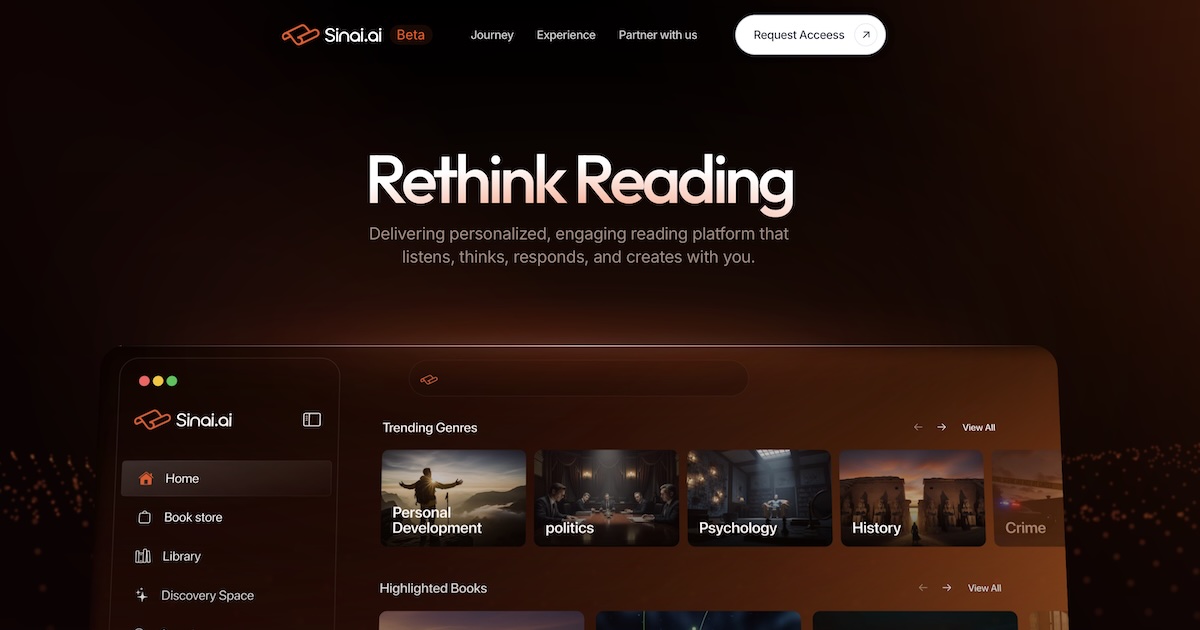
Open a Sinai.ai title in the spring of 2026 and you will find a page that does something pages were never supposed to do. It listens. You ask it a question - about the protagonist, about a term in the footnote, about that paragraph you read three times and still cannot pin down - and the page answers. In your language. In your reading voice. Without leaving the chapter.
The format has a name. The aiBook. Trademarked. Patent-pending. And as of April 2026, $1.45 million in pre-seed money believes it might be the most useful thing to happen to publishing since the spine.
Publishing is the only multi-billion-dollar industry where the product has been mostly unchanged since Gutenberg. You buy paper. You read paper. You put paper down. If you have a question, the paper is, regrettably, mute.
Ahmed Kamel noticed. So did Mohamed Elshamy. So did Mohamed Elshenawy, Hana Malhas, and Abdullah Moatasem. Between them they hold credentials from Stanford, Yale, the University of Toronto, the University of Michigan, plus work histories that include Google, McKinsey, Meta, Warner Bros., Netflix, and Disney+. They could have done anything. They picked books.
A traditional book has one job: deliver text. Sinai's aiBook has four. It delivers text. It speaks the text. It debates the text. It quizzes you on the text. Same book - one purchase, four interfaces. Switch between reading and listening mid-page. Ask a passage to translate itself. Ask a chapter what it really meant. Generate a study guide for the kid who needs to write the essay tomorrow.
The trick is that nothing has been scraped. Sinai signs publishers, licenses the full text, and runs its models on complete, legitimate works. In an AI industry currently spending most of its legal budget defending the opposite approach, that is a feature, not a footnote.
Read it. Listen to it. Argue with it in English, Arabic, Spanish, or German. Highlight a sentence and ask why. Generate a quiz for your exam. Hand it to a kid in seventh grade and a postdoc in comparative literature and watch both find the level they need. The platform is in invite-only beta. General availability is on the way.
That readers do not want shorter books, they want deeper ones. That publishers do not want a war with AI, they want a piece of it. That a $1.45 million pre-seed, well-placed, can do more than a $30 million Series A, mis-placed. Whether Sinai is right will play out in the closed beta - and the next round.
AI will fundamentally reshape industries, and publishing needs meaningful innovation. Sinai transforms books into interactive experiences.Mohamed Okasha · DisrupTech Ventures
Trademarked, patent-pending file format that turns a licensed published title into a multimodal experience. The unit Sinai sells.
Talk to the text in real time. Ask, argue, debate, summarize. No tab-switching, no copy-paste, no extra app.
Custom study guides, exam-style questions, and chapter summaries generated from the actual book, on demand.
Read and discuss in dozens of major languages - English, Arabic, Spanish, German, and more.
Switch between reading and listening mid-page. Same position. Same voice. No second purchase.
Postgrad AI work at Stanford. Google Developer Expert in ML. Serial entrepreneur.
Yale MBA. Prior at Google, McKinsey, and Meta.
PhD in AI from the University of Toronto.
Michigan MBA. Background spanning creative industries and startups.
Creative director with credits at Warner Bros., Netflix, and Disney+.
Sinai.ai is founded by Ahmed Kamel and four co-founders, spanning Stanford, Yale, Toronto, Michigan, and Hollywood.
aiBook format prototyped. First publisher licensing conversations begin.
$1.45M pre-seed round closes, led by KAUST Innovation Ventures and DisrupTech Ventures.
Public funding announcement; AI and publishing trade press pick up the story. Closed beta continues.
Return to the opening scene: a page, a reader, a question. The page used to be silent. Now it answers in your language, it quizzes you on its meaning, it reads itself aloud when your eyes are tired, and it does all of it on a license that the author actually signed. The book did not get smaller. The book got louder. Sinai.ai built the room where it learned how to talk.