Before they made silence, they made noise. Joshua Waldron and Jonathon Shults were boyhood friends from American Fork, Utah, running a music recording studio - Waldron behind a camera on the side, Shults engineering sound. The problem that started the company was personal: years of hunting had chewed up Waldron's hearing, and the suppressors on the market for a .22 rimfire pistol were, in their opinion, not very good. So in 2008, in a garage in West Valley City, they set out to build a better one.
That first product, the Sparrow .22, did the unglamorous thing well. It came apart easily, cleaned up fast, and could run long strings of rimfire ammunition between services - a genuine annoyance solved for the people who actually shoot a lot. SilencerCo grew out from there into rifle cans, pistol cans, a shotgun suppressor, and eventually a pistol with the silencer built inside it. Today the company is widely described as the largest firearm suppressor manufacturer in the United States, a claim that competitors rarely bother to contest.
01 / What They Actually MakeSuppressors, and the myth around them
First, the correction the whole industry is tired of making: a suppressor does not make a gun movie-quiet. The Hollywood pfft is fiction. What a suppressor does is knock the muzzle report down from a level that permanently damages hearing to one that is merely loud - closer to a jackhammer than a whisper. Framed that way, the product is less a spy gadget and more a piece of safety equipment, which is exactly how SilencerCo prefers to sell it.
Figures are approximate and vary by host firearm, caliber and ammunition. The point is the ballpark, not the decimal.
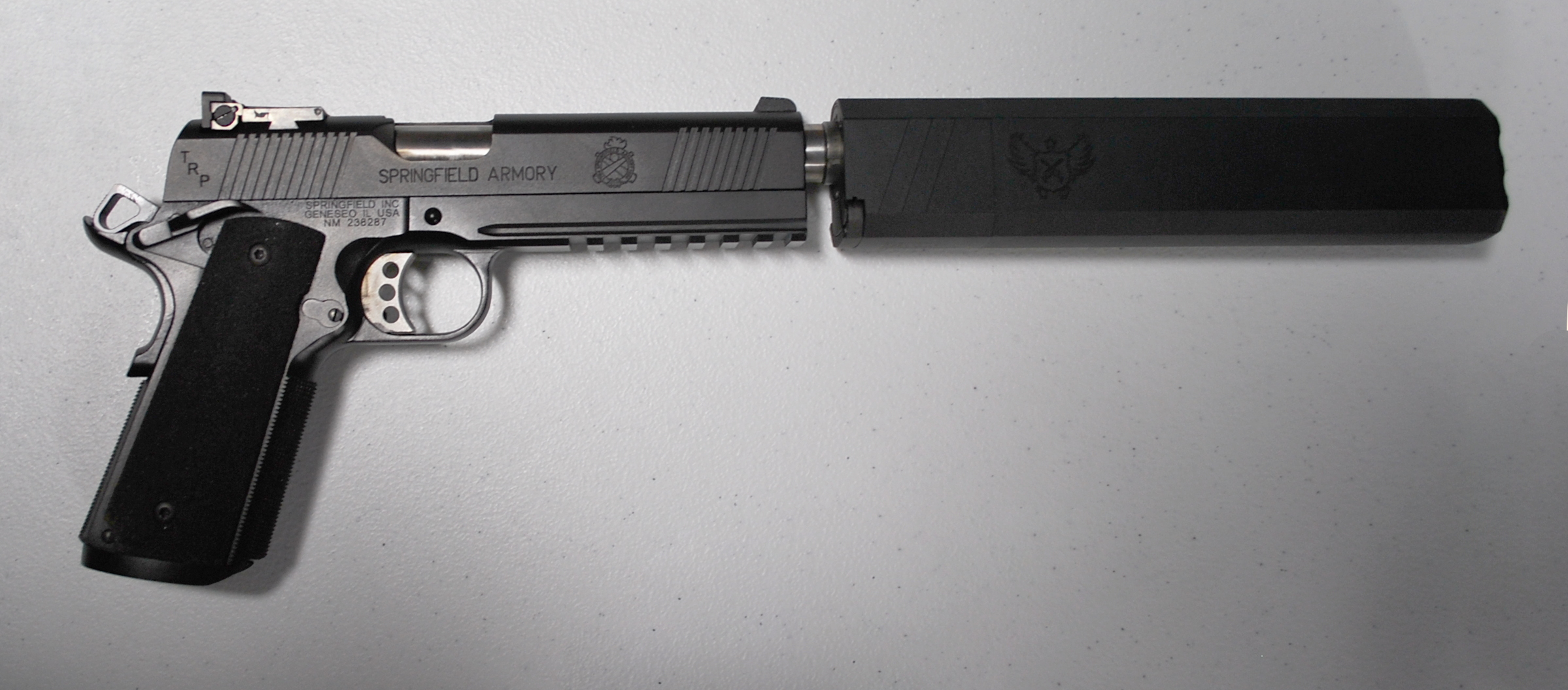
The lineup fans out across every category a shooter might carry. On the rifle side there is the flagship Omega family (the 300 and the modular 36M), the compact Omega K, the Velos LBP line engineered to reduce the gas that blows back into a shooter's face, plus hunting-focused Harvester and Scythe models. For pistols there is the Osprey, the rimfire Sparrow and Switchback, and titanium Spectre cans. The Hybrid 46M is the do-everything unit, rated from pistol calibers up through .45-70 Government in a single tube. And then there are the two products that made the company famous.
02 / The Two That Made the NameA quiet shotgun and a pistol that hides itself
In 2014, SilencerCo introduced the Salvo 12, a modular 12-gauge shotgun suppressor - a thing most of the industry had quietly filed under "not possible." Shotgun shot columns and the huge gas volume of a 12-gauge make suppression genuinely hard. The Salvo works because it is configurable: shooters can build it to 6, 8, 10, or 12 inches, trading length and weight for quiet depending on whether they are hunting turkey, chasing waterfowl, or standing in a doorway at 2 a.m.
SilencerCo's habit is to pick the product everyone says can't exist, then just make it.The Salvo 12 and the Maxim 9
Three years later came the Maxim 9, unveiled at SHOT Show 2017: a 9mm pistol with the suppressor engineered directly into the gun, and - critically - one you could still fit in a holster. It was named after Hiram Percy Maxim, who patented the firearm silencer back in 1909, a naming choice that tells you something about how these founders think. They came from acoustics, not gunsmithing, and they treat the suppressor as a sound problem first and a firearm accessory second.
03 / Who Buys ItHunters, competitors, and the guy at the range next to you
The customer base is broad and mostly civilian: hunters who would rather not lose the top of their hearing range, sport and competition shooters, home-defense buyers, and a meaningful slice of law-enforcement and military users. It is a consumer brand as much as an industrial one - the "Shoot Suppressed" tagline, the hundreds of thousands of Instagram and Facebook followers, and a merchandise store all point at a lifestyle audience, not just a procurement officer.
04 / The Business ModelSelling America's most paperwork-heavy product online
Here is the genuinely interesting operational story. Suppressors are National Firearms Act items, which means you cannot simply add one to a cart and check out. A buyer has to go through an ATF Form 4 process - fingerprints, a background check, and, historically, a $200 tax stamp - with a licensed dealer physically holding the item until the government approves the transfer, a wait that has often run for months.
Most companies would bury that friction. SilencerCo did the opposite: it built the process into the buying experience, sells direct-to-consumer through silencerco.com alongside a wide dealer network, and offers an "Easy Pay" financing option so buyers can put money down and spread the cost while the ATF does its thing. Owning the most annoying part of the purchase turns out to be a moat.
As of January 1, 2026, the federal tax stamp on suppressors falls from $200 to $0. The registration and background check still apply.
05 / How It's DifferentEngineering, materials, and an in-house range
Two things separate SilencerCo from the crowd of machine shops that stamp out cans. The first is a willingness to redesign the shape of the product when physics demands it - the offset Osprey and the modular Salvo are both cases of the company ignoring what a suppressor is "supposed" to look like. The second is testing culture. The headquarters includes an 80-yard indoor shooting range and a sound lab, and validating a design means firing thousands of rounds through it. Materials range from titanium and stainless steel to more recent 3D-printed baffle structures, chosen for the tradeoff between weight, heat, and durability.
A suppressor is an acoustics problem wearing a firearm accessory's clothes.The founders came from sound engineering
06 / Scale and Market PositionThe biggest name in a regulated niche
SilencerCo made the Inc. 5000 list of fastest-growing companies three years running (2013 through 2015) and is consistently cited as the largest suppressor manufacturer in the country. As a private company it does not publish figures, so revenue estimates - somewhere in the range of roughly $67 million to over $100 million - and headcount of around 220 should be read as approximate. Its competitive set includes SureFire, Dead Air, Rugged Suppressors, Gemtech, Liberty Suppressors, and SIG Sauer's own suppressor line.
Growth has come by acquisition as well as invention. SilencerCo bought SWR Manufacturing in 2011, folding in additional suppressor lines, and in 2024 acquired the business operations of ZEV Technologies, a firearms and parts maker - a signal that the company sees itself as more than a maker of cans.
07 / The Long GameWhen the best product upgrade is a change to the law
The most consequential thing SilencerCo built may not be a suppressor at all. A founding member of the American Suppressor Association, the company spent years lobbying for suppressor reform - and in 2018, the founders stepped back from day-to-day leadership specifically to focus on the legislative fight while remaining major equity holders. The payoff arrived in 2025: federal legislation zeroed out the $200 tax stamp on suppressors, effective January 1, 2026. The device still has to be registered, so it is a partial win rather than the full deregulation advocates wanted - but a 90-year-old tax hitting zero is a rare thing for any company to help engineer.
A short history
- 2008The garage. Waldron and Shults found SilencerCo in West Valley City, Utah.
- 2009The Sparrow ships - the modular .22 that made the company's early reputation.
- 2011Acquires SWR Manufacturing, adding lines and capacity.
- 2014Salvo 12, marketed as the first commercially viable shotgun suppressor.
- 2017Maxim 9, the first integrally suppressed, holsterable 9mm pistol.
- 2018Founders step back to focus on suppressor law reform.
- 2024Acquires ZEV Technologies operations, expanding beyond suppressors.
- 2026The tax hits zero. The federal suppressor stamp drops from $200 to $0.