A phone call looks effortless only if you never ask where it goes. Underneath the greeting is a switch, a route, a carrier, a codec, a queue, sometimes a recording, and lately an AI model trying to respond before the caller notices a pause. SignalWire’s founders spent years working on the part most people never see. Their argument today is that the invisible part has become the whole contest.
- SignalWire sells programmable voice, messaging, video and AI infrastructure to builders.
- Its technical inheritance is FreeSWITCH, the open-source phone engine created by its founding team.
- Its bet: keep call control and AI close to the live audio, then expose both through code.
Anthony Minessale started FreeSWITCH in 2005. The project let developers assemble the machinery of calling without buying a proprietary switch. It became a quiet ingredient in a large part of modern communications. In 2017, Minessale and colleagues founded SignalWire to put that experience behind a hosted, programmable service. The shift was from running your own engine to instructing one over an API.
That distinction sounds small until a call changes direction. A customer asks for a refund, then needs a person. An emergency line must route to the right operator. A school has to send a message after a recorded announcement. Each moment forces the application to know what just happened, what can happen next, and who is still connected. SignalWire calls the governing layer a control plane. Plainly put, it is software that stays with the call while decisions are being made.
01 / Origin storyThe engine became the argument
SignalWire has a useful advantage in an industry full of diagrams: its team wrote the underlying engine. FreeSWITCH supplies the real-time media heritage; SignalWire adds hosted infrastructure, developer interfaces, orchestration and AI. The company reports more than 2,700 companies on its platform and more than 2.7 billion minutes and messages delivered each year. Those are company-reported figures, but they give the scale of the claim.
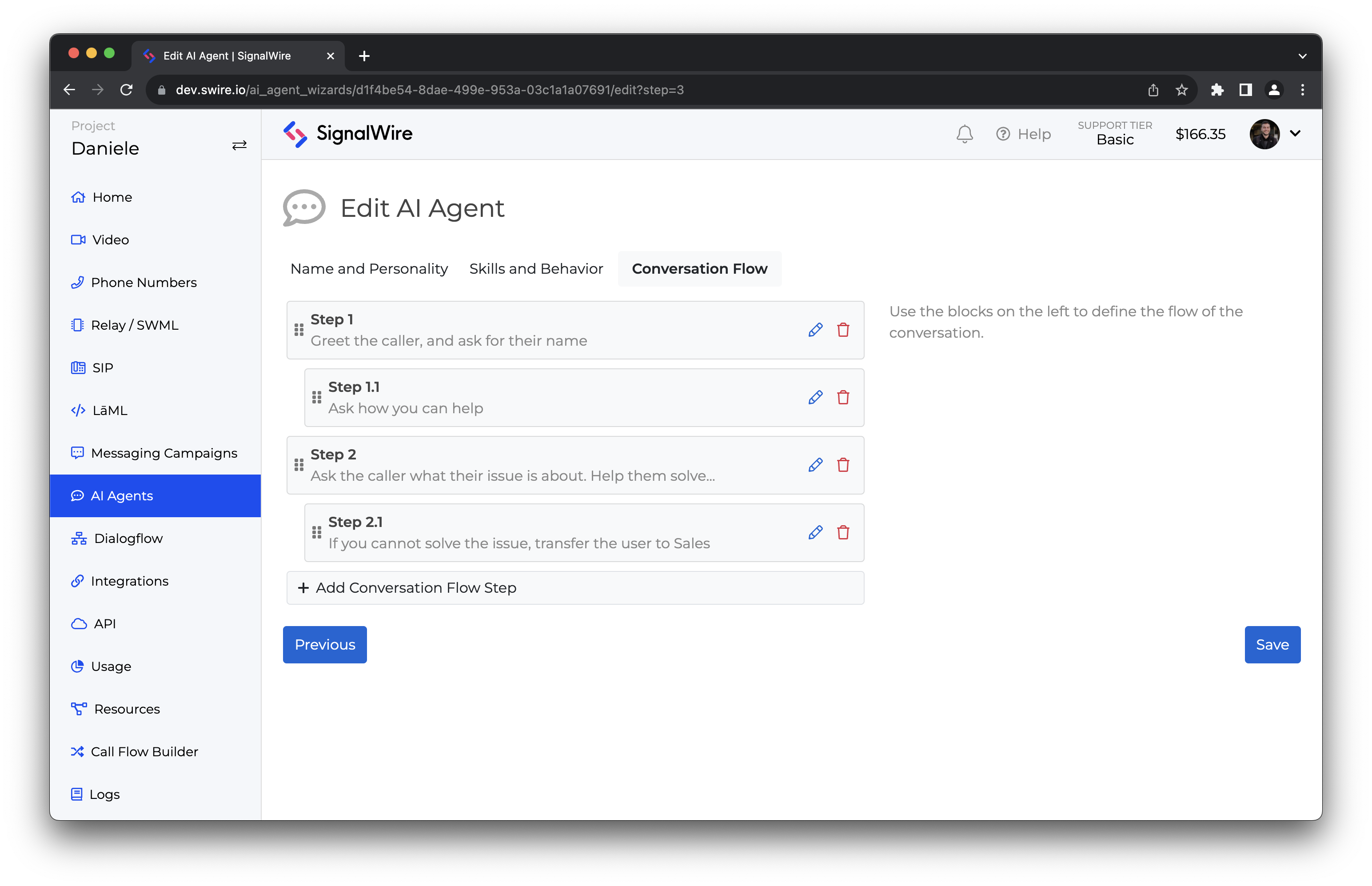
The catalog is broader than its current AI pitch. Developers can buy phone numbers; send SMS and MMS; place or receive PSTN, SIP and WebRTC calls; manage video rooms; write call flows in SignalWire Markup Language, or SWML; and use server SDKs for agents, real-time Relay control and ordinary resource management. There is also a visual Call Flow Builder and commercial FreeSWITCH support for operators who want the software in their own environment. In short, it sells the plumbing and the instructions for the plumbing.
02 / The design choiceKeep the brain near the ear
A typical voice AI assembly can hand audio from a carrier to a speech recognizer, then a language model, then a voice generator, and back again. Every handoff creates a place where time, context or ownership can get lost. SignalWire’s approach places orchestration in the media path it operates. Developers still define the agent’s behavior and connect their own tools; SignalWire handles the call, speech pipeline and live actions. The company cites a typical conversational turn of about 1,200 milliseconds. That is a platform claim, not a universal promise for every model, network or caller.
This is where SignalWire sets itself against two kinds of alternative. Twilio and Telnyx sell programmable communications building blocks. Vapi, Retell and LiveKit address pieces of the newer voice AI workflow. A team can also wire several suppliers together. SignalWire’s pitch is that its own media engine and call control give developers fewer moving parts to manage in the middle of a conversation. Whether that matters most depends on the application: a simple alert line asks less of a platform than a multilingual support agent that must retrieve records, interrupt politely and transfer with context.
03 / The billTwenty thousand minutes is a real number
The published AI Agent Runtime rate is $0.16 per minute. That includes standard speech recognition, language-model orchestration and standard text-to-speech, while voice transport is charged separately. On SignalWire’s US rate deck, inbound local voice is $0.0066 per minute; SIP and WebRTC are each $0.003 per minute. Premium voices and some other services can add charges. So 20,000 AI minutes would mean $3,200 in runtime before transport. At the listed inbound local rate, the voice portion would add $132, for a simple $3,332 illustration before numbers, taxes or optional features.
| Illustrative 20,000-minute month | Listed charge |
|---|---|
| AI runtime | $3,200 |
| US inbound local voice | $132 |
| Combined illustration | $3,332 |
Rates are published list prices as checked on September 30, 2026; actual bills depend on route, features and contract.
This is a usage business. Minutes, messages, phone numbers and video consumption generate revenue; large customers can negotiate volume agreements. SignalWire also sells support for FreeSWITCH deployments. Its investors backed the infrastructure thesis early: an $11.5 million Series A in 2019, a $30 million first close of its Series B in 2021, and later strategic participation from Deutsche Telekom’s Telekom Innovation Pool.
04 / In the wildThe migration that had almost no rewrite
Robotalker, which sends calls and texts for churches, schools and medical offices, offers a more revealing test than a demo. Its problem was operational: slow support and expensive phone numbers at its previous provider. In a SignalWire case study published in July 2026, the company said it moved roughly 1,000 phone lines from Twilio in five days, including testing. The old autoresponder handlers did not change. It added one initialization method to send each number to the right provider, because some legacy numbers remained elsewhere. Robotalker also reported that its monthly cost per direct-inward-dial number fell from $1 to eight cents in its arrangement. That is one customer’s outcome, not a current public price for every buyer.
“We had thousands of lines of code for our autoresponder and we didn’t need to change a single line of code.”Thomas Mahoney, CEO of Robotalker
The case shows why compatibility can matter more than a new feature list. Textline, a business texting provider, likewise said it had a proof of concept running in about a day after looking for more responsive technical support. Elsewhere, Phoenix Children’s used short codes to improve delivery of patient and employee texts; Québec emergency-call operator CAUCA moved from its own FreeSWITCH setup to hosted SignalWire APIs as call volume grew. These are different buyers, but the common purchase is operational: make a communication workflow work, and have someone answer when it does not.
05 / What comes nextAn agent that can listen without interrupting
In September 2026, SignalWire introduced AI Sidecar, which attaches to a live call as a listener. It can spot a phrase or event and send a signal to a customer webhook for coaching, supervision or compliance. It does not speak to the caller, and SignalWire does not supply the finished agent dashboard. That is a precise piece of infrastructure, which is more interesting than pretending it is an entire contact center.
The company also introduced AI Chat for an existing voice-agent definition to operate in an embedded website chat while carrying conversation context between modes. That product is web chat, not SMS or WhatsApp; the company lists a starting price of $0.005 per turn. The direction is clear: a customer should be able to change channels without becoming a stranger to the system.
For a builder, the part worth copying is the sequence of questions. First, decide who owns the call’s state. Then decide where the audio travels, what an agent may do, how a human takes over, and what each minute costs when a real customer repeats themselves. Test number porting and existing handlers before promising a quick migration. If the job is a basic outbound notification, the value of deep orchestration may be modest. When a live interaction has to remember, decide and act, SignalWire is betting that the people who built the switch have earned a place at the table.