The first week of Shortboxed makes a suspiciously tidy comic-book origin story. Gene Miguel and BJ Abordo launched their marketplace at C2E2 in Chicago in March 2020. They flew home to San Francisco. The city locked down. Comic conventions, the trading floors of the hobby, vanished from the calendar.
For two founders who had spent vacation days and weekends selling comics behind convention tables, this looked like the first thing to fail: the physical network on which their industry ran. Instead, the collapse exposed why their app needed to exist. Dealers had inventory and nowhere to show it. Shops closed their doors. Collectors, stranded at home, reopened dusty boxes and rediscovered characters they had loved years earlier. Shortboxed did not create that demand, but it had built a shelf just as the old shelves became unavailable.
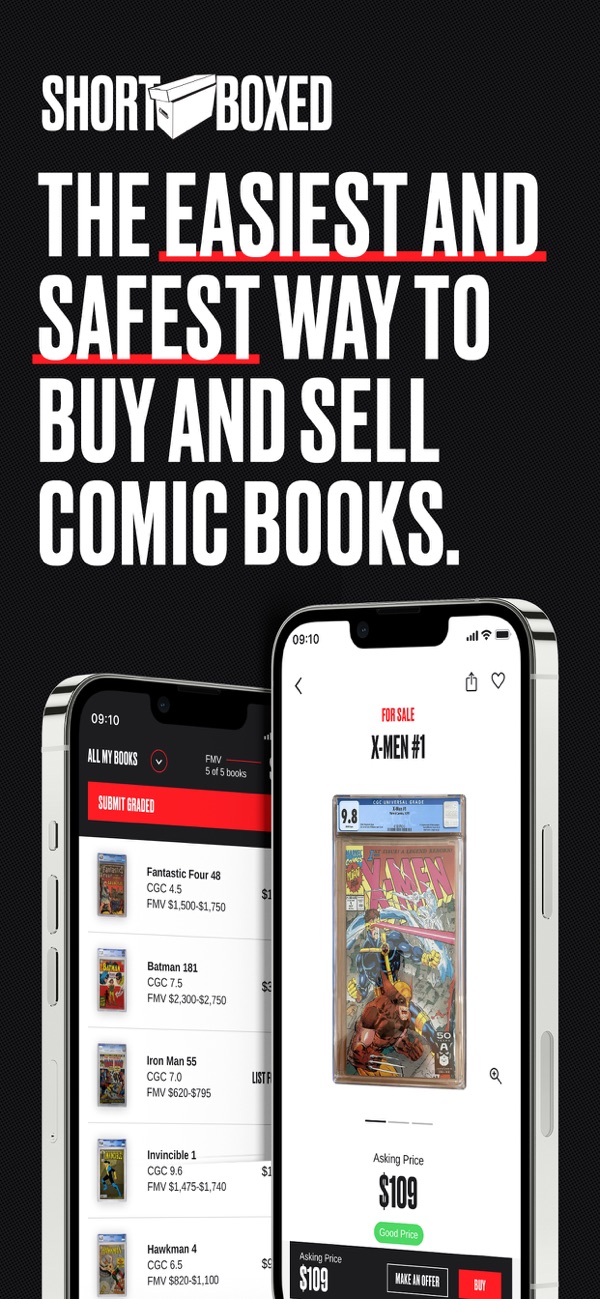
The company is now a marketplace and auction platform for graded and raw comic books. Collectors browse, make offers, buy, bid, track a portfolio, and consult recent sales. Sellers take front-and-back photos, add a price, and submit. After a marketplace sale, Shortboxed issues a prepaid shipping label, holds the money through delivery, handles support, and pays the seller after the book arrives. It is ecommerce with an obsessive vocabulary: slabs, grades, census data, raw books, fair market value, and bubble wrap applied with dignity.
The problem was not comics. It was clerical work.
Miguel and Abordo were childhood friends and lifelong readers. About a decade before the app, they started Shortboxed as a blog to meet other collectors. That community led them onto the convention circuit, first as enthusiasts and then as dealers. It was there, on the seller’s side of the folding table, that annoyance became research.
Buying and selling comics online often meant generic forms, manually composed descriptions, dated websites, scattered price references, direct-message negotiations, uncertain grading, and the low hum of possible fraud. A beautiful book might be buried beneath a seller’s mediocre HTML. A buyer could win an item and still wonder whether it would arrive, whether it had been overgraded, or whether the package could survive a postal worker having a spirited afternoon.
“We’re huge comic nerds and we wanted to put our skills to work.”Gene Miguel, co-founder and CEO
The founders had technology careers, including experience around companies such as Apple, Yahoo, and Twilio. Their useful combination was not simply “tech plus comics.” It was software knowledge plus the memory of every irritating click and awkward customer conversation they had endured as working dealers. The product began as a very simple mobile app because most shopping had moved to phones, while much of comic commerce had not.
Start with the books least likely to start a fight
Shortboxed initially limited the marketplace to comics authenticated, graded, and sealed by third parties such as CGC and CBCS. That constraint was strategic. A slab gives buyer and seller a shared description of condition. It removes a large, subjective variable from a transaction between strangers.
The marketplace was also designed as double-blind: the buyer does not need to know the seller, and the seller does not need to know the buyer. Shortboxed sits between them, manages the order, and becomes the accountable party when something goes sideways. It is less social than a Facebook group and, paradoxically, can feel more human because there is a support team whose job is to solve the problem.
Later, the company opened the platform to raw, unencapsulated comics. That brought more inventory and more risk. Raw condition is easier to overstate, whether through inexperience or optimism with a price tag attached. Shortboxed’s answer was verification: raw books are checked before delivery to the buyer. The company widened the marketplace only after it had an operational layer capable of handling the mess.
What it costs - and what the fee is for
On the standard marketplace, Shortboxed says its seller fee is a flat 10 percent. The buyer pays shipping. That is not a magical number, nor is it dramatically below every possible alternative. A motivated seller can find lower-fee venues, especially in private communities. The case for Shortboxed is that the fee pays for completed work: simple submissions, exposure to a specialist audience, labels, payment handling, delivery confirmation, and support.
Shortboxed presents one seller charge and makes its argument through fewer chores.
The economics differ for special services. In the 2026 PSA x Shortboxed Grade & Sell program, the Shortboxed consignment fee is 13 percent. A collector ships eligible comics to PSA, which authenticates, grades, encapsulates, and images them. PSA then sends the books directly to Shortboxed. Within seven days of receipt, Shortboxed places them in seven-day auctions starting at $1 with no reserve, and it processes seller payouts after buyer payment settles.
That program removes a second shipping trip, photography, listing copy, buyer questions, and fulfillment. It also removes seller control over the opening price and the option to cancel later. Convenience has a clear price and a clear condition: the seller must be comfortable letting the market decide.
The shelf became a toolkit
A marketplace needs supply, demand, and reasons for both sides to return between transactions. Shortboxed expanded accordingly. Its price guide includes more than one million recent comic sales from multiple platforms. Fair-market-value ranges and deal indicators give buyers context. A free portfolio manager lets collectors organize personal and for-sale books and track estimated value.
Auctions arrived after fixed-price listings. By 2024 the app supported curated event auctions, consignments, and community auctions, with search and filters designed around comic inventory. The company also introduced an API for dealers. Its first announced user, Reece’s Rare Comics, synced more than 5,000 CGC-graded books, valued in the millions, within hours. This is the unglamorous move that marketplaces live on: do not ask a high-volume seller to retype a warehouse.
Shortboxed reported tens of thousands of users and more than 10,000 books for sale in 2021. Five years later, PSA described it as a platform used by more than 100,000 collectors. The App Store listed a 4.8 rating from 849 ratings when this profile was prepared. Those figures do not make it eBay, and that is the point. Shortboxed is trying to be useful to a narrow market in more ways than a general marketplace can justify.
What changed their mind
The company’s decisions show a pattern of revising the boundary without abandoning the premise. It began mobile-only because the founders believed collectors shopped on phones. It began with graded books because authentication made remote transactions safer. User demand and operating experience pushed it toward raw books. Fixed-price listings established the marketplace; auctions added price discovery and urgency. Manual dealer submissions proved the need for an API. A marketplace became a set of connected collector utilities.
The pandemic made the largest change for them. Their convention background had taught them what was broken; lockdown proved that offline workarounds could disappear overnight. The answer was not to imitate the convention online with chat rooms and digital velvet ropes. It was to make the transaction reliable enough that the missing room mattered less.
What another founder can steal
- Do the job before coding the job. The founders sold comics and felt the workflow from both sides.
- Begin where trust is easiest. Standardized graded books reduced early disputes.
- Make the smaller marketplace less laborious. You may not beat incumbent liquidity, but you can beat incumbent paperwork.
- Turn support into product design. Labels, payment timing, packing rules, and verification are features.
- Integrate the power sellers. An API can add more supply than another campaign asking dealers to list manually.
Where the trick stops working
A vertical marketplace is not a universal prescription. It struggles when the niche trades too rarely, average order values cannot absorb shipping and support, condition cannot be described consistently, or sellers care more about the incumbent’s enormous audience than saved effort.
Shortboxed also depends on trust continuing through every handoff. A verification backlog, weak auction demand, a damaged package, or thin inventory in a collector’s favorite corner can undo the polish of the interface. The PSA consignment route will not suit sellers who require a reserve, want to choose timing, or are unwilling to commit before seeing the grade.
Its competitive set is wider than comic apps. There is eBay, of course, but also MySlabs, HipComic, ComicConnect, Heritage, ComicLink, Whatnot, local shops, convention dealers, Reddit, Instagram, and Facebook groups. Each offers a different mix of audience, fee, entertainment, expertise, and personal reputation. Shortboxed’s position is between the giant bazaar and the handshake deal: specialist software with an accountable operator in the middle.
That position explains the company better than any claim about “disruption.” Shortboxed is not changing why people collect. It is removing the administrative tax around the moment one collector’s book becomes another’s. A comic can still be irrational, nostalgic, gorgeous, overprinted, undervalued, or argued about for three hours. The shipping label, at least, can be boring.