Three startups in a year would make a busy opening chapter. Three failures make a rather different book. In 2001, Shishir Gupta launched salah4u, fashion4india and jamunapaar.com. By the end of that year, all three had failed. The useful discovery was painfully ordinary: he needed a mentor. Fifteen years later, he would build a business around that missing person.
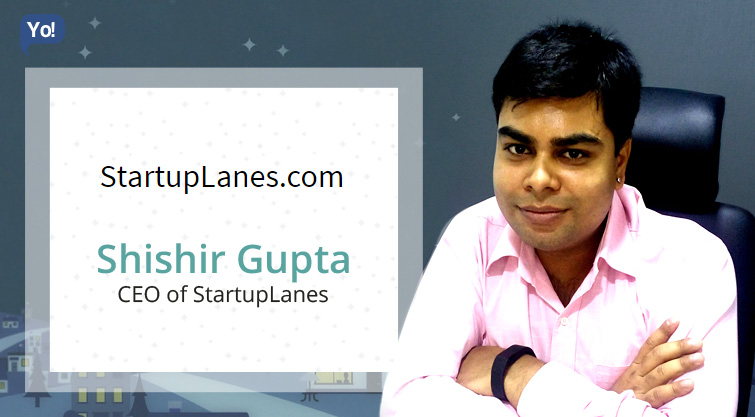
Today Gupta is the co-founder and CEO of StartupLanes, connecting entrepreneurs with investors, advice and business services. He is also the author of Startup Easy. The distance between those two chapters gives his work its particular shape. He has occupied both sides of the advice business: the founder who could use some help, and the person selling a way through the confusion.
There is something appealingly practical about that progression. An unsuccessful venture leaves questions that a celebratory photograph tends to conceal. Who should have checked the idea? Who could have challenged the assumptions? Who knew the right next step? Gupta's response was eventually to make access to those people part of the product. The company grew out of a problem he could recognise without a market research presentation.
Paint first. Software next.
His introduction to commerce came before the startup vocabulary. As a teenager, he worked in his father's wall-paint business, taking part in direct and channel sales. At 15, technology began to attract him. In 1997, he developed an inventory and billing application for MS-DOS, using C++/Clipper and a FoxPlus database. It was software for keeping track of things that had to be counted and paid for.
That is a revealing starting point for someone who later became involved in fundraising. Billing software begins with the unromantic mechanics of a business. A product moves. A record changes. Somebody owes somebody money. The details have a stubborn habit of mattering, however attractive the larger idea may be.
Gupta has described his father and grandmother as his early business teachers. In a 2019 conversation about his book, he connected their guidance with his ability to get through difficult periods. The family connection gives the later mentoring work a personal context. Advice had already been useful to him long before it became a service with an appointment slot.
A motorcycle with an expensive introduction
One of Gupta's own recollections supplies a more precise price for being new. He says he borrowed ₹41,666 to buy his first motorcycle in 2002, paying annual interest of 26%. He attributes the expensive terms to having no credit history. It is a compact story about the cost of arriving without an established record.
Years later, he recalled the motorcycle while describing a ride to a business meeting in an Aston Martin. The remembered detail was the back seat. He was being driven to the meeting; the anecdote does not require him to own the car. Its interest lies in what he chose to compare: an early purchase financed on difficult terms, and a later moment when the surroundings suggested professional arrival.
Gupta treats appearances as part of business credibility. That position is more candid than the familiar claim that appearances never matter. People make judgments before the meeting begins. His story acknowledges that fact while preserving the less photogenic number that came before it: 26%. The interest rate makes a more memorable supporting character than the sports car.
January 2016: advice becomes the enterprise
StartupLanes launched on 16 January 2016, the same day as the Startup India Action Plan. Gupta identified that initiative as an inspiration. He co-founded the company with Neha Gupta, bringing the problem of starting a business into a business of its own. The name promised a route through a process that can otherwise feel like a succession of closed doors.
Its remit crossed several boundaries. Gupta's professional profile describes help with idea validation, co-founder agreements, fundraising, sales strategy, marketing and expansion. That range matters to the story: his work did not stop at introducing a founder to somebody with a cheque book. It also addressed the preparation and decisions surrounding the introduction.
By April 2016, he described StartupLanes as bootstrapped and profitable. He also said its employees could work from different locations, including home. Those early choices put flexibility into the operating model. A business organised around connections could begin with people working apart, provided they were able to do the work of bringing others together.
The book that left the conversation open
In August 2017 came Startup Easy - Part 1: The Essentials. Its intended reader was the person still learning the language of starting up. Terms such as traction, disruption, co-founder and angel investment can seem obvious inside the industry and oddly ceremonial outside it. Gupta wanted explanations that a newcomer could use.
He described the reason for writing in personal terms: he had wanted an accessible book with recognisable examples. When he could not find the book he wanted, he set about making one. That is consistent with the earlier software project and the later advisory company. A recurring feature of his career is the decision to turn a frustrating task into something somebody else might use.
The book was presented as author-assisted, allowing readers to contact him through social channels and other routes. A printed explanation could therefore lead to a further exchange. The format asks something unusual of its author: keep the door open after the final page. For a person building a network around founders, the book could serve as the beginning of a conversation rather than its tidy conclusion.
Its subtitle is modestly useful: The Essentials. Before a founder can assess a funding offer, they need to understand the words in it. Making those words less mysterious is a small intervention with a concrete purpose. A dictionary rarely receives applause at a pitch meeting, but somebody has to explain what everyone is saying.
- 1997Inventory & billing software
- 2001Three early ventures fail
- 2016StartupLanes launches
- 2017Startup Easy is published
From a conversation to a capital network
Gupta's work now includes angel investing, venture fundraising and services for companies preparing to enter public markets. He dates his angel-investing activity to 2015, including participation in CNBC Young Turks' TiE the Knot. StartupLanes later developed SL Angels alongside its other activities. The progression brought investor introductions into the same business as founder guidance.
The company reports a footprint of 56 cities across 15 countries. Its January 2026 account says it has facilitated $111 million in investment across 136 startups and helped list six companies on the stock market. These are StartupLanes' reported totals for its work; they describe the organisation's activity rather than Gupta's personal wealth or a personal investment cheque.
His educational background spans commerce, finance and law, with a doctorate in entrepreneurship specialising in venture capital. His current work draws on those overlapping subjects. A founder's product, company structure and financing needs arrive together, even when the professionals hired to deal with them work in separate disciplines.
The scope has also moved beyond very young businesses. StartupLanes offers SME IPO services, guiding smaller enterprises towards public offerings. That extends the relationship from an early question about whether an idea is workable to a later question about how an established company raises capital. The founding difficulty and the financing difficulty belong to different moments, but Gupta has built services around both.
A network still needs people to run it
There is a less glamorous side to the geography: somebody has to organise the meetings. Gupta's recent public activity includes recruiting chapter directors and inviting professionals with offices to establish StartupLanes branches in their cities. The proposed work includes referring businesses seeking funding and facilitating investor meetings. Local organisers give the larger network an address and a room.
The employment connection predates the current expansion. In December 2020, a college placement notice described a StartupLanes live project in which students would contact and interact with founders in international markets. It named Gupta as the speaker for a session on startups and career opportunities. The activity placed relationship-building itself on the list of things a student could learn by doing.
His company now states a goal of helping create one million jobs through entrepreneurship. That is an ambition, with a different status from the investment totals it reports. It also explains why community management, founder introductions and student opportunities sit near fundraising in the same enterprise. In that account of the business, helping a company get started should eventually mean work for people beyond its founders.
The stated ambitionOne million jobs, through entrepreneurship.
StartupLanes' mission
The questions have acquired a microphone
In 2026, Gupta added another public format: StartupLanes: Building Business and Raising Funds. Episodes released in September cover branding and intellectual property, the importance of documentation, and managing remote teams. An August episode tackles startup jargon. The subject matter returns to his established interests, giving practical business questions more space than a short social post permits.
The remote-team topic has a pleasing continuity with his early description of StartupLanes. A decade earlier, he was already talking about staff working from different places. The newer episode addresses the harder questions that accompany flexibility: conflict, feedback and the running of a team. The freedom to choose a location still leaves the work of managing people.
Asked for his guiding principle back in 2016, Gupta offered: “Knowledge is meant for sharing else it is waste.” It is a plain sentence, and a useful thread through the software, the book, the network and the podcast. Each gives something he has learned a form that another person can pick up.
The three failed ventures remain a good place to begin his story because they keep the later work intelligible. Before the cities, investment figures and chapter meetings, there was a founder who needed guidance. Gupta's continuing project is to put more people within reach of it. Getting started, in his telling, becomes less lonely when somebody is available for the next question.