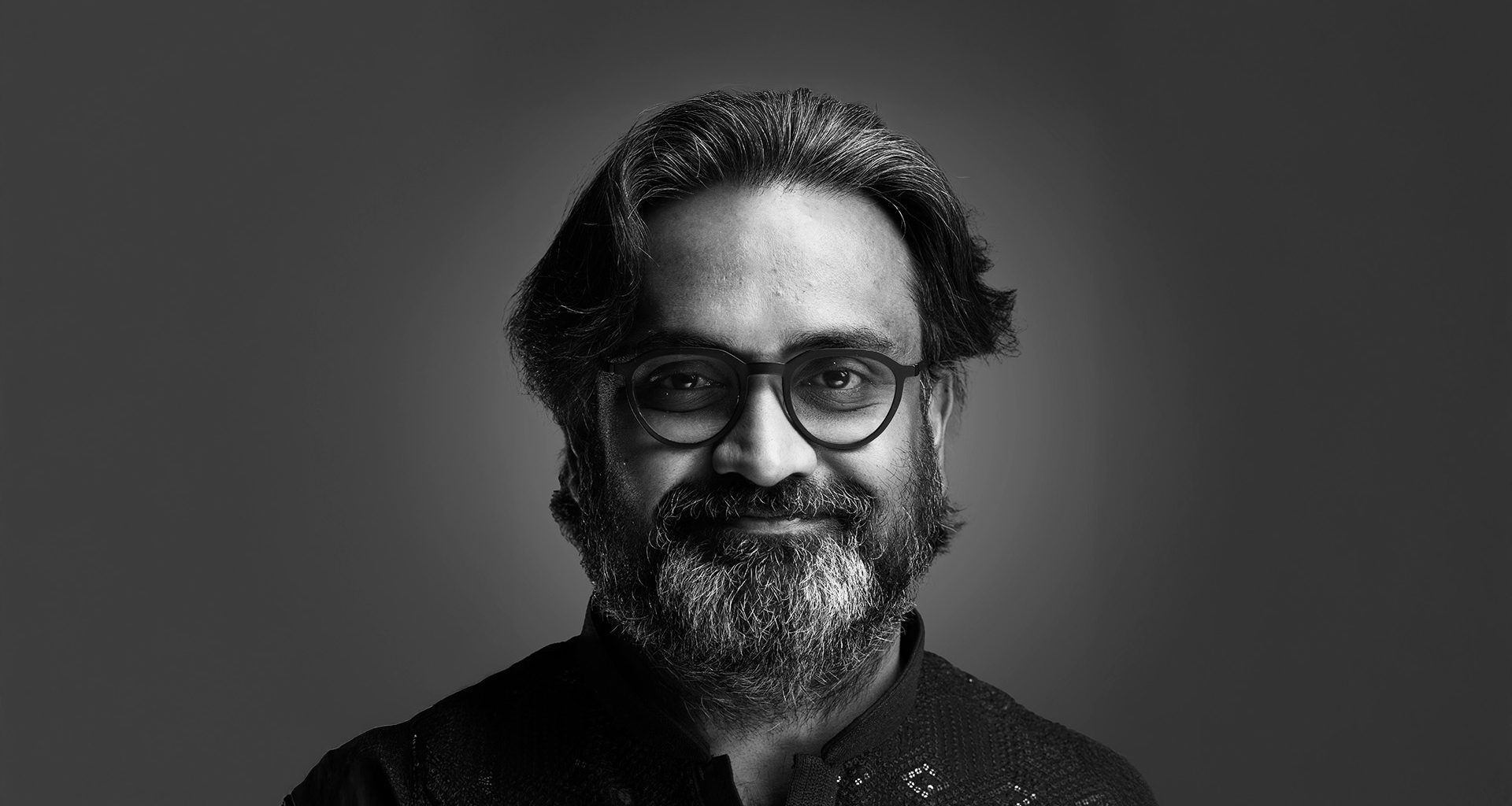
The machine that learned from a wedding ring
Eight people in one room in Secunderabad. A father who cycled 15 kilometers every day just to provide. A mother who stood outside a school headmaster's office, every single day, for a full year - until the system finally blinked and let her third child in. When tuition fees came due and 30 rupees were missing, she pulled off her silver wedding toe ring and placed it in her son's hand.
Shekhar Natarajan didn't turn it into a metaphor. He turned it into an operating principle. "That ring was the first piece of code in my life," he has said. "It taught me that the most valuable thing you can move is hope."
He arrived at Georgia Institute of Technology with $34, a backpack, and the kind of persistence that makes gatekeepers uncomfortable. He worked five jobs - coding by day, cleaning by night. He slept in his car for two weeks after removing his father from life support following a series of strokes. He kept going. He got in to see professors by sitting outside their offices until they paid attention - the same move his mother had perfected a decade earlier against a headmaster.
His first corporate break came via a business card that wasn't a business card. He designed his resume in movie-poster format, business-card sized, and it caught the eye of Coca-Cola executive Ron Hammond. That introduction landed him inside one of the world's most complex distribution networks. He never left the supply chain again - but he kept changing it.
At PepsiCo he digitally transformed Direct Store Delivery, generating 20-30% productivity gains. At Disney he contributed foundational architecture to what became the MagicBand - the RFID wristband that turned a theme park into a seamless physical-digital experience. At Walmart he pioneered crowdsourced last-mile delivery through the Walmart-Uber partnership before the industry understood what that even meant. He scaled Walmart's grocery division from $30 million to $5 billion. He also used Coca-Cola's supply chain to deliver medicine to over 1,000 remote villages in Zambia via his ColaLife initiative - proving that a freight network built for profit can also carry hope.
At American Eagle, he launched Quiet Platforms: an internal venture that convinced 15 competing brands - Fanatics, Steve Madden, Saks, and others - to share logistics capacity. Revenue went from $60 million to $390 million in nine months. In 2022 he served as CEO of Quiet Platforms before stepping back in early 2023.
Then in 2023, he did what he always does when a system isn't designed right from the start: he built a new one.
Orchestro.AI launched in August 2023 with a mission to create a Physical Internet for global trade - a network where goods move as dynamically and intelligently as data packets, optimized across open, independent networks rather than locked inside proprietary silos. But Natarajan wasn't just building another logistics platform. He was building what he calls Angelic Intelligence: the world's first virtue-native AI. Not ethics as a compliance checklist. Not guardrails applied after the system is already running. Ethics as the substrate - baked into the architecture itself.
In February 2026, Orchestro.AI raised $15 million in seed funding and announced expansion into the GCC and Middle East. In May 2026, Oxford University awarded Natarajan its Bodleian Medal for contributions to AI in the public interest. "To stand in Oxford and receive the Bodleian Medal," he said, "is a moment I could not have dared to imagine."
He has 3 million followers, 670 million views, and a standing ovation in New Delhi. He has spoken at Davos. Forbes Middle East has listed him as a defining voice on AI's future. None of it seems to be the point. The point, as he put it once, is a child studying under a streetlight who is not a data point. She is the point.