On July 1, 2024, Shankar Iyer became chief executive of a company that was both mature and newborn. Omnissa arrived with roughly $1.5 billion in annual recurring revenue, 26,000 customers and about 4,000 employees. Its products, including Workspace ONE and Horizon, had spent years inside VMware. Its independent habits had existed for approximately zero days.
There was no garage, no folding table and no charming tale about a server under somebody's desk. KKR had bought the business from Broadcom for approximately $4 billion. Customers around the world still expected their devices, virtual desktops and applications to behave on Monday exactly as they had on Friday. Iyer had to preserve that confidence while replacing much of the machinery behind it.
This is the peculiar drama of a corporate carve-out. A startup searches for product-market fit. Omnissa already had customers, products and revenue. What it needed was company-market fit: a way for thousands of people trained in the cadence of a much larger corporation to decide, build and communicate as an independent business.
“How do you motivate people and help them grow?”Shankar Iyer on the question he asks himself daily
A career built by widening the question
Iyer began as an engineer. His first professional question, as he later described it, was how to create products people wanted to use. At Adobe, engineering widened into product management, positioning and marketing. At TIBCO, where he became vice president of products and strategy during the company's IPO era, the frame widened again. A product was no longer only an object to build or explain. It belonged to a business with timing, investors and an operating system of its own.
The expanding field of view
The route from there reads like a tour through the recent history of enterprise software. He led strategy, products and marketing at object-database maker GemStone. At WebEx, and then in Cisco's cloud applications group, he worked on the conferencing platform and its ecosystem. At Citrix, he helped build the XenMobile enterprise mobility business. Then came VMware, first in product leadership, later running the desktop business, and by 2018 leading the entire End-User Computing division.
His education contains a useful clue. Iyer earned a bachelor's degree in mechanical engineering from IIT Bombay, a master's in the same field from Ohio State and an MBA from Santa Clara University. Mechanics studies forces and motion. Management, on an especially good day, does too. His career kept moving outward from the component to the whole machine.
The software was proven. The culture was the prototype.
When Iyer looks back at the first independent year, he does not describe the central difficulty as technical. He calls it cultural. Nearly 4,000 employees were accustomed to VMware's processes and pace. Independence asked them to reconsider ownership, speed and performance while continuing to serve a large installed base. Some people took naturally to the entrepreneurial energy. Others needed time. That six-month effort to establish an Omnissa identity tested the leadership team.
Culture is often treated as the soft upholstery of a company. During a carve-out it becomes load-bearing. Who may decide? How quickly? Which meeting settles the matter? What happens after an error? Those questions determine whether independence is a legal fact or an operating reality.
One of Iyer's answers was structured collaboration. Leadership workshops brought different functions together around the largest problems. He says work that might once have taken months could be settled in a week. Another answer was direct communication: meeting teams around the world, listening for local needs and making the leadership message clearer.
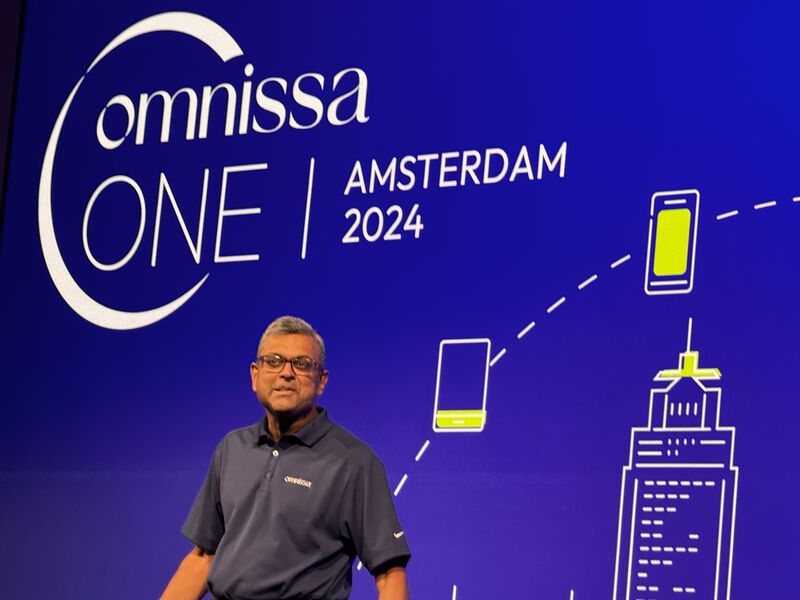
The global introduction acquired its own collection of rituals. In India, employees planted a tree to represent growth and resilience. In Tokyo, they broke a sake barrel to mark a beginning. In California, the company opened an office in Mountain View. Corporate identity can become desperately abstract; these were physical acts, different in each place, that made the transition visible.
Permission to miss the shot
Iyer has a neat way of discussing mistakes. He points to Stephen Curry's three-point shooting. Even a player celebrated for making long shots misses more attempts than he lands. The remaining attempts are material for reflection. The operating lesson is plain: movement requires shots, and improvement requires studying the misses.
It is an appealing analogy because large companies can become museums of remembered mistakes. A failed launch earns a committee; an untried idea leaves no paperwork. A newly independent company needs a different calculation. The carve-out itself was a calculated risk. So was moving faster, retooling teams and simplifying the customer experience. Iyer's standard is neither recklessness nor spotless execution. It is reflection followed by another informed attempt.
“You have to take your shots to move forward.”Shankar Iyer
That attitude also explains something about his leadership style. Former colleagues describe a person able to move between strategy and product detail, with clear goals and an easy manner. Iyer himself defines success as a duty shared across customers, employees, partners and shareholders. The fulfilling evidence, he says, is not confined to financial measures or industry recognition. It appears in camaraderie, common purpose and a team excited to build together.
A workplace that gets quieter
Omnissa's product argument begins with an ordinary nuisance multiplied to corporate scale. Modern work is scattered across laptops, phones, virtual desktops, identity systems, applications and security products. Every gap between them can produce another dashboard, ticket or opportunity for something to fail silently. Iyer wants Omnissa to join endpoint management, virtual applications and desktops, employee-experience data, and security controls in one platform.
He calls the destination an autonomous workspace: an environment capable of configuring, healing and securing itself with less manual intervention. The ambition is to move IT staff away from reactive firefighting and toward architecture. Better observability identifies patterns. Automation handles routine remediation. Human attention goes to the exceptions and the design of what comes next.
The word “autonomous” deserves care. Offices are full of technology that promises to disappear and then sends six notifications before breakfast. Omnissa still has to prove how reliably its vision works across the untidy variety of real enterprises. Iyer's case rests on context: signals from devices, applications, experience and access are more useful together than separated across tools. The platform can see more before it acts.
Omnissa launches independently under Iyer, backed by KKR.
The company tours its strategy through Omnissa ONE events and opens its Mountain View office.
A dedicated partner program expands training and the path to managed services.
Omnissa emphasizes AI-powered observability, autonomous workflows and an expanded board.
There is a second version of autonomy running beneath the product pitch. A healthy company also routes context to the right place, resolves routine friction without summoning the chief executive and lets people act within a clear design. Omnissa is attempting to build that quality in software while Iyer installs it in the organization.
The ecosystem after the empire
Leaving VMware created freedom, but it also removed the convenience of a vast corporate umbrella. Partnerships became more important. Omnissa introduced a program tailored to end-user computing, with training for resellers and service providers. Iyer argues that partners can combine Omnissa with security systems, manage the resulting environment and reach customers the company cannot serve alone.
This is less glamorous than announcing a clever feature. It may be more consequential. Enterprise products rarely succeed alone; they live among existing contracts, specialized advisers and teams with too much to operate. Iyer's phrase for the shared value of connected products is “one plus one equals three.” It is cheerful arithmetic, and it contains a serious point: independence does not require isolation.
His growth plans are measured in years, not a launch-week crescendo. He has discussed a path to double or triple the company, mostly through organic growth, with deliberate acquisitions possible in security and employee experience. In 2026, Omnissa added Lynne Doherty and John Swainson to its board as it entered what Iyer called its next phase. The company also sharpened its emphasis on observability: seeing the digital workspace clearly enough for AI and humans to make better decisions.
The next question
Iyer's career has been a sequence of broader responsibilities without abandoning the earlier craft. The engineer remains interested in what gets built. The product manager asks how it is understood. The operator worries about systems and routes. The CEO asks what customers will need next and whether the people around him can grow into delivering it.
Omnissa gives him all four problems at once. The product must become more unified. The market must understand a new name attached to familiar technology. The company must move without the old parent. The team must discover that ownership is not a line in a transaction document but a daily habit.
At the end of his launch note in 2024, Iyer used four wonderfully unceremonious words: “It's time to get to work.” For a chief executive surrounded by the usual ceremonial language of rebirth and transformation, the sentence had the clean click of a door closing. Two years later, the interesting work is still the same: keep the mature business dependable, let the new company become itself, and design systems that need less fuss tomorrow than they did today.