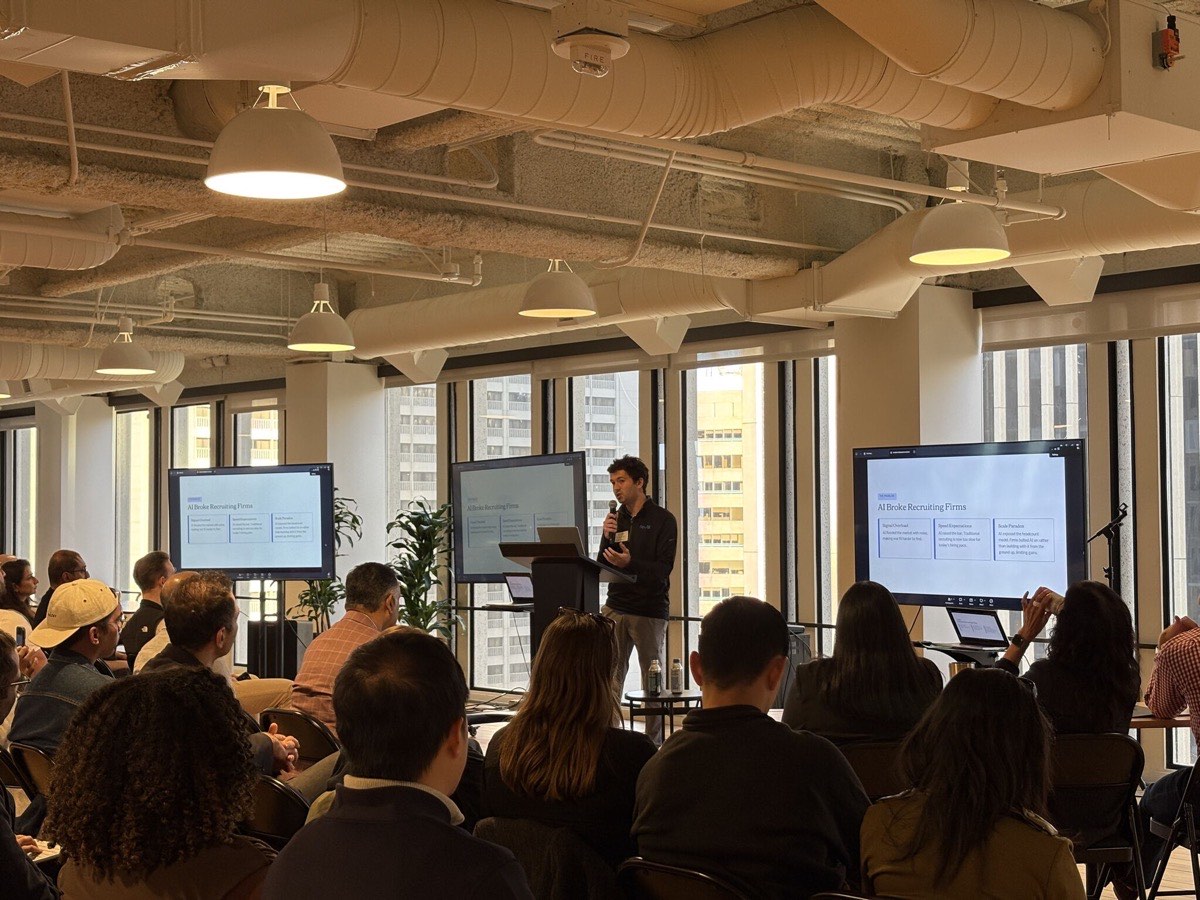
The slide behind Seth Tilliss says “AI Broke Recruiting Firms,” which is a rather efficient way to begin a sales presentation. In the photograph, he stands at a lectern in a dark Reval pullover, one hand around a microphone and the other open toward a room of recruiters. The audience has heard the cheerful version of artificial intelligence many times. This one begins with the mess: more applications, more outreach, more plausible resumes, and less confidence about who is worth meeting.
Tilliss built Reval inside that mess. The company began in 2023 as an AI agent for reference checks, the awkward final errand of hiring that usually requires calendars, phone calls, notes, and tact. By 2026, Reval was doing much more. Its agents sourced people, screened them, checked them, matched them to roles, and put interviews on calendars. The narrow tool had become an AI-native recruiting firm. Then, on August 11, Metaview acquired it, and Tilliss and co-founder Aditya Gupta joined the buyer to accelerate fillmore, Metaview's autonomous recruiting coworker.
A neat acquisition announcement makes this journey look designed in advance. The more useful reading is less tidy. Tilliss has spent years finding manual handoffs, wiring them together, and seeing which human problem appears when the machinery starts moving. His career is a small study in following friction.
01 / Before the companyThe spreadsheet was already telling the story
In 2019, while studying computer science at Duke, Tilliss interned at customer-engagement company Braze. An onboarding team was trying to adopt project-management software, but each new client required a custom technical task list. The source of truth was a giant Google Sheet known as the “task bible.” Turning it into a plan meant reviewing survey answers, finding relevant tasks, copying links, creating project entries, and composing a long email. Adding another tool had created another hour of work.
Tilliss mapped the chain. A survey captured the customer's needs. Salesforce stored the answers. Zapier moved the payload. Google Apps Script read the task bible and created the correct Mavenlink tasks. A second script assembled a customized Google Slides deck for the client. When a Salesforce webhook misbehaved, he used Zapier as a bridge. When the system worked, he recorded tutorials, removed excess code, added comments, and prepared it for other onboarding managers.
The sentence is about engineering, but it also describes the companies that followed. Break a workflow into links. Make one reliable. Then connect the next. The glamour arrives later, usually in a press release written after the debugging.
At Duke, Tilliss also co-founded the Duke Sports Management Group, filmed recruitment-camp footage for Duke Football, and built an OCR receipt scanner called WasteNoMore at HackDuke. His first company, GoodWorker360, used data to help restaurants manage labor and revenue. His personal website dispatches its ending with four blunt words: “Covid killed it.” C3 AI came next, where he worked as a solution engineer on enterprise AI. The route from restaurant operations to enterprise software to hiring may look crooked. The operating instinct is quite straight.
02 / Reval's expansionAutomate the chore, then follow the work
Reval's beta focused on autonomous, conversational reference checks. A candidate could send a link to a reference, who answered an AI agent on any device and on their own schedule. The agent could ask follow-up questions and synthesize the conversation for the hiring team. The pitch removed coordination without pretending references had nothing useful to say.
The product followed the hiring funnel upstream
But a good reference does not matter if the right person never enters the funnel. Reval moved upstream. It began sourcing, screening, vetting, and scheduling. Its website promised a first batch of qualified, interested candidates within 48 hours. The commercial model moved with the product: a small kickoff fee and a percentage of base salary when a hire was made, rather than a shelf of monthly subscriptions.
This is where Tilliss's language became revealing. “The product is the outcome,” he wrote. Recruiting teams did not wake up longing for one more sourcing tab. They wanted credible people on the calendar. By operating searches itself, Reval had to own all the inelegant gaps between database and interview. Service work became product research with consequences.
In spring 2026, Tilliss said the internal team had used those agents to onboard 50 direct clients, handle 150 active roles, screen 30,000 candidates, book hundreds of interviews, and make several dozen hires. Reval then began opening the machinery to recruiting firms. Ten contingent hires arrived through the private beta in March. Soon after launch, he said 25 firms were running on the system.
03 / The signal problemWhen applying gets cheap, judgment gets expensive
Tilliss's case for Reval was not simply that recruiters needed faster software. He argued that AI had changed the shape of the market. Candidates could tailor resumes and apply to hundreds of jobs. Recruiters could generate personalized outreach at similar scale. Each side was acting rationally, and together they were producing an inbox opera in which every singer had a megaphone.
The casualty was signal. Tilliss described employers sorting through fake profiles, indiscriminate applications, and a thin layer of plausible matches. Strong candidates could sit at the bottom of the same pile. More automated screens added friction for applicants, who repeated similar first-round conversations for company after company.
Reval's proposed answer was a living candidate signal: screen once, capture preferences, skills, experience, sample work, and goals, then use that evidence across relevant opportunities. The approach treated a candidate as more than a document and a job opening as more than a keyword filter. It also exposed the restraint inside the automation. Reval could do the searching and sorting; the hiring manager still chose whom to meet.
That paradox explains why an agentic recruiting product can be valuable even when hiring already has plenty of software. Automation increased the volume of actions. It did not automatically increase the quality of decisions. The new product had to absorb volume and return a smaller, more credible set of conversations.
04 / The acquisitionA larger home for the same thesis
Metaview met Reval while building toward a similar destination. Its fillmore product was designed to own the operational top of the funnel, from sourcing through qualified screening calls. Reval had approached the same question as a recruiting operator. By the time of the acquisition, it had worked with more than 100 enterprises and agencies, including FabFitFun, Enver Studio, and LangChain.
The deal brought Tilliss and Gupta into Metaview's product and engineering work. Tilliss framed the choice around distribution and shared conviction: “We chose to join Metaview to take our thesis to thousands of organizations and reinvent recruiting at scale.” Metaview already served more than 5,000 companies and had thousands of teams waiting for fillmore. Reval supplied a three-year education in what happens when an agent is responsible for the work rather than merely offering advice beside it.
Tilliss now describes himself simply as building product at Metaview. His five-stop personal timeline moves from Duke to GoodWorker360, C3 AI, Reval, and Metaview. It is compact enough to disguise the important part: the loops of observing, building, operating, and revising between each label.
05 / The useful theftFour things worth carrying into another company
The tasks people postpone, patch with spreadsheets, or perform after everyone else has gone home often reveal sharper demand than a fashionable category does.
Running recruiting searches forced Reval to encounter every broken handoff. Direct responsibility made the roadmap less theoretical.
Reference checks led to screening, then sourcing and scheduling. Each step was justified by the next obstruction in delivering the result.
When the product is measured against a booked interview or hire, the team cannot confuse feature activity with customer progress.
There is also a quieter lesson in the Braze story. Tilliss did not stop when the script ran. He cleaned the code, documented the system, and prepared it for people he would not be there to help. Agentic software inspires grand speeches about autonomy. Useful autonomy is usually built from prosaic virtues: clear inputs, tested links, sensible fallbacks, and an owner who cares what happens after deployment.
Reval's story closes one company chapter, but not the problem it chased. Hiring remains a procession of uncertain judgments wearing the costume of a funnel. AI can move the paperwork and introduce the people. Someone still has to decide whom to trust. Tilliss followed the work far enough to discover that the enduring product was never the reference call, the screen, or the sourcing campaign. It was the credible meeting at the end.