There is a peculiar kind of delay that happens at a pharmacy counter. The prescription can be perfectly legible. The medicine can be on the shelf. The pharmacist can know exactly what to do. And still, the transaction stalls, because the question has become: who is going to pay?
For prescriptions tied to a workplace injury, that question has its own machinery. Someone must establish the claim, deal with an insurer and navigate the rules surrounding reimbursement. ServRx, an Arizona claims processor, has made that machinery its business. Its customer is the pharmacy trying to dispense the medicine without inheriting an administrative project.
- Processes workers’ compensation prescriptions for pharmacies and dispensing sites.
- Offers conditional payment guarantees and help with claim verification.
- Advertises free enrollment and no redirection to mail-order pharmacies.
The first prescription is a credit decision
Consider the first fill. A patient arrives before all the insurance details have been settled. Dispensing the medicine and collecting the money are now two separate tasks, with a potentially uncomfortable interval between them. The pharmacy has stock to replace and staff to pay. It cannot put its own expenses into a pending folder.
ServRx’s FAQ contains an unusually revealing answer. If the insurer denies the claim, will the pharmacy still be paid for the first 30-day supply? Yes, it says, provided the prescription was correctly transmitted as a workers’ compensation claim and received a paid label. Those conditions are the mechanism of the promise.
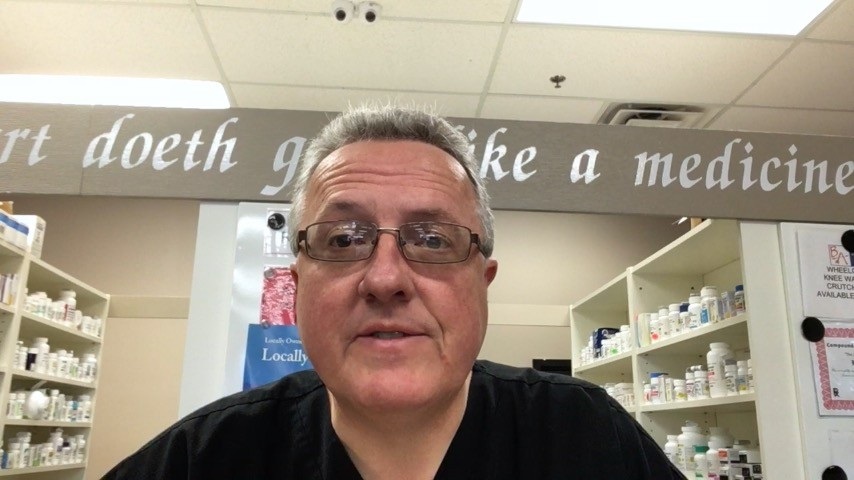
In a September 2026 interview, co-founder and chief revenue officer Breck Rice described the principle plainly:
“We take the risk on that first fill.”Breck L. Rice · September 2026
For a pharmacy owner, this changes the calculation. A service that sends a message faster is useful. A service that accepts a defined financial exposure can change whether a transaction feels manageable in the first place. That is the interesting feature of ServRx: software is involved, but confidence in reimbursement is what gives the software a reason to be used.
A routing number is only the beginning
The company advertises a single BIN, the routing identifier used to send pharmacy claims to a processor. The appeal is easy to understand. Staff get one destination for a troublesome class of prescriptions. ServRx then handles the work behind that destination, combining electronic adjudication with claim verification and payment support.
Illustrative workflow. Claim conditions and authorization requirements apply.
Yet the FAQ is full of reminders that a routing number cannot make every exception disappear. A rejection may mean verification is incomplete, information is missing or an account has restrictions. It does not necessarily mean the claim is closed. That distinction matters to the person deciding what to tell a waiting patient.
A medication costing more than $750 triggers an edit. A mismatched injury date can interrupt processing. Prior authorization can require a conversation with the insurer; the published guidance says that process usually takes 48 hours. Real-time adjudication is therefore different from universal, instantaneous approval. The seven-day live help desk is part of the product because the difficult cases still need people.
Keep the patient. Change the paperwork.
ServRx’s competitive argument reaches beyond getting a claim through. It says it has no affiliation with pharmacy benefit managers, or PBMs, and will not redirect patients to mail-order fulfillment. For a community pharmacy, a prescription is also a relationship. Losing the next fill can mean losing the next conversation at the counter.
That makes the company’s position fairly specific within the market. It serves the pharmacy’s workers’ compensation workflow, including repeat prescriptions, rather than merely offering an initial-fill workaround. Its published customer descriptions range from independent stores to chains and non-pharmacy dispensing sites. Those sites receive customized adjudication and payment services.
The distribution strategy includes pharmacy organizations. PFOA appears in ServRx’s material as a preferred-vendor relationship; CARE Pharmacies also lists ServRx as a preferred partner. The enrollment page tells pharmacies they may already be contracted through their pharmacy services administrative organization, or PSAO. That is a useful place to begin: check the relationship already in place before adding another one.
Growth needs money, too
This narrow problem produced a substantial historical business. Coverage of the 2016 Inc. 5000 placed ServRx at No. 194, reporting three-year growth of 1,929% and 2015 revenue of $47.2 million. Those are dated figures, but they establish that workers’ compensation billing was more than an obscure software sideline.
Reported with ServRx’s No. 194 placement on the 2016 Inc. 5000.
In February 2016, CEO Todd Delano bought majority stock interests in ServRx and related company WCRx from co-founder Randall Prust. Gemino Healthcare Finance provided senior secured financing and a facility for future growth. The financing announcement also identified working capital as a purpose. A business organized around payment certainty has to pay attention to its own access to money.
Enrollment is advertised as free. In the 2026 interview, Rice described the company’s earnings as a thin margin from the state fee schedule. The practical question for a prospective pharmacy is how its actual prescriptions will be reimbursed under the applicable terms. An enrollment price alone cannot answer that.
The part worth copying
Rice also described a sales shift toward account management and industry conferences. The lesson is worth considering: when a company already reaches its niche, helping existing accounts use the service may deserve more attention than another round of outbound calls.
The broader lesson is to find the uncertainty that stops a customer from acting, then decide how much of it your business can responsibly carry. ServRx combines a simple submission route with people who handle exceptions and a conditional promise about payment. Each piece supports the others.
For a pharmacy, the fit still depends on workers’ compensation volume, state rules, authorization requirements and contract terms. For another business copying the idea, it depends on understanding the risk well enough to price it. A guarantee is useful only when the operation behind it can keep the promise.