The useful thing about an ugly number is that it ends an argument. In 2015, only 31 percent of ServRx employees qualified as engaged on an organizational climate survey. Todd Delano, the company's founder and CEO, had already sensed the problem. The Scottsdale operation was growing out of its startup phase, but the original fellowship of the place was getting lost in the expansion. Managers spent their days putting out small interpersonal fires. Conversations went crooked. The leadership team was tired. Then the graph appeared at the front of the room, and discomfort acquired an axis and a percentage.
Delano is a finance graduate. Numbers are where he goes when an idea needs to become accountable. Yet the number in question measured something that executives often admire in speeches and neglect in budgets: whether people trusted one another enough to do good work. He later put the lesson plainly: “You've got to put people at the center - but I'm a numbers guy, so we need to measure the people side too.”
That sentence is the hinge of his career. Delano built his first large enterprise by understanding a technical delay most people never notice. Then he discovered a second kind of delay inside the company itself: the distance between colleagues who were employed by the same organization but no longer moving as one. Both problems required translation, infrastructure, and patience. One involved claims. The other involved candor.
A business hidden inside the first afternoon
ServRx began in 2009 to make workers' compensation prescriptions easier for pharmacies to process. The difficulty often arrives early. A worker is injured in the morning, receives a prescription, and reaches a neighborhood pharmacy that afternoon. The claim is too new for every database and payer system to agree that it exists. The customer is present. The paperwork is still introducing itself.
Delano understood that awkward interval well enough to build a company inside it. Before ServRx, he had spent seven years as an award-winning sales representative for Pfizer. He also served as chief operating officer of WCRx Solution. His degree from Texas State University-San Marcos was in finance, which helps explain the precision with which he speaks about reimbursement, cash flow, and the small economic mechanisms behind a pharmacy counter.
At a 2021 hearing of the Industrial Commission of Arizona, he gave the operation scale: ServRx had contracts with 12,000 of the country's 25,000 community pharmacies, he said, and between 3,000 and 6,000 used its services in a typical month. The company sat at the frontline of new claims, handling the administrative uncertainty that begins before a workers' compensation file is fully legible to the system.
It is not glamorous work. There is no small-talk version of real-time claim adjudication. But unglamorous machinery is often the machinery that determines whether a service works. ServRx offered pharmacies electronic processing, immediate payment confirmation, and a help desk that could stay with a claim when the ordinary path rejected it. The company made the Inc. 5000 in consecutive years, ranking No. 194 in 2016 and No. 971 in 2017.
Growth is flattering from a distance. Inside an office, it tends to move the furniture. More customers produce more staff, more managers, more handoffs, and more chances for an innocent sentence to arrive wearing brass knuckles. By 2014, ServRx had proved the business case. Its culture had become the unfinished software.
“The results were not pretty, but it caused a lot of people on the team to sit up and finally take notice.”Todd Delano on ServRx's first organizational climate assessment
The CEO goes to class
A case study of the ServRx turnaround includes a fine, oddly domestic detail: Delano's office had a large wall of books about developing people. There is something endearing about a chief executive with a wall full of instructions. There is also something insufficient about it. Books can make a leader fluent in aspiration. Employees still have to work with him on Monday.
Delano remembered reading Daniel Goleman's work on emotional intelligence in college. He searched for a practical application, found the Six Seconds network, and in spring 2014 completed its intensive five-day practitioner certification. This matters because he did not dispatch the idea through human resources with a cheerful memo. He went first. Over the following year he worked with coach Michele Royan on his own habits and on a plan for the company.
The plan began with diagnosis. Once the 31 percent engagement result was visible, leaders were asked whether the climate could produce the results they wanted, what needed to change, and what each of them would have to do differently. The desired vocabulary was modest and revealing: trust, teamwork, engagement, family-oriented, efficient. No incense. No corporate sonnet. Just the conditions under which adults might solve a problem together without making the problem lonelier.
Employees received “brain profiles” describing their working styles and posted them outside their stations. Managers entered monthly coaching. Workshops dealt with trust, generational differences, customer care, and change. New-hire training and performance reviews absorbed the same language. The tools became ordinary, which is where a cultural program either earns its usefulness or expires.
A year later, engagement measured 71 percent and disengagement 5 percent. In the same period, the case study reported that revenue rose 25 percent and net profit 110 percent while staffing increased 15 percent. These figures do not prove that every dollar sprang from a workshop. They do show that attention to people did not interrupt the business. The people were the business, a fact accounting systems often discover rather late.
Delano's public comments after the turnaround avoid the tone of a man who believes he has completed himself. He said he would continue practicing his own emotional-intelligence skills “a bit more each day.” The modesty is useful. Culture is not plumbing; nobody repairs it once and puts the wrench away.
A second arena, with an actual court
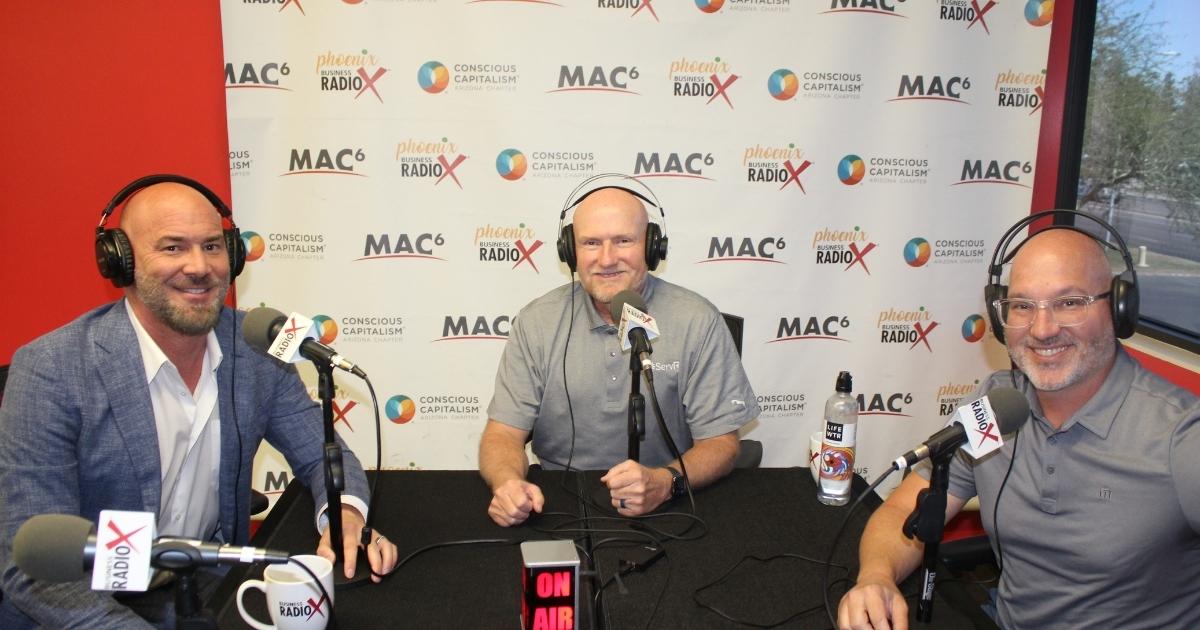
In a 2022 radio interview, Delano and ServRx co-founder Breck Rice discussed the sacrifices behind the company, including steep pay cuts and the complication of expanding across states with different rules. Delano's biography for the program described more than 15 years of industry experience, policy work with Arizona and other states, and a central role in recruiting ServRx's executive team. It also mentioned a parallel commitment: youth sports.
He is associated with Give N Go Hoops and serves on the board of the Arizona Basketball Coaches Association. He and his wife, Carolyn, have three sons and have devoted time and money to youth basketball and mentorship. A Delano Media Group biography says their work through the DREAM Foundation helped more than 100 HBCU students receive professional access and mentorship at major sporting events.
The shift from claims processing to events is less eccentric than it appears. Delano Media Group, where he is a founding member and executive chairman, gathers businesses in event production, printing, creative work, and sports marketing. Its projects include the Hall of Fame Series in college basketball. In 2024, Delano announced a partnership with REVELXP for premium seating and hospitality across games in Las Vegas, Phoenix, Baltimore, and New York.
He was also credited with helping Matt King develop Section 7, the Arizona high-school basketball recruiting event. By 2025, the event's organizers said it drew more than 400 teams, over 5,000 athletes, and more than 900 college coaches annually. Those are event figures, not a personal trophy cabinet. Delano's part is best understood as the operator behind the encounter: making the room in which athletes can be seen.
The pharmacy counter and the basketball court are both stages. Delano's work happens before the curtain rises, in the rules, relationships, and handoffs that let somebody through.
The architecture of access
A first prescription and a recruiting weekend do not belong to the same industry. They do belong to the same kind of mind. Each contains institutions that must coordinate before an individual can reach an opportunity. Each punishes casual logistics. Each is full of invisible gates.
Delano's career has been spent near those gates. At Pfizer, he learned the territory around pharmacies. At ServRx, he turned a reimbursement obstacle into a nationwide operating system. When the company began to outrun its own cohesion, he treated trust as something observable and trainable. In sports, he helped assemble events and mentorship routes that put students and athletes closer to decision-makers.
The temptation in a founder profile is to make scale the hero. ServRx's scale is real, and the numbers are considerable. But Delano's more distinctive achievement may be his willingness to admit when scale produced a debt the company could not settle with revenue. The engagement graph was a bill. He read it.
There is wit in the sequence. A company devoted to adjudicating claims had to adjudicate its own claims about culture. A numbers man had to learn that feelings were not the opposite of data. And an executive from a business nobody sees moved toward arenas designed for spectacle, only to remain fascinated by what happens backstage.
The best operators are not always the people standing in the brightest place. They are the ones who notice the gap, name the friction, and build enough trust for the next person to pass. Todd Delano has done that with software, policy, coaching, and courts. The industries changed. The work kept its shape.