Before Sensa became an insurance proposition, there was a man in a ditch. In a 2018 account of MDGo’s origins, Itay Bengad described finding a cycling friend unconscious after a fall in the Jerusalem hills. Bengad, then a medical student, summoned an ambulance. What troubled him was everything he could not tell the people coming to help: what had happened inside the body, and what they ought to prepare for. His friend recovered. The question stayed.
- Sensa paired auto coverage with crash-triggered assistance.
- MDGo supplied the medical and automotive analysis behind it.
- Agents sold the U.S. policies, beginning in Illinois in 2022.
- By June 2023, reporting described customers being moved elsewhere.
That question became MDGo, an Israeli technology business established in 2017, and eventually Sensa, its American insurance venture. It is an unusual route into financial services: begin with the uncertainty facing an injured person, then work backwards towards the policy. Insurance ordinarily promises to settle an account. Bengad wanted it to take an interest while there was still something useful to do.
The accident starts before the claim
In February 2022, Sensa launched auto insurance in Illinois. Coverager described a consumer business built on its parent’s accident-detection system, with every policy sold through an agent. The launch plans included other states and, later, home insurance. The agent remained the familiar face; the unfamiliar addition was a device intended to notice a collision and start the response.
For a motorist, the attraction was straightforward. The driver might be frightened, disoriented, or unable to make a call. A policy that could initiate assistance offered something tangible in that gap. For an insurer, earlier information offered the prospect of containing the consequences of a loss. The business argument depended on the same event being both a human emergency and a financial problem.
“Every minute counts and every diagnostic detail makes a difference at the scene of a crash.”Itay Bengad · Sensa launch announcement, 2022
Sensa said its device activated when impact indicated a collision, without continuous driving monitoring. Assistance was advertised as included at no extra charge. Those details gave the proposition a particular character: customers were being asked to accept a device for emergencies, rather than submit every ordinary journey to scrutiny.
A conceptual sequence, not a measured response-time guarantee.
A car can be a medical witness
The underlying expertise crossed disciplines. An ITU speaker biography describes Bengad as a physician and researcher in motor-accident trauma. A 2019 MDGo conference abstract describes a team of physicians, engineers, and business development staff, pursuing insurers and carmakers as routes to market. That combination matters. A vehicle records physical forces; a medical team needs information about people.
Hyundai’s 2019 partnership announcement outlined the bridge between those worlds. The companies planned connected services using vehicle sensors to inform emergency responders about injury levels and activated safety systems. The objective was to help crews prepare before arrival. Hyundai also envisaged using accident analysis to improve vehicle safety design.
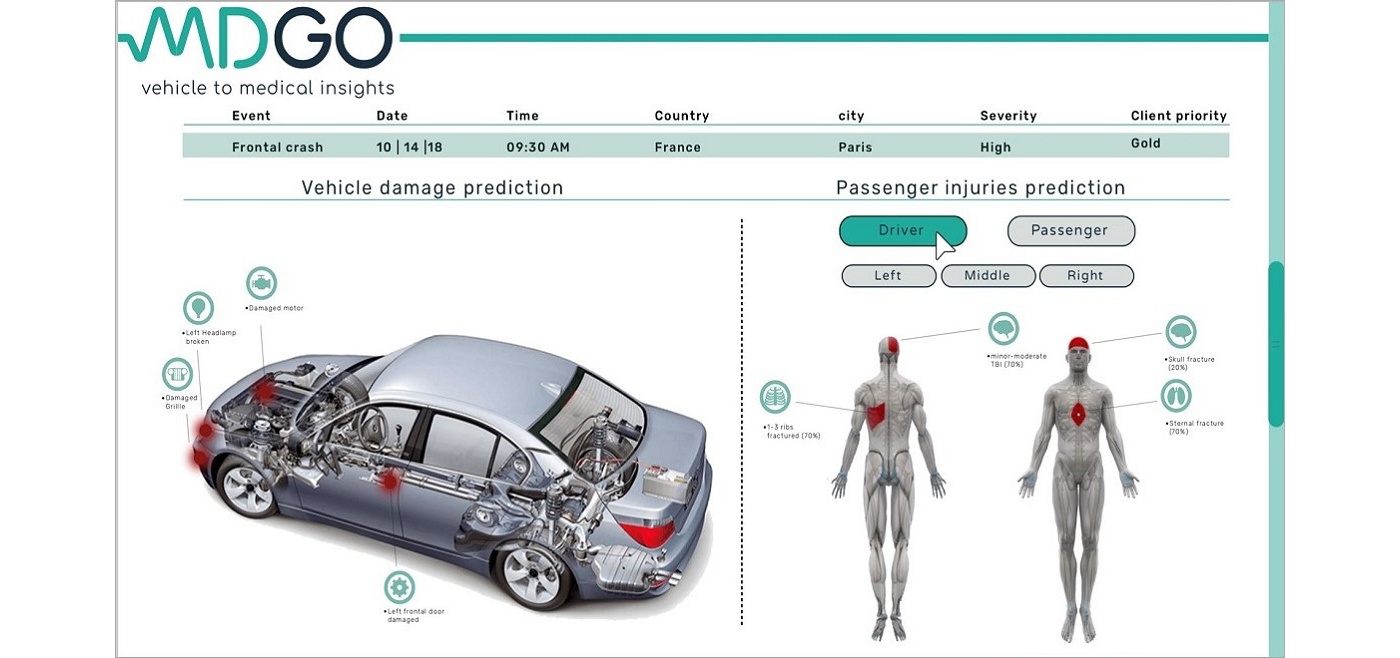
The training problem was less glamorous than the pitch. In an Altair case study, CTO Gilad Avrashi explained that MDGo began with physical crash tests, then turned to simulation because those tests could not provide enough training examples. The model connected vehicle acceleration with acceleration experienced by the head and pelvis. A persuasive demonstration requires data; a useful model requires enough of it.
The policy was one route to the customer
Sensa occupied the consumer end of a broader technology effort. In Israel, AFMDA described MDGo working with Magen David Adom and Direct Insurance to relay crash location and predicted injuries. That deployment illustrates why an alert alone is insufficient. The receiving organization needs a way to use it, and the information needs to reach the people making decisions.
The economics also need careful reading. Coverager’s 2022 analysis put the Israeli sensor’s estimated cost at roughly $30, offered free to policyholders. That was an estimate for the earlier deployment, not a U.S. Sensa retail price. The same reporting described MDGo raising $4 million in 2018 and $13 million in 2020. Parent-company investment is not a receipt for Sensa’s American launch.
Per sensor, reported in 2022 for Israel.
Hardware only; not the cost of running an insurance service.
There is a practical lesson here for anyone building a service. An inexpensive component can sit inside an expensive obligation. Shipping, installation, connectivity, staff, insurance distribution, and response coordination all stand between the box and the benefit. Copying the component copies only one part of the bargain.
The competitive field also widened. Apple introduced Crash Detection with the iPhone 14 in September 2022, describing automatic emergency calls after a severe collision when the user could not respond. A phone feature and an insurance policy serve different purposes, but both address the silence after impact. For a specialist insurer, detection itself becomes a less exclusive proposition when customers already carry another detector.
Sensa’s distinctive offering therefore rested on what followed the signal: assistance connected to the policy and delivered through a coordinated service. That is a useful distinction for buyers and builders alike. Ask what happens after the alert, who accepts responsibility for the next step, and whether the advertised response is available wherever the customer actually travels.
Then the delivery chain frayed
In June 2023, Coverager reported that Sensa agents had been told to arrange alternative coverage for customers within 60 days. It described an email in which Bengad attributed the withdrawal to systems he could not obtain and changes he could not agree with the board. Asked by the publication, he characterized the situation as a reduction in agency relationships.
The report also described halted device shipments and warned that accident assistance might not operate. A source attributed problems to the loss of a sensor manufacturer. These are reported explanations, not an audited account of what failed first. Their significance is operational: a promise to intervene immediately depends on equipment arriving and support remaining available.
IVC subsequently listed Sensa AI Ltd., formerly MDGo, as having ceased operations in the second quarter of 2024. That related entity’s status completes a sobering arc for this historical profile. The interesting idea survives as a design question: can a service act before its customer asks? The condition is unforgiving. Every link from detection to help has to work on the day the customer needs it.