A search for five people began with a pool of 1,550. Spatially Health needed senior specialists who could work with data, including programmers whose experience went beyond writing application code. SD Solutions reports interviewing 49 candidates, making six offers, and securing five acceptances. The average time to hire was 1.8 months. For anyone who thinks international recruitment means opening a bigger résumé drawer, those numbers are a useful interruption.
- Recruitment comes bundled with the machinery of employment: HR, payroll, infrastructure, and local support.
- Customers can build a dedicated team, an R&D center, or an overseas branch.
- The revealing customer cases measure different things: hiring speed, specialist fit, and retention.
SD Solutions occupies the space between finding someone and making it possible for that person to work effectively inside another company. Its customers include technology businesses building products in finance, healthcare, advertising, and gaming. The company’s LinkedIn profile reports more than 40 customers across the United States, Canada, Britain, and Israel. Its proposition begins where a recruiter’s placement announcement usually ends.
The small print becomes the product
Consider the unglamorous questions hiding inside an overseas hiring plan. Who runs payroll? Who handles onboarding? Who provides equipment? Who knows the local hiring market? A product manager may want another engineer. The company has acquired an administrative project along with the vacancy.
SD Solutions offers several ways to take on that project. Staff augmentation supplies professionals who join existing teams. A dedicated team concentrates on a client’s work. An R&D center supports multiple teams or initiatives. An integrated branch extends the arrangement across departments. Employer of record covers the employment administration of overseas workers without requiring the customer to establish its own local employment entity.
There is also recruitment process outsourcing, bringing recruiting capacity into the hiring operation, and business process outsourcing for functions such as customer support, quality assurance, data operations, sales development, and DevOps/MLOps. These distinctions matter. A buyer seeking one specialist and a buyer seeking an entire support department have different management problems, even if both begin by asking for people.
“we handle recruitment, HR, legal, IT support, and the entire infrastructure”
Julia Itskovych, founder and COO, on LinkedIn
Two months. Twelve people. Several kinds of work.
The Perion case makes the scope concrete. SD Solutions describes helping organize an R&D department for Smilebox, a Perion subsidiary. Recruitment and operations teams first worked through objectives and requirements, then chose Kyiv. The reported result was 12 professionals recruited and onboarded within two months.
Look at the roles: customer support manager, support lead, digital designer, product manager, back-end developer, full-stack developer. This was a staffing brief with several moving parts. The useful lesson is to map the department before filling it. Hiring developers alone would have answered only part of that brief.
Tipalti’s Tbilisi expansion offers another view. The company’s case study dates the partnership to 2022 and describes market-entry estimates, benchmarks, dedicated local recruiters, and customized onboarding. SD Solutions says the team exceeded 30 employees in its first six months. HR coordination, background checks, and department-level integration accompanied recruitment. Those activities explain what the service includes far better than the word “outsourcing.”
What the five-person search reveals
Spatially Health’s requirement was narrower. Its Equity Equalizer platform uses spatial analytics, location intelligence, and machine learning to examine barriers to health. SD Solutions had to distinguish data science positions from programming positions requiring data engineering experience. The second group reduced the available candidate pool.
The response started with an expectations call, a definition of essential skills, and a plan for team size. The company reports 100% retention over the three-year collaboration described in the case. That is a result for this engagement, with five reported hires. It gives a buyer something specific to investigate rather than a universal promise to repeat.
The comparison with Perion is instructive. Twelve hires in two months and 1.8 months per specialist describe different searches. Speed depends on the brief. A sensible buyer asks which past assignment resembles the one on the desk.
A new market requires a conversation
SD Solutions supplied a candid example of its own learning in Georgia. In June 2022, it invited Georgian IT recruiters to a workshop at its new Tbilisi office. Its account acknowledged that knowledge of local culture and working practices had been theoretical. Discussion with practitioners offered a way to test assumptions.
Julia Itskovych’s advice included organizing internal processes, breaking tasks into smaller parts, and asking clarifying questions. The workshop report concluded that Georgian and Ukrainian IT staffing were not significantly different, while local discussion widened the company’s understanding. Sometimes research changes the question more than the answer.
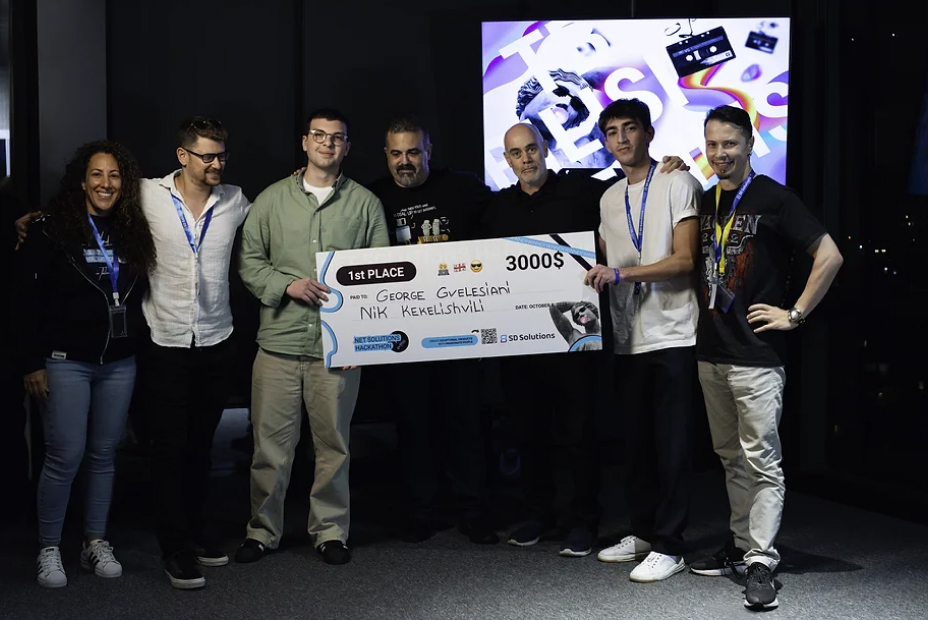
The company also hosted that hackathon with industry partners. The winning pair built a Georgian-language SQL learning solution. It is a useful glimpse of community activity around the recruiting operation: developers meeting other developers, with an actual technical problem to solve.
Put the whole job in the budget
For a buyer, the economic question is the cost of running the team. SD Solutions sells services arranged around customer requirements; its Tipalti account describes custom estimates. A useful quote comparison would include employment costs, service fees, equipment, onboarding, and the manager’s remaining workload. A salary comparison captures only one piece.
The model makes particular sense when a company wants ongoing capacity and already knows who will set priorities and review work. That is an inference from how the services are organized. A short, isolated assignment may call for a different arrangement. Moving recruitment and administration outside the company still leaves someone responsible for product decisions.
That division of responsibility is also a useful way to compare alternatives. A recruitment-only agency answers a sourcing need. An employer-of-record arrangement answers an employment administration need. An outsourced project answers a delivery brief. SD Solutions combines several of these services, so the decision starts with the work the customer intends to keep. Ask who interviews candidates, who approves the hire, who reviews performance, and who resolves a mismatch. The answers make a broad service description usable. They also give the customer a practical list of responsibilities to discuss before signing.
SD Solutions’ June 2026 writing on forward deployed engineering returns to a related problem: getting technical expertise to work inside a customer’s actual environment. Across its staffing cases, the practical advice is similar. Define the work. Test the local assumptions. Assign the operational chores. Then count the people who join, contribute, and stay.