BREAKING  ScribeUp raises $3M seed led by Mucker Capital Average user saves ~$600/year in forgotten subscriptions From 10,000+ consumer users to embedded bank infrastructure Founded by four MIT Sloan MBAs Integrates with Jack Henry, Q2 & NCR Demoed at FinovateSpring 2024 BREAKING  ScribeUp raises $3M seed led by Mucker Capital Average user saves ~$600/year in forgotten subscriptions From 10,000+ consumer users to embedded bank infrastructure Founded by four MIT Sloan MBAs Integrates with Jack Henry, Q2 & NCR Demoed at FinovateSpring 2024
Company Dossier · Fintech

ScribeUp cancels the things you forgot you were paying for.

An AI-powered subscription and recurring-bill manager that lives inside your bank's app - not another one you download and ignore.

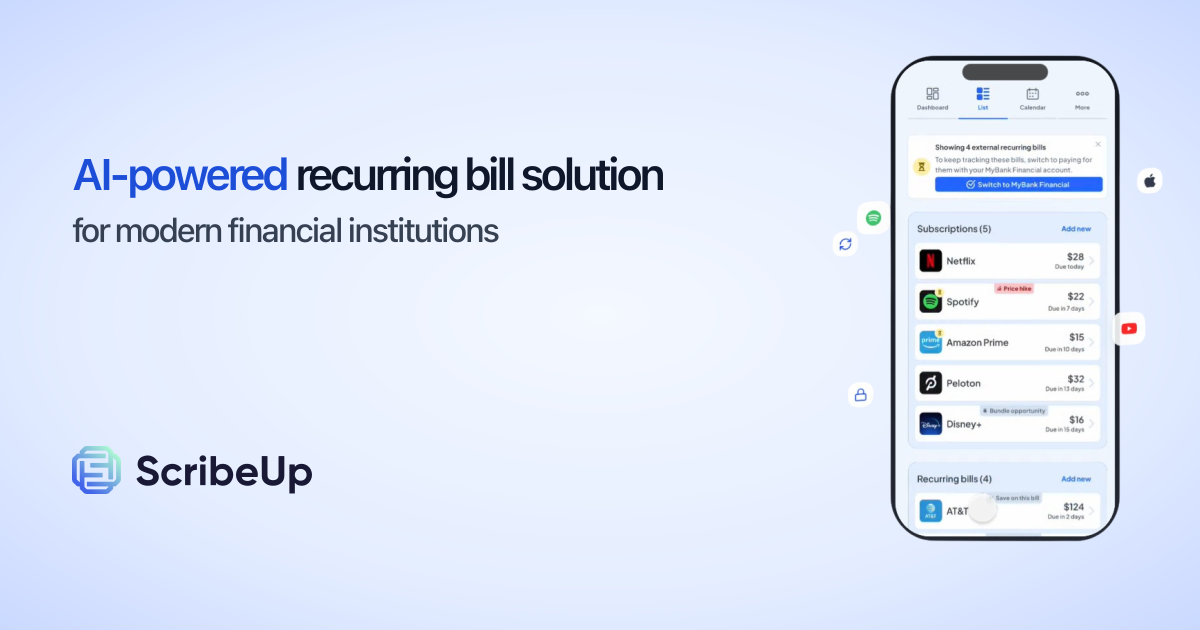
ScribeUp - AI-powered embedded recurring bill solution for modern financial institutions
The logo of a company betting that the most valuable thing a bank can do is help you spend less.

The Scene

It is the third of the month, and somewhere a card is being charged $14.99 for a streaming service nobody in the household has opened since spring. No one notices. That is the point of a subscription - it is designed to be forgotten. ScribeUp is the company that decided forgetting should have a refund button, and then handed that button to your bank.

Open your banking app. Scroll past the balance, past the transfers, past the offer for a card you did not ask for. There, native to the same screen, sits a tidy list of every recurring charge you carry - the ones on this bank's card and the ones hiding at other institutions. A tap cancels the one you are done with. A quiet toggle points every merchant back at this bank's card. You did not download anything. You did not visit a website with a countdown timer. The subscription just, finally, ended.

That screen is ScribeUp. And the more interesting story is how a small team convinced banks to want it.

$3M
Seed, Mucker Capital
~$600
Avg saved / user / yr
10K+
Early consumer users
4
MIT Sloan founders

The Turn Nobody Claps For

They had a working consumer app. Then they gave it to the banks.

ScribeUp did not start as infrastructure. It started as a Chrome extension and a virtual card - a scrappy consumer tool that spotted sneaky charges and let you swat them. People liked it. More than ten thousand of them signed up. In startup terms, that is traction. In most stories, that is where you double down.

Instead, the founders noticed something less flattering about their own success: the people who most needed subscription control were exactly the people least likely to install one more app to get it. The tool was good. The distribution was the problem. And the best distribution in personal finance already exists - it is called your bank, and you open it more often than you would admit.

"ScribeUp partners with banks, credit unions and fintechs to offer the best-in-class subscription management suite, embedded natively within your mobile and desktop experiences." - ScribeUp

So they made the turn from cool app to quiet plumbing. In 2023 ScribeUp pivoted to B2B, rebuilding its consumer product as an embedded suite banks and credit unions could drop straight into their own experiences. Mucker Capital wrote a $3 million seed check on the bet, and Service Credit Union came in as the first strategic backer of ScribeUp's credit-union arm. The unglamorous pivot turned out to be the whole business.

What Ships To A Bank

Four features that decide who wins your wallet.

Subscription360

See everything, in one place

An embedded dashboard where a customer can track, manage and optimize every recurring subscription and bill - without leaving the banking app.

Bill Finder

Find what's hiding elsewhere

Scans linked internal and external accounts through Plaid to surface recurring charges, including ones paid at other institutions.

Automated Cancellation

Kill it in one tap

Cancel an unwanted subscription with a single click - no phone tree, no retention gauntlet, no leaving the app.

Payment Updater

Win card primacy, quietly

Updates the card-on-file across merchants so the institution's card becomes the default. A small feature with large strategic stakes.

The Strategy

A retention feature disguised as a favor.

Banks obsess over two words: card primacy - being the card a customer reaches for by default. It sounds dry. But whoever owns the default owns the relationship, the data and the interchange.

ScribeUp's insight is that the fastest route to primacy is not another rewards gimmick. It is being genuinely useful about the thing customers quietly resent: the creeping pile of subscriptions. Help them spend less, and they stay.

Where The Savings Land

Forgotten subs
high
Price-hike creep
med
Duplicate services
med
Free-trial traps
high

Illustrative - categories where embedded subscription control tends to recover the most for a typical user.

The Road So Far

A short history of a stubborn idea.

2020

Four classmates, one annoyance

Jordan Mackler, Yohei Oka, Cinar Fidan and Erica Chiang - MIT Sloan MBAs - launch ScribeUp as a consumer subscription manager with a Chrome extension and virtual card.

2020-2022

10,000+ users

The consumer tool detects and blocks unwanted charges and crosses ten thousand users - proof the problem is real, and that distribution is the hard part.

2023

The B2B pivot

ScribeUp rebuilds as an embedded suite for banks, credit unions and fintechs, trading its own front door for theirs.

Aug 2023

$3M seed

Mucker Capital leads the round; Service Credit Union backs the credit-union arm as first strategic investor.

2024

On the Finovate stage

CEO Jordan Mackler demos embedded subscription management inside a live banking experience at FinovateSpring 2024.

The Team

Built by people who read the fine print.

The founding four met at MIT Sloan and split the work the way good early teams do - Jordan Mackler as CEO on the outside, Yohei Oka as CTO on the build, with Cinar Fidan and Erica Chiang rounding out the founding bench. The company runs lean - roughly fourteen people - and remote-friendly, with the engineering-heavy, product-led temperament its MIT roots suggest.

The plumbing they lean on is serious: Plaid for account linking, Marqeta and Mastercard for cards, Pathward, N.A. as sponsor bank, and integrations into the Jack Henry, Q2 and NCR platforms that banks already run.

Marginalia

  • Started as a browser extension. The first version was a Chrome add-on and a virtual card that blocked sneaky charges.
  • The whole pitch rests on a human flaw. We forget to cancel things. ScribeUp turned that into a product.
  • Payment Updater is the sleeper. Quietly deciding which card wins checkout is a small feature with outsized stakes.
  • MIT Sloan, class project energy. Four classmates, one shared irritation, one company.

Watch & Demo

See it working.

The Scene, Revisited

It is the third of the month again. The card is not charged $14.99. Two weeks earlier, in the same app where the customer checks a balance, a small list flagged a streaming service no one had opened since spring - and a single tap ended it. No website with a countdown. No retention script. Just a subscription that quietly stopped, and roughly $600 a year that stayed put.

That is the whole trick, and it is not a small one. ScribeUp did not build a flashier place to manage subscriptions. It built the plumbing so the place you already go can do it for you - and in the bargain, gave banks a reason to be the app you actually open. The forgotten charge was the enemy. ScribeUp just made forgetting affordable.
Find ScribeUp

Links & dispatches.

Share This Page