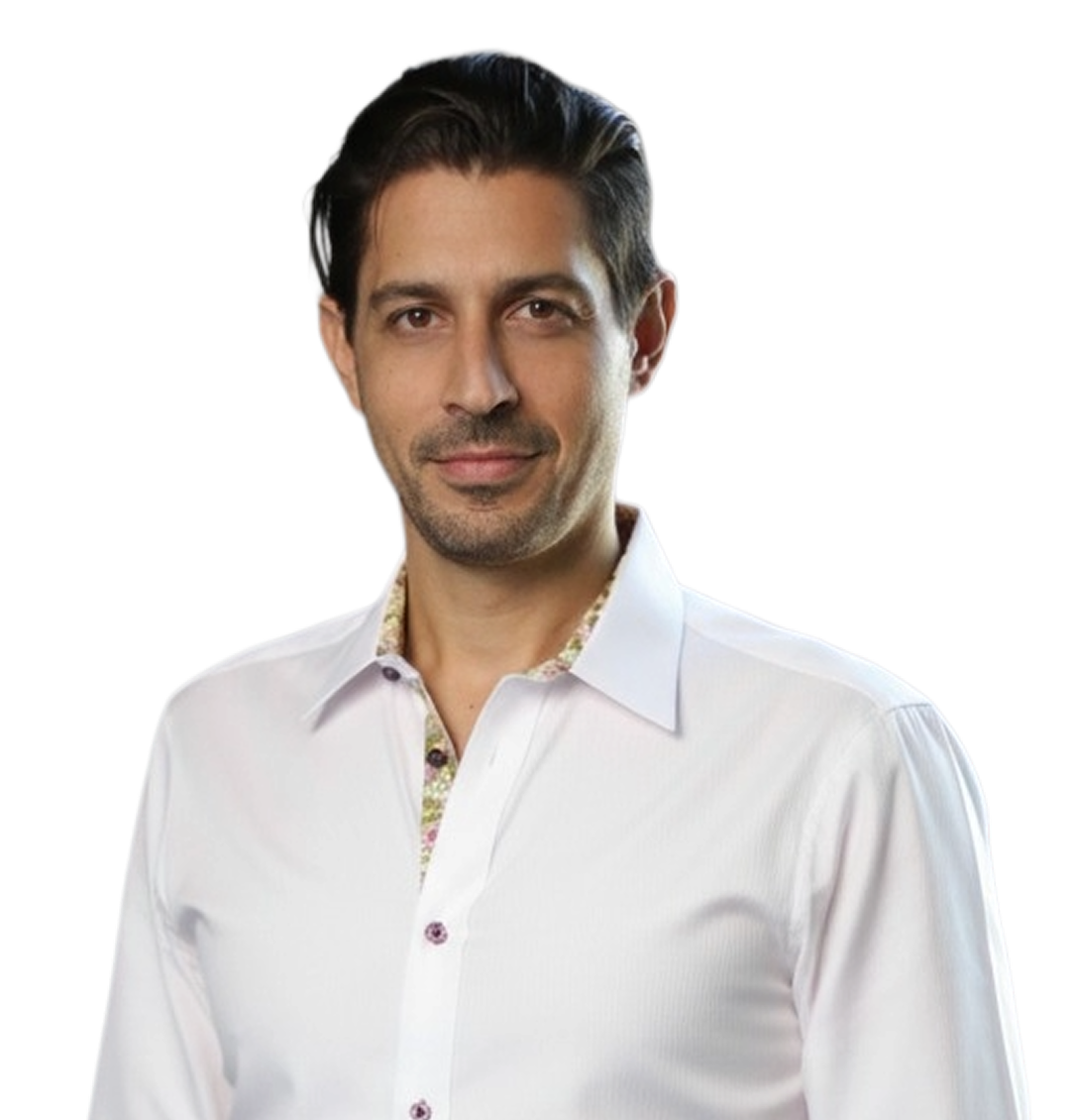
Shawn Melamed runs a fintech that most consumers have never opened, from a 31st-floor office at Hudson Yards, on a mission that reads suspiciously like a bumper sticker - "savings made personal, impact made local" - but the numbers underneath are unusual: a company that takes cuts of banking economics and gives some of it back to charity, plus a $150 annual donation match paid out of Spiral's own pocket. Which is a strange thing for a for-profit fintech to do, unless you concede, as Melamed clearly has, that guilt is a distribution channel and that community banks are quietly desperate for a reason to be interesting.
Spiral is what happens when someone who spent a career watching startups pitch a bank decides the interesting problem isn't in trading. Melamed is the co-founder and CEO. Before this he was the Managing Director running Morgan Stanley's Technology Business Development and Innovation Offices, which is a long title for a job that mostly involved being pitched. Over years he sat across from the founders of what he later described as "hundreds of tech companies" - fintech, SaaS, AI, cybersecurity, data infrastructure - and, one assumes, learned the shape of a good idea by watching many bad ones. He left to build the thing he did not see anyone building.
The pitch, briefly
Melamed likes to invoke Amazon, which is a useful shorthand for what he wants Spiral to be and a slightly dangerous one because Amazon is not, as a rule, associated with generosity. But the analogy is about friction, not vibe. "Just like what Amazon did to consumption with the click of a button," he told Banking Dive, "that's what we're trying to do to charitable giving." Which in practice means embedding donation flows, round-ups, matching and impact tracking inside the mobile apps of banks and credit unions. The end user still uses their bank. The bank now has a reason customers open the app on days that aren't payday.
Most people would like to do good, but they don't get a lot of opportunities to do so easily.- Shawn Melamed, Banking Dive
The way Spiral talks about its own market is worth quoting, because it is a rare instance of a fintech CEO expressing something like sympathy for the counterparty. "There are 1.5 million nonprofits in the U.S.," Melamed has said, "and they are led by amazing people who are trying to create an impact, help the homeless or cure cancer, and they're struggling with raising capital." The bit that follows is the pitch: Spiral wants to be the plumbing that makes small-dollar recurring donations a default, not a project.
Three startups, one groove
The Melamed résumé looks, at first, like three unrelated fintech careers stacked on top of one another. Look longer and it starts to look like the same career with different products. He co-founded Correlix in 2005, which sold transaction monitoring to electronic trading venues; it was later acquired by TS-Associates. He then ran commercial products at Strike Technologies, where he oversaw StrikeRisk and StrikeNET, the latter of which was one of the first commercially available long-haul microwave networks built to shuttle market data and trades at ultra-low latency. He led the sale of StrikeNET to TMX Group in 2014.
The connective tissue isn't finance, exactly. It's plumbing. Melamed keeps building the invisible layer that moves numbers from one place to another faster or more usefully than they moved before. In his first company it was trade telemetry. In his second it was raw microwave capacity for market makers. In his third it is donations - flowing from a checking account balance to a nonprofit, on a schedule, without the donor having to think about it. The instrument changes. The instinct does not.
Funding Arc / Spiral
The Morgan Stanley detour
The step in the middle - the corporate MD job - is the one that makes the whole thing work. A founder who has been on the other side of the pitch table for a decade knows things a first-time founder does not: which incumbents will actually integrate versus which will run a pilot for eighteen months and quietly forget; which board-level metric a bank actually cares about; how "deposit growth" enters and exits a quarterly call. Spiral sells to credit unions and community banks. Melamed did not learn to sell to them by cold-calling. He learned by being the person credit union executives were trying to reach.
He holds a bachelor's degree from Tel Aviv University, which is worth noting less for the school itself than for the pipeline it hints at: Spiral's lead investor is Team8, the Israeli venture group that specializes in helping founders spin up companies with a strong technical bench. Team8 co-signs a certain kind of fintech - security-adjacent, plumbing-heavy, unafraid of talking to banks. Spiral fits the template.
What Spiral actually does
The product, stripped of marketing copy, is a set of embedded modules that a bank or credit union can drop into its existing mobile experience. A donation widget. A round-up-to-charity feature. A verified-charity search. An impact dashboard that tells a customer, in reasonably concrete units, what their giving added up to over the past month. Spiral also runs a direct-to-consumer product in parallel, but most of the growth story is B2B - a small team selling into a lot of small institutions.
The economics have an interesting kink. Spiral matches individual customers' donations up to $150 per year. That is a real cash outlay for a Series A fintech, and one Melamed has repeatedly defended in public. His logic, roughly: customers who donate stick around; banks like customers who stick around; banks pay for products that make customers stick around. The match is a marketing cost that reads on the P&L as a virtue.
We believe that if you bring in front of the customer engaging content and quantify what their donation has done, they may convert from giving you a one-time donation to becoming a monthly supporter.- Shawn Melamed
The recognition
In 2024, The Financial Technology Report named Melamed one of its Top 50 Fintech CEOs, which is the sort of list that any founder in the sector would accept and roughly a third of them would refuse to publicly celebrate. Spiral celebrated. The company's post about the honor is characteristically low-key, framing Melamed as a "visionary leader" who is showing "how banking can empower people to build better lives and create stronger communities." The prose is corporate. The underlying data - the partner list, the deposit growth, the retention numbers his customers report - is why he ended up on the list.
Two anecdotes, one arc
StrikeNET, Melamed's second startup, existed to shave microseconds off Wall Street trades using microwave towers strung across the countryside. It was invisible to consumers. It was extremely valuable to market makers. TMX Group bought it in 2014. If you want to understand Melamed's taste in problems, notice that he keeps picking ones where the customer isn't the person visibly benefiting.
At Spiral, the visible beneficiary is a nonprofit. The customer is a bank. The donor is somewhere in the middle, clicking a checkbox during a session that was originally about seeing whether a paycheck cleared. The trick is the same trick as the microwave towers: build the boring, essential layer that nobody sees, and let someone else take credit for the outcome.
What he sounds like
Melamed writes a column for CUInsight, the trade publication for the credit union industry, which is a fairly niche form of thought leadership and probably tells you more about his target market than any funding announcement. He goes on podcasts - the Bank On It podcast, hosted by John Siracusa, released a full episode with him in November 2021 - but does not appear to be a Twitter personality. Spiral's account (@Spiralgives) is more active than his own. This is consistent with the general pattern of Melamed's career, which involves being useful to a specific room of people rather than famous to a general audience.
He is not, in interviews, especially quotable in the way a first-time founder might be. His sound bites are practical. His metaphors are drawn from consumer commerce ("what Amazon did to consumption") rather than from movements ("we are building the future of good"). The word that keeps coming up in his own descriptions of the work is "engagement" - a metric word, not a moral one. This is a founder who has decided that the moral part of the product speaks for itself and that his job is to make sure the checkout flow works.
The bet, put plainly
Spiral is a bet on two things at once. First: that community banks and credit unions - roughly 5,000 institutions in the U.S., collectively holding a large share of American deposits but a shrinking share of American attention - will pay for anything that differentiates their app from the megabanks'. Second: that charitable giving is one of the very few product categories where community financial institutions have a natural advantage over the megabanks, because being local was already their pitch. Melamed's insight, if it is one, is noticing that these two facts fit together.
The counter-bet is that consumers don't actually change their giving behavior based on a widget in their banking app; that giving is a values act, not a UX act; and that impact tracking is a nice-to-have. This is a legitimate objection, and Spiral's response is essentially empirical - they publish retention and engagement lifts for partner institutions and let those numbers do the work. Whether the numbers hold at scale is the interesting open question, and probably the one that determines whether Spiral is a durable middleware business or an interesting footnote in the history of embedded finance.
Aspirations
Melamed's stated ambition, refracted through half a dozen interviews and one podcast, is deceptively small: make giving as easy as spending. In the context of American consumer finance - where spending has been optimized to a friction level approaching zero and giving still runs, in significant part, on paper checks and end-of-year guilt - this is not a small ambition at all. It is, in fact, the kind of problem that only a plumber would find fun.
He is 44 employees into it. He is $42 million into it. He is on a list of the top 50 fintech CEOs. He is going to be at this for a while.