The first office customer in Sawan Laddha’s account worked the night shift. A second shared the space. Before Workie became a business spread across Indian cities, it had this modest arrangement: an office, customers with particular working hours, and room to grow. There is something pleasingly economical about the origin. The furniture did not need a new address every time somebody had a new idea.
Laddha had reached the office problem through the people problem. His earlier business, Splash India, helped companies recruit. But finding a team left another job unfinished. Employers needed somewhere for that team to work. In his telling, ready-to-use infrastructure was an obstacle, so he began providing it. Customers expanded; the space serving them expanded too.
That sequence is the thread through his working life. Laddha, Workie’s founder and CEO, has built around the practical requirements of companies coming to Indore and other emerging business centres. Recruitment led towards premises. His involvement in investor networks and mentoring addressed another requirement: people who could help a founder make the next decision.
A recruiter meets the next problem
Splash India began in 2006. Laddha’s background there was in recruitment and staffing, work that puts a business close to an employer’s actual plans. A company may talk about entering a city in grand language. Eventually, somebody needs to know which jobs it will fill and how quickly the candidates can arrive.
Recruitment is a revealing vantage point. The demand comes from companies making commitments: opening operations, expanding teams, replacing missing skills. It offers repeated encounters with the distance between an attractive location on a presentation and a functioning office. A city can have capable people while still making an employer work hard to establish a base.
In Indore, Laddha came to see the connection between staffing and infrastructure. His personal account describes helping companies with recruitment, coordination and office setup. Workie grew out of that overlap. The customer arriving for one service could expose the need for the next. The boundary between the businesses was less tidy than a company brochure might suggest.
He was also thinking about the city beyond individual contracts. By August 2016, he had helped start the Madhya Pradesh Angel Network with 30 other investors. At the time, he was looking for startups to support with seed funding and mentorship. The interest in connecting founders predates Workie’s widely reported 2017 founding.
“Patience gives you staying power, but execution defines your survival.”
Sawan S. Laddha
The night shift gets the keys
The early shared-office arrangement matters because it begins with a customer’s timetable. A night-shift operation has a fairly direct relationship with its surroundings: the space must be available when work happens. A beautifully arranged reception can wait until morning. The business occupying the room cannot.
As Laddha tells it, those early customers grew, and a fuller centre developed around their requirements. The story contains no need for an elaborate founding scene. It gives him a problem to understand closely and an opportunity to grow with the companies already using the space. Expansion begins with the customer rather than the map.
Workie’s present offering makes that operating role explicit. It specialises in offices built around an enterprise’s requirements, alongside ready-to-use spaces and coworking. Finding the premises is part of the work. So are setting them up and managing them once the customer moves in. The handover starts a continuing responsibility.
For the founder buying that service, the appeal is easy to understand. Setting up a workplace can become a second project running beside the business itself. Every separate arrangement demands attention. A provider bringing the jobs together offers the chance to spend less time supervising the office’s creation and more time using it.
Laddha also tells customer-service stories in which the work spills beyond the formal brief. In one public account, he recalled an employee visiting a customer at three in the morning after the customer ran into financial trouble. It is his anecdote, rather than a service promise. Still, it shows the kind of help he chooses to celebrate.
The hour is memorable. The relationship is more revealing. Managed offices put providers close to companies as they change size, encounter difficulties and make new plans. Laddha’s account of customer care rests on that proximity. A building may have opening hours; a customer’s problems are under no obligation to consult them.
The numbers acquire a date
In January 2025, Workie announced ₹13 crore in equity funding. Its backers included the Sunil Singhania family office, NAV Capital and Raman Roy, among others. At that announcement, the company reported 15,000 managed seats across 50 locations and more than 150 clients. The small shared-office arrangement had become a substantially broader operating business.
January 2025
at that announcement
at that announcement
The date belongs beside the figures. They describe the scale reported at a particular point in Laddha’s journey, rather than an undated claim about today. Among the clients named then were Zomato, Bajaj, Patanjali, Schneider and OYO. Workie was operating across more than 15 cities, including Mumbai, Chennai, Pune and Bengaluru.
A February 2025 report described a second funding round, facilitated by Arihant Capital, with the amount undisclosed. It also reported Workie’s acquisitions of Karyasthal Coworking and Antares Business Centre in Indore. National expansion and additions in the original city were occurring within the same business story. The home market still warranted attention.
For Laddha, growth brings an ordinary but demanding question: can the operating responsibility travel? It is one thing to understand a customer in a familiar building. A network introduces more premises, local arrangements and teams. Every location adds another place where the promise of a usable office has to hold up after the sales conversation ends.
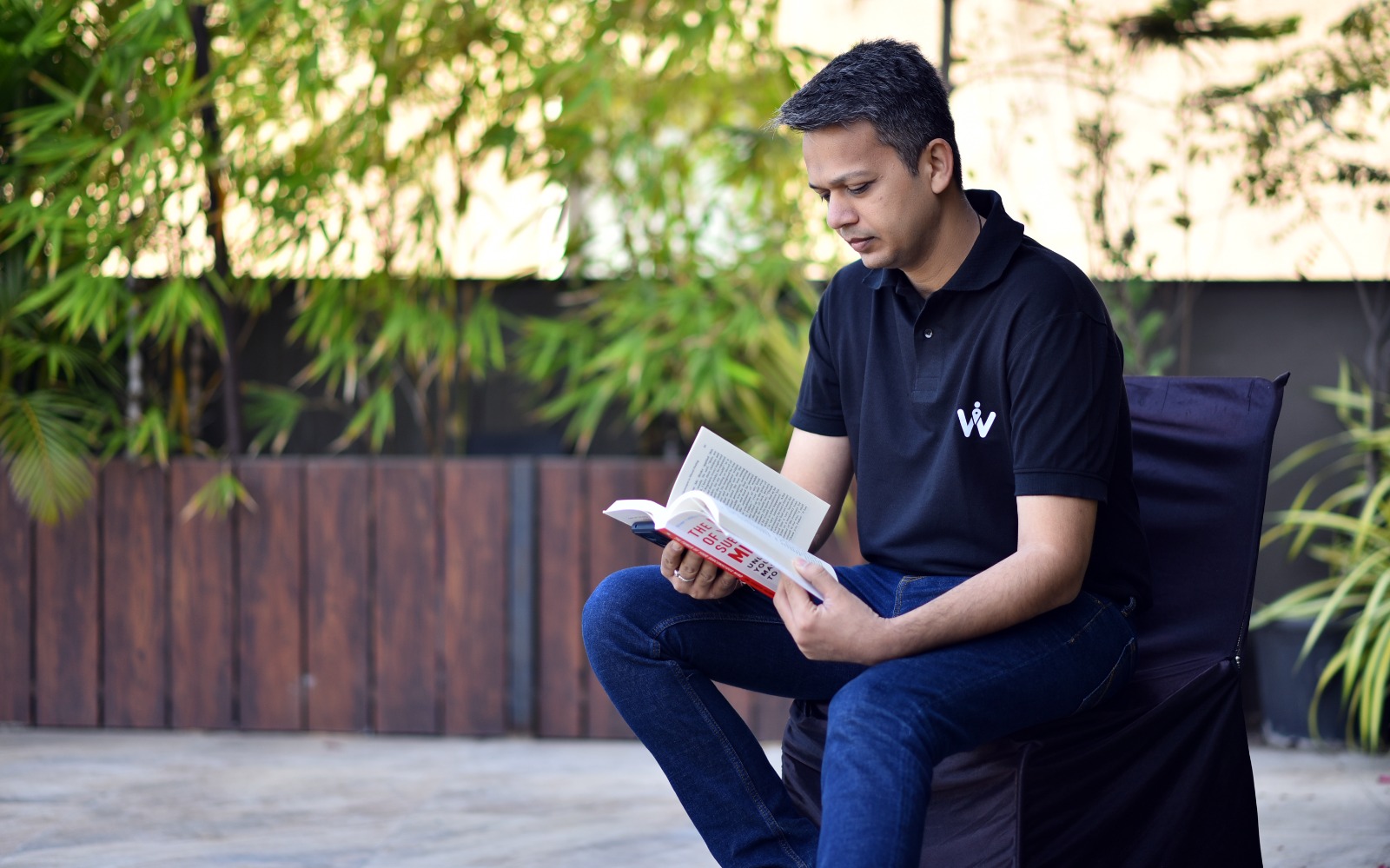
A useful introduction has no floor plan
Alongside the offices runs a less visible part of Laddha’s career. He invests in startups and participates in organisations that connect their founders. His publicly documented investments include STAGE, the regional-language entertainment platform, and Kyari, the plant brand. The range reaches well beyond the category in which Workie itself operates.
An investor’s position differs from an operator’s. The operator is responsible for delivery inside a company. The investor encounters somebody else’s decisions, customers and constraints. Laddha’s involvement in both puts him on different sides of conversations about growth. His career includes building a service business and backing founders building quite different ones.
The network-building has a long paper trail. A January 2017 e-Chai event at IMS, Devi Ahilya Vishwavidyalaya, listed him as founder of MP Angel Network among speakers helping students connect classroom understanding with industry experience. The timing places mentorship alongside his commercial work, rather than presenting it as an activity discovered only after expansion.
In August 2023, he spoke to trainees at SAGE University Indore about entrepreneurship, mentorship, investment opportunities and workspace for new businesses. The audience was attached to an agricultural enterprise programme. His speaking activity was therefore reaching prospective entrepreneurs outside the office and technology circles most readily associated with Workie.
AIC-Prestige also lists him as a mentor. TiE Indore MP now lists him as president. Its work includes education, networking, incubation and access to investment. These are separate tasks, but they share a practical aim: helping a founder reach the experience or relationship needed to move a business forward.
After TiECON MP 2025, Laddha thanked the people behind an event he said had brought together more than 1,700 attendees and 35 speakers. His acknowledgements included colleges, incubators, students, volunteers and his Workie team. The list gives a better sense of the organising work than an attendance figure alone. A gathering needs people who arrange it, people who contribute and people prepared to turn up.
He also asked attendees for feedback and said he would personally use it. That is a small detail, but a useful one in a career spent serving other businesses. An office customer can tell an operator what needs fixing. An event participant can tell an organiser what would make the next gathering more useful. Both require somebody willing to hear an answer after the occasion for congratulations has passed.
A useful introduction is hard to put on a floor plan. Its value appears when it reaches the right person at the right moment. Laddha’s involvement in these groups extends the logic of his earlier work. Once people and premises are in place, a company still needs routes to advice, partners and capital.
The ambition stays close to home
Laddha’s writing about Central India argues for using local talent, building relationships with educational institutions and taking operating costs seriously. He encourages founders to make those advantages part of their plans. The outlook links business ambition to a specific place and to the work required to make that place commercially useful.
It also leaves room for patience. Staffing, office management and mentorship operate on different clocks. A vacancy has a deadline. An office needs continuing attention. A founder relationship may take time to become useful. The career connecting them has developed over years, with Indore recurring as a base, a market and a subject of advocacy.
There is a temptation to tell an entrepreneurial story as a departure: the hometown left behind, the bigger city reached. Laddha’s story offers another route. He has repeatedly worked on the reasons a company might come to his city, and on the arrangements that could help it stay.
The early night-shift customer gives that ambition a human scale. Somebody had work to do. Somebody needed to provide a place where it could happen. Between recruitment, managed offices and founder networks, Laddha has kept returning to the things a business needs around it. The address remains Indore. The list of useful arrangements keeps growing.