Before Savi tracked cargo, its founder had trouble finding his son. Robert Reis had trouble finding his young son in a store. The idea that followed was appealingly concrete: put a radio transmitter in a child’s shoe, and a parent could find the child. Reis established Savi Technology in 1989. The shoe concept proved technically and commercially unworkable. The technology, however, had somewhere else to go.
That somewhere was the supply chain. A container, like a wandering child, can disappear from the attention of the person responsible for it. Savi developed radio-frequency identification technology for locating things in transit. Military logistics became an important market. The ability to find objects survived changes in customers, ownership and ambition.
- Active RFID tags, readers and portable kits help military teams track cargo in transit.
- Savi closed its commercial software business in 2021 to concentrate on government customers.
- A 2026 tag order was worth about $2.63 million; equipment prices depend on the purchase.
A shipment needs a voice
Savi sells the pieces that let cargo identify itself: active RFID tags, readers, portable deployment kits and associated services. A tag travels with an asset. A reader collects its identity. Software turns those encounters into a record people can use. The point is to reduce the gap between equipment moving through the world and somebody knowing where it is. The purchaser’s problem is operational: choosing where to collect a read, how to deliver it and who is responsible for responding.
Its expertise sits at the junction of radio engineering and logistics operations. In 2013, Savi introduced tags using a 9-by-9-millimeter system-on-a-chip that combined radio, processing, memory and protocol functions. The company reported longer detection ranges and battery life beyond five years, with performance validation by Pacific Northwest National Laboratory.
The portable kit matters because logistics does not always happen beside permanent infrastructure. A field team needs to establish a reading point where the work happens. Savi’s catalog includes equipment for that problem. Its government customers buy a capability shaped by field conditions.
The commercial detour
Lockheed Martin completed its acquisition of Savi in June 2006. In September 2012, affiliates of LaSalle Capital bought it, returning the business to independent ownership. Savi pursued an expansive proposition: combine sensors with software that could explain supply-chain performance. Finding cargo was the starting point; interpreting its journey was the larger ambition.
The product names made the progression clear. Savi Visibility addressed goods in transit. Savi Insight offered analytics. Savi Locate supplied location data, while Savi Secure added tamper and environmental monitoring. In 2017, the company announced Locate pricing below $50 for orders of at least 100. That was a dated hardware offer, rather than the cost of installing and operating an entire system.
The strategy attracted partners and money. SGS bought a 17.65 percent stake in 2015, gaining access to sensor analytics for services including cargo tracking and asset monitoring. In November 2018, Savi announced $7.5 million in financing led by Eastward Capital Partners, intended to develop its visibility and analytics suite and expand commercial and government business.
Then came a consequential reversal. Savi filed for Chapter 11 protection on August 4, 2021. That month, it announced the closure of its commercial software business and a renewed focus on government contracts. Those earlier analytics products belong in its history. Reading the old product announcements as a current shopping list would miss the company’s change of direction.
Visibility + analytics2021Chapter 11 filing
Government refocus
The tracking company that needed a shipment
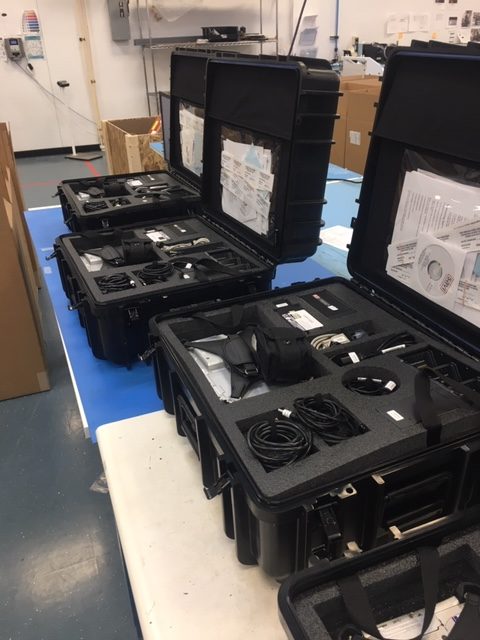
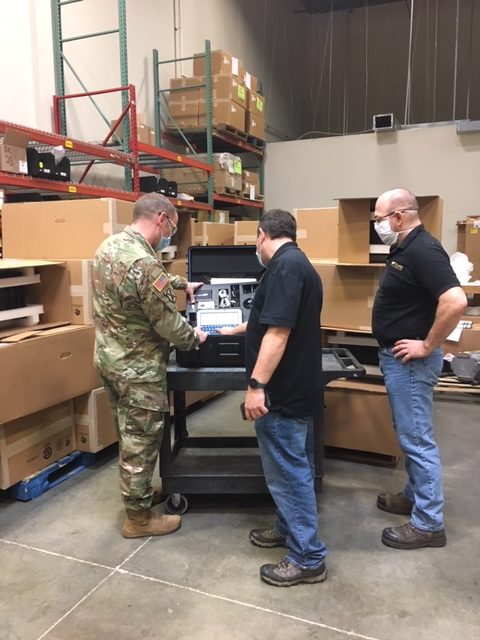
One episode makes the distinction between information and action unusually vivid. In 2020, the Army National Guard ordered 221 Savi PDK III units for $3.2 million. The Army Reserve ordered another 354 for $5.1 million. These were substantial equipment purchases, with an urgent purpose as military first responders supported the coronavirus response.
Savi itself ran into disrupted production and transport. In the company’s account, securing airfreight space did not solve the problem: a supplier’s factory then faced a shutdown. Parts, assembly and acceptance each had their own bottleneck. The seller of supply-chain visibility was dealing with the same physical constraints as its customers.
First Source Electronics, a division of Commercial Vehicle Group, assembled the kits in Maryland. It obtained an exemption to continue the work. The National Guard also changed its usual procedure: Captain Adam Hever traveled to the assembly location to inspect and accept the equipment there. The useful move was changing where acceptance happened, reducing another source of delay.
The network is part of the product
Savi’s defense focus continued beyond that restructuring announcement. The Army’s August 2024 aRFID-VI award notice names Savi as the sole-source supplier under a contract with five one-year ordering periods. It describes transponders and fixed, handheld and portable interrogators based on Savi-developed technology associated with ISO 18000-7. This is a business built around an installed operating environment.
A June 2026 Defense Logistics Agency delivery order offers a more recent price reference: approximately $2.63 million for radio-frequency tags. The published order detail lists 28,094 units at $93.63 each. This particular purchase puts a concrete number beside the phrase “asset visibility.”
The broader market includes ORBCOMM’s container-monitoring systems and IDENTEC SOLUTIONS’ asset-tracking technology. The right comparison depends on what must be tracked and the infrastructure already in place. Savi’s distinction is its long association with military in-transit visibility, specialized equipment and procurement channels. A purchaser has to match the system to the journey.
Copy the inspection, not just the sensor
The practical lesson is to begin with a decision. Which missed handoff creates a cost? Who can respond when a shipment stalls? Which inspection could happen sooner, or somewhere else? Tracking earns its keep when someone can use the observation to change an operation. The National Guard delivery provides a concrete example: move acceptance closer to assembly.
There are limits built into the equipment. Savi’s published hybrid IoT sensor specification describes collecting RFID reads and transmitting them when cellular service becomes available. It also describes buffered messages and battery life tied to reporting intervals. A live view depends on communications, power and the chosen configuration. A location report cannot supply missing freight capacity.
Savi’s history keeps returning to that small gap between knowing and doing. The shoe idea failed. The commercial software expansion was closed. Military customers kept ordering tracking equipment. The company’s enduring proposition is modest enough to test: make an asset easier to find, then give the person who finds it something useful to do next.
“The Value of Knowing”
Savi’s brand line