Sanjay Kumar built a business around answering the telephone. Then he began asking a question that could make an accountant put down the receiver: what if the business helped its customers receive fewer calls?
A call centre paid by the call has a fairly obvious interest in a ringing phone. Kumar wanted vCustomer to look further ahead. If it could help a client understand why people kept calling, perhaps it could remove the problem, shorten the conversation and become more useful. There is a pleasing awkwardness to that proposition. The customer gets some peace. The supplier has to find a better reason to send an invoice.
That tension gives Kumar's career its shape. He had worked on networks, broadband and satellite communications before founding vCustomer in 1999. He understood the machinery that allowed people on different continents to speak. Building the company meant learning what those people needed from one another once the connection worked.
A trip to Gurgaon, a year to change direction
The decisive visit came in 1998, at a GE facility in Gurgaon. Kumar saw the potential for business process outsourcing in India. The attraction was unusually tangible for the period: companies already needed support, and someone already had to provide it. He spent the following year assembling the business plan and financing.
His route there had begun in Mumbai. At seventeen, he left India for the United States and studied computer science at Carnegie Mellon, followed by graduate work at the University of Pennsylvania. He completed his doctorate in 1991. An interview with Boeing brought him to Seattle; he joined Microsoft instead.
At Microsoft, his work included networking, broadband and telephony. Teledesic followed, with its ambition of a global communications network. That brought him into the practical business of ground connectivity and regulatory approvals. The move into customer service might look like a detour from that technical career. In practice, it gave the communications problem a paying customer.
Years later, recalling India in 1998, he said, “there was magic in the air in India.” Telecom changes and a large pool of graduates made work across borders look increasingly possible. His interest extended beyond people who could write software. Front-office and back-office work offered another route into an international business.
Two grandfathers enter the business plan
During preparations in India, Kumar encountered Aditya Gupta, the founder of Intec Solutions. Gupta was already operating telephone and internet call centres for American businesses with Indian subsidiaries. They joined forces, with Intec becoming vCustomer India. The connection came with a detail no investment committee could have ordered: their grandfathers had been neighbours in the same village.
By April 2000, the business had about 350 call-centre agents and fifteen people at its Bellevue headquarters. Its fourteen American and European clients could buy email support, live chat or help during periods of heavier demand. A company could also use vCustomer as backup. Geography supplied a useful trick: an American evening was an Indian working day.
The enterprise belonged to the internet economy, but much of its appeal was old-fashioned. Someone had sent a question and wanted an answer. Being able to send messages around the world was an achievement. Getting a business to reply was a separate occupation, with enough unfinished work to keep a company busy.
The engineer underneath the headset
Kumar's technical background became visible in the infrastructure. vCustomer adopted an entirely IP-based network, combining voice and data rather than maintaining separate systems for each. For a business adding locations and agents, that choice affected equipment, maintenance and the work required to expand.
Separate voice and data networks meant separate demands on money and expertise. Bringing them together allowed the company to centralise parts of its voice infrastructure. The useful engineering question was how to make a growing operation easier to run while keeping conversations reliable. A cheaper call that repeatedly drops is an expensive way to annoy someone.
In February 2003, Kumar described a deployment that had started in 2000 and grown to 1,200 agents across two Indian sites. Another centre, with 800 enabled workstations, was due the next month. These were concrete measures of expansion: places to sit, calls to route, and capacity that had to be ready when a client needed it.
By September that year, vCustomer had around 2,000 employees and planned to add another thousand technology-support and customer-care professionals. Its three New Delhi centres served clients in Canada, Britain and the United States. The business was becoming a daily coordination exercise across time zones, rather than an idea that could fit neatly on a presentation slide.
Growth acquires a management problem
As the operation expanded, Kumar recruited Sujit Baksi from HCL's outsourcing business to lead India and global operations. Adding centres in more cities required stronger management on the ground. The ambition also involved larger contracts, where a customer was trusting an outsourcer with years of work rather than a small experiment.
In early 2004, technical help-desk support accounted for about 65 percent of vCustomer's work. Retail customer support and airline loyalty programmes made up the remainder. Its technology subsidiary, vCLabs, developed tools for the operation. The company had been profitable since 2001, giving the expansion story a foundation beyond anticipated demand.
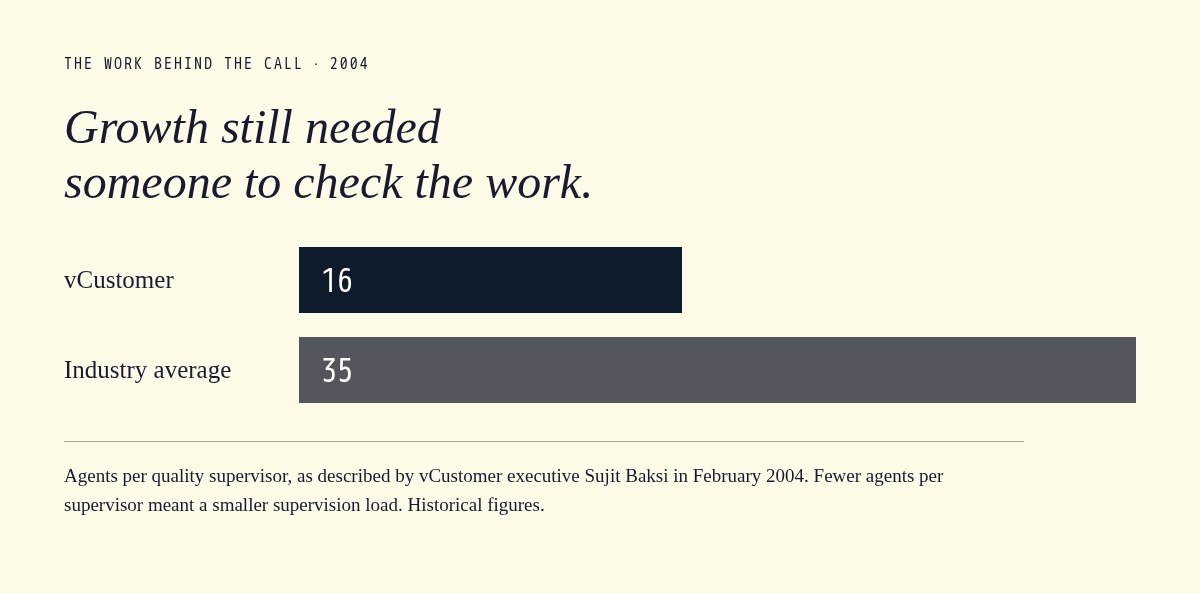
Quality required its own staffing decisions. At the time, Baksi described one quality supervisor for every sixteen agents, compared with an industry average of thirty-five. Behind the growth targets sat an ordinary managerial difficulty: how to keep service consistent when the number of people delivering it keeps changing.
The wider outsourcing argument was less comfortable. American users could struggle with unfamiliar accents, and Kumar acknowledged that problem while defending his technicians. vCustomer spent on technical training and communication training. The distance between a capable employee and a satisfied caller could include language, expectations and the patience remaining after a computer had stopped working.
The value of a telephone that stays quiet
Kumar's proposal to help reduce calls pushed beyond the economics of staffing. By 2007, vCustomer was handling more than 100,000 calls a day. Those conversations also produced information. Recording and analysing it could help explain recurring customer problems, giving the company something useful to offer beyond the next available agent.
The commercial risk was obvious: fewer calls could mean less immediate revenue. Kumar argued for a longer relationship in which solving problems earned a supplier more trust. “But that is a very short term viewpoint,” he said of protecting call volume. The idea required a client to value the information coming out of its service operation.
It also made customer support a place to learn about a business. A repeated question could reveal an instruction people misunderstood or a process they could not complete. The attraction of the approach is easy to recognise from either end of a telephone: a problem prevented saves a conversation nobody particularly wanted to have.
“But that is a very short term viewpoint.”Sanjay Kumar, on protecting revenue by preserving call volume, 2007
India becomes the customer, too
In late 2007, vCustomer announced plans to serve more large Indian companies. It had three Delhi facilities and one in Pune, and was setting up in Mumbai. The planned expansion included customer-management software, interactive voice services and business-intelligence tools. Experience serving overseas customers would now be offered to domestic businesses.
India's expanding telephone market supplied the context. As more people became customers of telecom providers and other large companies, those businesses needed ways to respond to them. The familiar question had travelled home: how could service remain useful and affordable as the number of customers increased?
In 2008, Kumar was also discussing employee retention. He described twice-yearly satisfaction surveys, corrective action based on feedback and internal postings that filled a majority of senior roles. He argued that the outsourcing industry had failed to show people clearly how they could build careers within it. Recruitment could bring someone through the door; a visible next step helped explain why they might stay.
Recognition followed in the company's inclusion in the 2009 Global Services 100. The selection considered customers, skills, scale and other operating measures. For Kumar, whose company depended on people repeatedly handling someone else's difficult moment, those measures belonged together. Customer experience and the organisation delivering it were closely connected.
Thirteen years, then a different kind of decision
On March 7, 2012, Mahindra Satyam announced a $27 million acquisition of vCustomer's international operations. The scope matters: the announcement concerned those operations. Retail, consumer technology and technical support were central to the buyer's rationale, reflecting the areas in which Kumar's company had developed experience.
The transaction also brought a familiar colleague back into the picture. Baksi, who had joined vCustomer during its earlier expansion, was chairman of Mahindra Satyam's BPO board at the time of the announcement. Kumar spoke of investment supporting growth and new services. The company that began in 1999 had become an operation another business wanted to build upon.
His career offers a particular view of entrepreneurship: technical knowledge applied to a job that has to be done again tomorrow. Networks carry the conversation. Managers organise the people. Customers decide whether the answer helped. Kumar's more interesting wager was that, over time, a supplier could be rewarded for making the whole exchange less necessary.
For anyone who has waited through hold music, that is a business ambition with an unusually agreeable sound.