The football match that helped inspire LiveU has a peculiarity: its founders could not remember who was playing. Samuel Wasserman and his fellow entrepreneurs remembered wanting to watch it. They remembered that it was not being broadcast live. The clubs, apparently, had failed to make as lasting an impression as the inconvenience.
There is something rather pleasing about a sports grievance outliving the score. A missing broadcast became a business question: how many events stayed off television because getting pictures out of the venue cost too much? A school game, a local competition, a story unfolding beyond the reach of a broadcast truck. The camera might be there. The audience might be waiting. Between them sat a formidable bill.
Wasserman, known as Shmulik, co-founded LiveU in 2006 with Avichai Cohen and Rony Ohayon. His career would become entangled with that gap between seeing something and showing it to everyone else. Nearly two decades later, he remains the company’s chief executive. The forgotten fixture has acquired a remarkably long second half.
A career spent getting the signal through
Before the cameras, there were networks. Wasserman has described an interest in technology stretching back to his teenage years. He studied electro-optical engineering through Israel’s military academic program, then served in the navy. His civilian career took him to ECI Telecom, where his work included project management, marketing and product management.
He subsequently joined Ceragon Networks and held marketing and product roles, including vice president of marketing, before leaving to establish LiveU. He also earned an MBA in marketing and information systems at Bar-Ilan University. Engineering and marketing make a useful, occasionally uncomfortable marriage: one asks whether a thing can work; the other must discover whether anyone will pay for it.
That combination runs through his early explanation of the business. In 2008, he described a first task of reducing broadcasters’ costs, followed by a wider opportunity to let correspondents report from more places and angles. Alongside national networks, his imagined customers included local television and websites. The ambition reached well beyond the evening bulletin.
“We’ve launched it, and it works.”
Samuel Wasserman, speaking about LiveU in 2008
It is an admirably compact product announcement. The rest of his career has involved persuading an industry that the sentence could be repeated under much less accommodating conditions.
A laptop goes to the Olympics
Beijing in 2008 supplied an early test with rather more spectators than a laboratory. NBC used LiveU during its Olympic coverage, after field-testing the system in the preceding months. The equipment enabled behind-the-scenes reporting and street interviews, giving crews a way to send pictures while moving.
The original kit sounds endearingly provisional beside today’s equipment: a laptop connected to a box of cellular modems and a camera. In Wasserman’s later recollection, it was a mature prototype working over low-bandwidth 3G connections. A small team took it to Beijing. At Tiananmen Square, a crane helped position the equipment to supply a live backdrop for NBC’s anchors.
He also remembered its use around the marathon, where a satellite truck could not reach. The detail matters. A sporting event may have a carefully planned route, but the interesting picture is not always considerate enough to happen beside a parked vehicle. Mobility was an editorial capability as much as an engineering specification.
The contemporary announcement emphasized immediate access to different venues and the ability to transmit on the move. Wasserman’s later account added a useful qualification: NBC did not use the system for long stretches. The deployment was enough to demonstrate a possibility. A young company had been given a place inside a demanding broadcast operation, and a reason to return.
The backpack’s quiet trick
To understand the appeal of LiveU, picture the old broadcasting bargain. A satellite vehicle offers a powerful connection, but comes with equipment, expense and requirements about where it can operate. A single cellular connection offers mobility, with less certainty about the bandwidth available. LiveU’s answer was to combine connections.
Cellular bonding pools multiple links into a connection suitable for carrying video. Different networks can contribute capacity; the system manages the transmission as conditions change. LiveU’s LRT, short for LiveU Reliable Transport, sits at the heart of its video-over-bonded-IP approach. The attractive part for a viewer is that none of this requires an explanation before the pictures appear.
VIDEO LINKNEWSROOM
The World Economic Forum selected LiveU among its Technology Pioneers for 2014. Its description highlighted equipment that could combine cellular bandwidth with Wi-Fi and, where needed, satellite. It also pointed to reporting indoors and from moving vehicles. The backpack was interesting because of the places it could go.
In 2020, LiveU received a Technology & Engineering Emmy for its cellular bonding technology. The award belonged to the company and its work, a useful distinction in a business where the executive is often photographed and the engineers are often busy. That year’s LU800 field unit brought multi-camera production into the same conversation as transmission.
A growing company, a continuing chief executive
The financing history has its own changes of scenery. In May 2019, Francisco Partners and IGP Capital acquired control of LiveU in a deal reported at a $200 million company valuation. Wasserman described the decision as a strategic investment in future growth, including opportunities opened by 5G and cloud technology.
Two years later, Carlyle announced its acquisition of the company from Francisco Partners. The official announcement did not disclose the transaction terms. It did describe a business serving more than 3,000 customers in over 130 countries, with services extending across video acquisition, cloud production and distribution.
For Wasserman, the significance was a chance to expand the company’s reach and offering. The task had grown from selling a new way to send a picture into supporting the chain of work around that picture. Broadcasters needed to obtain footage, manage it, produce programs and distribute the results. Each step supplied another practical problem.
He stayed at the helm through both ownership changes. As of June 2026, LiveU’s board-approved corporate statement still identified him as director and CEO. Founder biographies sometimes hurry towards an exit as though the credits must roll when the shares change hands. Wasserman’s working life at LiveU has continued well beyond those transactions.
Old problem, new networks
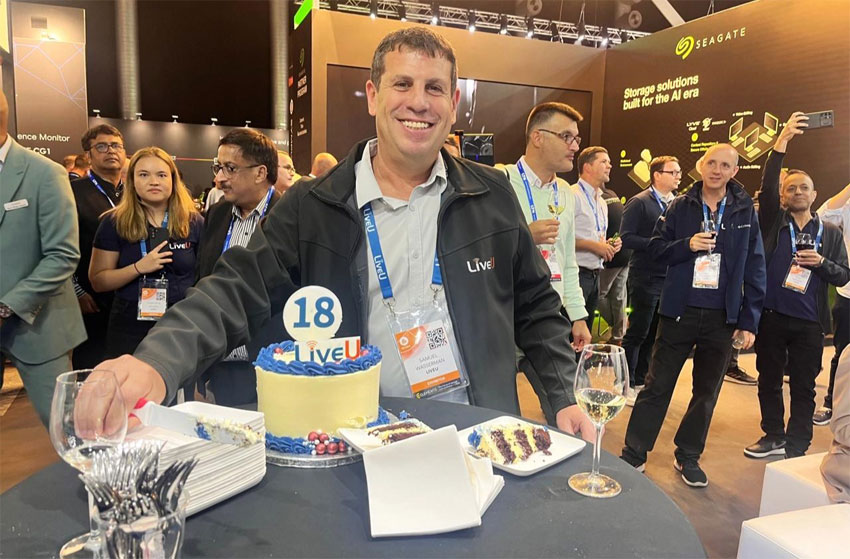
The anniversary celebration in 2024 provided a less abstract measure of longevity: a cake with an 18 on top. At IBC, Wasserman stood among colleagues and guests, smiling over the table. Chief marketing officer Steve Wind-Mozley led the occasion, giving customers and partners their share of the credit before handing the proceedings to the co-founder.
The gathering coincided with the introduction of LiveU IQ. The birthday party and the product launch made suitable companions. Eighteen years into the business, the company was still addressing the uneven quality of the networks available to a crew in the field.
LiveU IQ introduced dynamic switching between mobile network operators, using eSIMs, performance data and algorithms to choose connections as conditions changed. The practical promise was to move beyond a fixed, preselected group of cellular operators. Wasserman described switching network configurations while a transmission was live and on air. There is little room for a ceremonial pause when the presenter is already speaking.
In May 2025, LiveU completed its acquisition of Actus Digital’s business and technology. Monitoring, compliance logging and AI-assisted content tools joined the wider offering, with Actus continuing as an independent sister brand. Wasserman outlined a role for its products both on their own and alongside LiveU’s existing services. His original concern with moving the picture had expanded into checking and managing what happened to it.
The people at the other end
Wasserman’s public reflections also make room for occasions without a product specification. After attending the White House Correspondents’ Association Dinner in 2023, he thanked Associated Press executives Daisy Veerasingham and Gianluca D’Aniello for inviting him. Recognition from broadcasting executives prompted him to look back on the company’s beginnings in the United States.
He returned to the people who had done the work: employees past and present, customers, partners and colleagues. At another company occasion, LiveU welcomed employees’ parents to its Kfar Saba offices. Wasserman described the gathering as one of the moving moments of his career. His own parents attended too. A technology company had arranged a demonstration for the people who had watched its people grow up.
These are revealing choices of milestones. There are the Games, the transactions and the award. There is also a room full of parents, being shown what their children have helped make.
The missed football match remains a fitting beginning. Its participants slipped from memory; the wish to see it endured. Wasserman’s career has followed that wish into newsrooms, sports grounds, cloud systems and a succession of cellular networks. Somewhere, a crew has a picture to send. His company still has work to do before the rest of us can watch.