A dashboard can make a business look wonderfully composed. The numbers line up. The colors behave. Somewhere outside the frame, a person is still trying to work out what happens next. Sam Rangaswamy’s public discussions repeatedly return to what that person can do. The founder and CEO of ZeOmega came to enterprise software through airline technology, web ventures and business processes. His recurring subject is the distance between seeing something and being able to act on it.
In a 2014 interview, he was already questioning the usefulness of attractive dashboards when organizations lacked a practical way to respond to the information on them. It is an unusually unglamorous complaint for a technology entrepreneur. A screen photographs well. A redesigned process requires explanations, agreements and someone willing to ask why three departments are entering the same information. The second problem is where his argument becomes interesting.
Rangaswamy founded ZeOmega in 2001. By 2013, the company had attracted a $21.5 million growth investment. By October 2019, it had about 500 employees. Those dates offer the outline of a business story. Inside it sits a more particular professional story: an engineer learning that a useful system has to accommodate the organizations, vocabularies and people surrounding it. The software may be the product. Making it usable is the continuing assignment.
An apprenticeship in moving parts
His education joined two disciplines: a bachelor’s degree in industrial engineering from Manipal Institute of Technology and a master’s in computer science from North Carolina State University. One concerns the organization of work; the other supplies tools for expressing instructions precisely. Together, they make a useful way to read the career that followed. Processes and programs would both appear in his work.
Before ZeOmega, Rangaswamy worked on web solutions at American Airlines and the Sabre Group. His professional biography names Air New Zealand, Swiss Air, Carlson Travel and Travelocity among the businesses associated with that work. He also developed business-process and content-management solutions for Gartner. These were assignments involving established organizations with existing ways of operating. A new web interface had to meet an old business somewhere.
Travel is a suggestive apprenticeship for an enterprise-software founder. The customer experiences a booking as a single transaction, while the organizations behind it must exchange information and honor responsibilities. That observation helps explain the appeal of Rangaswamy’s later argument about connected workflows. It also gives his résumé a thread beyond its collection of company names: again and again, he worked where a digital interaction had to produce an operational result.
A technical paper in the background
One detail in Rangaswamy’s biography reaches beyond the usual executive résumé: a paper on the design of a fuzzy constraint-based controller for a dynamic control system. His biography records its acceptance at an IEEE fuzzy-systems conference in Yokohama, Japan. The title is technical enough to discourage casual conversation at dinner. It also records a professional interest in turning complex behavior into a system that can be described and controlled.
His earlier web-hosting and e-commerce ventures add another dimension to that technical background. Before ZeOmega’s later scale, he had experience with the commercial work of running online businesses as well as the engineering work of building them. The combination belongs in the story because enterprise software demands both. Code has to execute. A customer has to see a reason to buy it. An organization then has to keep delivering what was promised. Each requirement creates work for the others.
A founding, a financing, an operating footprint. Separate milestones, measured in different ways.
The year the calendar becomes useful
The founding date matters because it puts scale in perspective. ZeOmega began in 2001; the $21.5 million financing arrived twelve years later. The round was led by Bregal Sagemount, with participation from existing investors BlueCross BlueShield Venture Partners and Sandbox Industries. Phil Yates, a founding partner at Sagemount, joined the board. The announced use of the money was infrastructure and personnel.
Infrastructure and personnel are wonderfully resistant to a glamorous headline. They mean room to run the software and people to deliver it. For a founder, they also mean that the next stage of the company depends on work distributed well beyond the original builders. A financing announcement marks a transaction. Its stated purpose gives a glimpse of the operating demands behind the transaction.
By 2019, the Dallas Business Journal was describing a company with about 500 employees. Today, ZeOmega’s own company page lists more than 600. These are snapshots taken at different times, rather than a smooth annual growth curve. They still convey the change in the founder’s surroundings. A business begun in 2001 had become an organization whose coordination problems included its own staff, customers and leadership team.
Selling the next step
Rangaswamy’s comments about sales are revealing because he treats language as part of the work. In the 2014 interview, he described the challenge of addressing different markets with different vocabularies. He also talked about explaining capabilities customers might need in the future. A founder selling enterprise software has to describe a destination clearly enough that a buyer can recognize a reason to start moving.
There is a delicate balance in that task. Sell only the immediate feature and the larger architecture becomes invisible. Talk only about the eventual platform and the customer may reasonably ask what can be used on Monday. Rangaswamy described customers potentially starting with a small piece and expanding toward a broader workflow. That is a commercial argument, certainly, but it is also an argument about sequence.
His warning about disconnected systems follows the same logic. Purchasing several tools can create fresh inefficiency when the tools do not work together. Every purchase can look sensible in isolation. The combined result still needs scrutiny. In Rangaswamy’s telling, integration belongs in the original business conversation, alongside the capabilities printed on the product sheet. Otherwise the organization discovers the joins after it has paid for the parts.
What do we know?↓Responsibility
Who picks it up?↓Action
What happens next?
An editorial illustration of the workflow argument that runs through Rangaswamy’s public discussions.
A colleague supplies the human detail
A different view of Rangaswamy appears in a public message from Sadananda “Sada” Babu Rai, ZeOmega’s co-founder and president. Announcing his Executive MBA from the University of Texas at Dallas in 2022, Rai thanked his professors, family and friends. He also singled out Rangaswamy for “mentoring and supporting me throughout my journey.” It is a small piece of evidence, and a personal one.
The distinction matters. A corporate biography can enumerate positions and degrees. A colleague’s graduation message records a particular act of support, attached to a particular undertaking. Rai described two years of learning and his intention to apply it. Rangaswamy appears in that account as someone who helped another executive through the process. The relationship has a dimension beyond the titles on the company’s leadership page.
Rai’s own role includes overseeing ZeOmega’s day-to-day operations. His account therefore places that support within a working partnership between senior leaders. It would be too much to turn one message into a complete theory of management. It is enough to observe what he chose to acknowledge in public: while developing his own capabilities, he had a mentor in the founder beside him. The thank-you gives the business timeline a human scale.
“Technology is an enabler, as in any human situation.”Sam Rangaswamy · 2014
The office escapes the spreadsheet
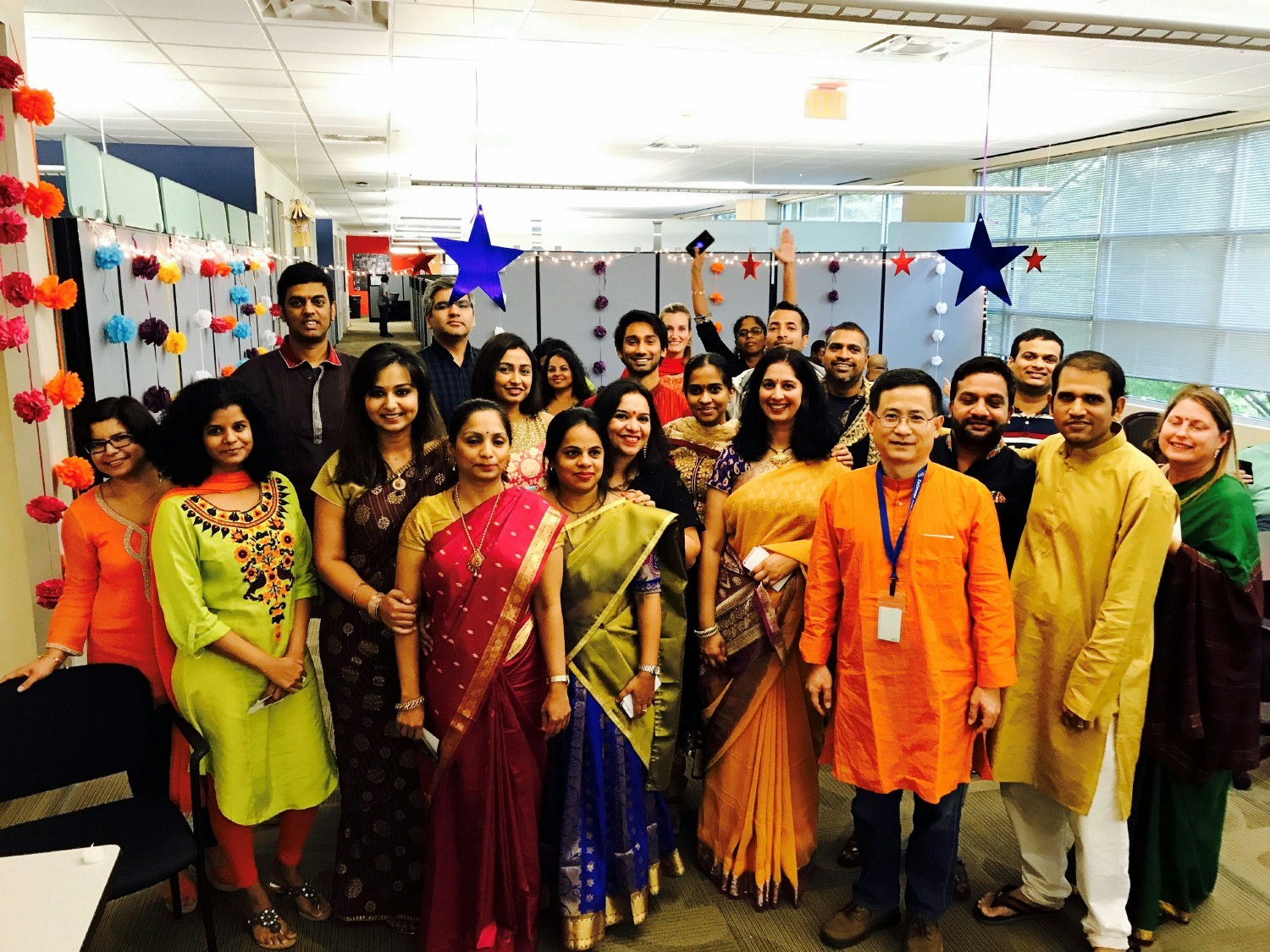
A published photograph of ZeOmega employees celebrating Diwali provides another useful change of scale. There are decorations above the office partitions, bright clothes and a group gathered for the camera. The photograph belongs to a workplace, with all the ordinary furniture that entails. Festivity has temporarily improved the color scheme.
It is a photograph of the team around the business, rather than an illustration of a founder’s private life. That makes it a fitting interruption in a story about systems. An organization appears on a chart as boxes and reporting lines. A group photograph supplies faces. Both representations are accurate in different ways; only one tells you that someone had to find a place to hang the stars.
The company’s India careers material also mentions tuition reimbursement, continuing education and learning sessions. Those published offerings give some institutional context to Rai’s account of further study. They are concrete commitments a prospective employee can examine. For the reader of a founder’s story, they add a useful question to the familiar measures of company size: what opportunities does the organization create for the people already inside it?
Twenty-five years, and still an operating question
In 2026, the calendar puts ZeOmega twenty-five years beyond its founding. Its official leadership page continues to identify Rangaswamy as founder and CEO, with Rai as co-founder and president. A quarter-century is a substantial span for a software business. It also resists the neatness of the launch story, in which a good idea arrives, a product ships and the important part is assumed to be finished.
Rangaswamy’s public discussions suggest a more ongoing assignment. In a 2023 podcast conversation, he discussed automation in terms of helping limited human resources become more productive. He distinguished measurable savings from less tangible improvements in stakeholder satisfaction. Both are tests of what happens after a system is installed. They also require the founder to keep looking beyond the demonstration screen.
There is something appealingly practical about that standard. A buyer can admire a feature and still need help changing a process. An executive can receive a report and still need a colleague with the authority to act. Rangaswamy’s career offers a reason to take those details seriously. The question at the end of the demonstration is the question that starts the working day: who picks this up, and what can they do with it?