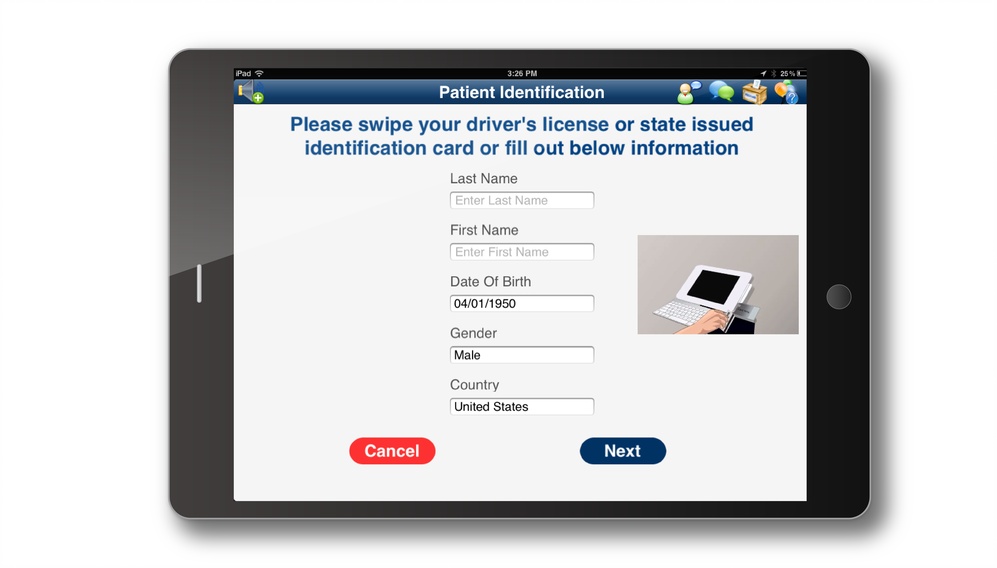
In an Ontario emergency department, a patient checks in at a kiosk. The machine takes over a little work that used to belong to a person. A time study published by The Shams Group puts the combined staff process at nine minutes without the kiosk and seven with it. There is a catch: the patient’s own process rises from nine minutes to nine minutes, 38 seconds. Two clocks. Two different answers to the question, “Is this faster?”
- TSG combines hospital software with implementation and consulting.
- Its specialty is the work around EHRs: intake, archives, outages, and automation.
- The useful buying question: whose work gets easier?
The Shams Group occupies the space between a hospital’s technology and the people expected to use it. Founded in 1989 by Kamruddin Shams, the company builds software and provides services for electronic health records, or EHRs. Its proposition is practical: improve the systems hospitals already depend on, preserve their history, and help the surrounding work move.
01 / Two clocks, one kiosk
The Ontario project started with preregistration and electronic triage, leaving full registration for a later phase. The comparison used small samples, with different counts across activities. It measures process work, rather than the entire emergency visit. Treat it as a local observation, with a useful lesson: staff capacity and patient convenience deserve separate scorecards. A purchasing decision gets better when those outcomes stay distinct.
02 / The expensive afterlife of software
A hospital can replace an application and still need the records inside it. That leaves an awkward arrangement: old servers, licenses, and maintenance kept alive for occasional lookups. The original system becomes a very expensive filing cabinet. TSG’s Legacy Data Viewer addresses that dependency by separating access to historical information from the application that first collected it.
The viewer brings clinical, administrative, and financial history into a common access point. Search, permissions, retention controls, and audit trails belong to the proposition. Hospitals can choose hosted software or an installation on their own infrastructure. This is a different purchase from a new clinical record system: the job is to keep yesterday’s information usable while allowing yesterday’s application to retire.
A Colorado health system’s Epic transition makes the distinction concrete. In an August 2026 spotlight, TSG describes mapping and normalizing data, integrating images, and providing facility-specific access through one legacy viewer. Historical information stayed within the organization’s warehouse environment, with contextual access from Epic. The assignment extended beyond moving files: it included making the surviving records usable across facilities.
& mapOld systems
& retainShared archive
& viewAuthorized teams
A conceptual workflow. The records outlive the application.
03 / When the main screen goes dark
Historical access answers one question. Downtime asks another: what can people see when their working EHR becomes unavailable? TSG’s Downtime Viewer is designed for planned and unexpected interruptions, giving multiple departments access to patient information through configured, role-based views. Physicians, nurses, medical-records teams, and business-office staff can have different needs during the same outage.
Its intake offering extends the idea. TSG describes keeping registration available during an EHR interruption and synchronizing information when the system returns. The broader product family includes arrival-time kiosks and a contactless portal for forms, demographic updates, signatures, and payments before arrival. Both require integration with the hospital’s workflows; the screen is only the visible end of that work.
For a buyer, the sensible test is an actual downtime exercise. Can authorized staff reach the viewer if the usual workstation, connection, or authentication service is unavailable? How current is the accessible information? These are deployment questions. A continuity plan has to account for the particular components that might fail together.
“Healthcare organizations should not have to replace everything to improve performance.”The Shams Group, on its approach
04 / Follow the repeated click
Another part of TSG’s business begins with the small irritations between systems. Its ezBrowser groups healthcare and business applications into a working environment with configured tabs, scripting, alerts, and bots. The company describes automation of defined steps, with staff handling review and exceptions. That is a concrete division of labor for a product whose name might otherwise suggest an ordinary web browser.
Consider error reporting. TSG says ezBrowser can capture a screenshot and route the problem to a help desk. Other features include navigation sequences, missing-data checks, and screen-specific guidance. These capabilities target repeated administrative friction. Their value depends on the frequency of the task, the reliability of the rules, and the effort required when the expected sequence changes.
The same operational instinct reaches the warehouse. In a June 2026 Louisiana case study, TSG describes connecting advance shipment notices with receiving systems. Scanning a shipment identifier could trigger purchase-order matching, receiving, labeling, and inventory updates. The vendor reports less manual processing. The interesting detail is the handoff: supplier information becomes useful before employees must reconstruct it at the loading dock.
05 / The people around the software
TSG sells into hospitals, health systems, clinics, and rural providers. Its public client roster includes Aspen Valley Hospital, Nova Scotia Health, Health PEI, and Willis Knighton Health. MEDITECH’s own vendor directory identifies TSG’s implementation work at Willis Knighton. In May 2026, TSG announced it had joined the MEDITECH Alliance, adding a formal consulting relationship to its established expertise.
The commercial model combines enterprise software with implementation, integration, training, and support. Consulting covers EHR selection through optimization after go-live. Depending on the assignment, a hospital might compare TSG with its EHR vendor’s services, a specialist archive provider, or another implementation firm. TSG’s distinguishing position is the combination of those services with its own tools for the work surrounding the EHR.
The cost question therefore starts with scope: which applications can retire, which interfaces must be built, and how much staff work changes? A buyer can copy the Ontario study’s most useful habit by timing each participant separately. Start with one handoff. Check the exceptions. Keep the patient’s experience on its own scorecard. Two saved minutes become meaningful when everyone agrees whose minutes they are.