The queue contained 778,983 pages. At a Minnesota hospital network, an OnBase Brainware upgrade had helped create a document-indexing backlog. Staff were short; money was tight. In 314e’s account, five people helped clear it, and the engagement produced nearly $775,000 in annual cost reduction. The interesting part is how: learn the local process, train a team, automate queues and check the work. A modern hospital, it turns out, can still be held up by the filing.
- 314e sells the work around the EHR: implementation, training, archiving, integration and support.
- Its software grew out of consulting: recurring customer problems became products.
- The buyer’s question is practical: which task gets easier, and who will maintain the result?
There is a pleasingly awkward contrast here. Healthcare technology offers ambitious language about intelligence and transformation. Hospitals also need somebody to attach the right document to the right patient. 314e lives comfortably with both propositions. Its business puts AI tools beside data conversion, training and the patient administration work that seldom earns a glamorous product launch.
The company says it serves more than 250 enterprise customers. Its market includes providers, payers and life sciences organizations, with academic medical centers and government institutions among the groups on its customer list. These organizations have different budgets and responsibilities. They share an appetite for software that can survive contact with an existing operation.
01 The upgrade that became an opening
Founder Abhishek Begerhotta’s route into the business began before 314e. A February 2026 company interview recap describes his move from physics into consulting at IBM in 1996, including work on an ambulatory medical-record system for Kaiser Permanente. When Kaiser moved from IBM’s clinical system to Epic, he entered independent consulting focused on data conversion. The change in platforms supplied a problem worth building a company around.
A replacement system arrives with a future. The previous system leaves a past. Lab results, notes and scanned records still need interpretation, testing and a usable destination. That is fertile territory for a specialist: somebody who knows what a record means in its old database, and what it must become in the new one.

314e began in 2004 with data migration and EHR implementation services. In his 2025 KLAS spotlight interview, Begerhotta dates a strategic move toward product development to 2018. That sequence matters. Consulting lets a company encounter the same nuisance in several disguises; software offers a way to stop solving every instance from scratch.
The obvious trap is confusing repetition with universality. A workflow can recur without being identical. The useful opportunity is to standardize the repeatable portion while leaving room for the hospital’s particulars. Read 314e’s product range through that lens and the names begin to make sense.
02 Jeeves answers at the elbow
Take training. In a Texas health-system case, 314e describes an effort to move 144 onboarding courses toward e-learning. Geographic spread, inconsistent ways of performing tasks, and insufficient classroom space and trainers made the existing arrangement difficult to scale. Its approach retained access to instructors while adding interactive practice tied to the client’s EHR configuration.
The lesson travels further than healthcare. When a process becomes too large for its original teaching method, uploading a manual is a modest response. People need a way to practise the task and a way to retrieve the answer later. Onboarding and remembering are separate jobs.
Jeeves addresses the second job as well as the first. It provides short learning resources, tip sheets, search and an AI assistant, with support accessible inside Epic through single sign-on and SMART on FHIR. Training teams can also create and manage content. The underlying proposition is sensible: the moment someone asks how to do something is an unusually good moment to offer help.
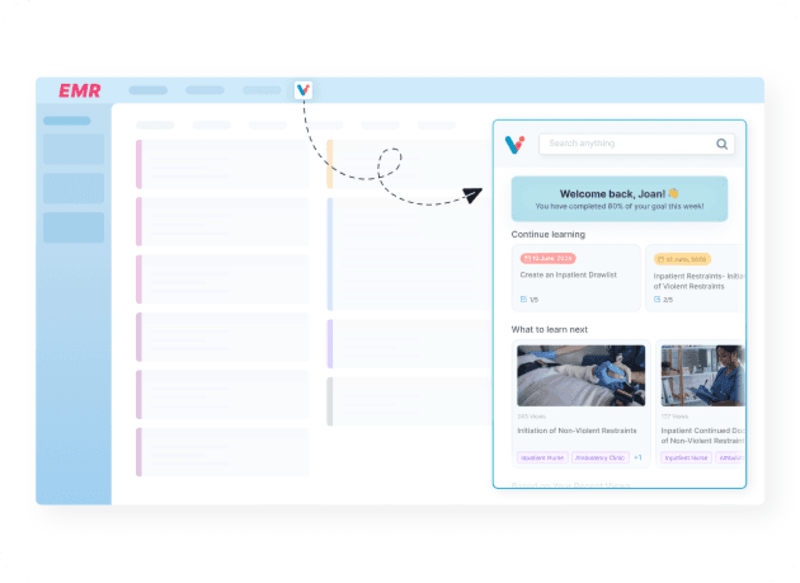
For a hospital evaluating Jeeves, an attractive demo is only the beginning. The useful test is whether the answer describes the hospital’s actual configuration, whether it is still current, and whether staff can find it during work. Those questions follow from the product’s purpose. A beautifully indexed answer to last year’s workflow is still last year’s answer.
03 The archive gets a day job
Muspell tackles the record that outlives its original software. 314e describes it as a cloud-based, FHIR-native archive and analytics platform. FHIR is a healthcare data standard; the practical point is that historical information should be organized for retrieval and use. The company advertises access to archived patient information from Epic, including patient-level single sign-on.
Archiving can be treated as an exercise in putting things away. Muspell’s pitch gives the archive continuing work: clinical access, release-of-information processes and analysis. A hospital considering it is asking two questions at once. Can we stop maintaining an old application? Can we preserve the information people still need from it?
Conceptual workflow, not a product architecture diagram.
The editorial lesson is to plan those destinations together. Leaving the archive conversation until the replacement EHR is nearly ready invites a second discussion about the same history. The technology decision becomes more useful when the clinical, records-management and implementation teams agree what access must look like.
“Start early enough… you just cannot accelerate it.”
Abhishek Begerhotta / February 2026 interview recap
04 A fax, a format, a front desk
Dexit operates closer to the incoming paperwork. It combines cloud faxing with AI-assisted document processing: classification, extracting information, identifying patients and routing work. The attraction is easy to understand. A document may already be digital and still demand a person’s attention at every step. Knowing what the document is, and where it belongs, is the expensive part.
That puts the earlier indexing case in perspective. Its reported savings describe a service engagement. They should not be read as a guaranteed Dexit return. What the example does show is the value of process knowledge. Automation has somewhere useful to go once a team understands the queue and its rules.
ZSegment addresses another kind of sorting: information crossing between systems. The cloud integration engine supports formats including HL7, FHIR, X12 and CCD. 314e advertises more than 100 prebuilt components. For an interface team, the commercial promise is less repeated construction and maintenance work. The interfaces still need to express the organization’s actual requirements.
Veritable moves the proposition to the front desk and billing office. It supports real-time and batch eligibility checks and claim-status checks, with more than 1,000 payers advertised. A practice can upload a patient list rather than work through individual payer portals. Practifly, meanwhile, extends the portfolio into practice websites and digital marketing. The breadth reflects several entry points into healthcare administration.
05 Two kinds of purchase, one patient business
Veritable’s advertised starting subscription, checked September 2026. Hospital platforms and services have separate commercial arrangements.
314e earns money through software and services. The Jeeves KLAS spotlight describes enterprise pricing informed by organizational needs, users or providers, and usage. Consulting, managed services and staff augmentation offer other ways to buy its expertise. That mix matters because customers can need a tool, a delivery team, or help keeping an existing system useful.
A hospital can hire 314e for Epic work, interfaces, analytics or training without buying every product. A medical practice can start with an eligibility subscription. These are distinct purchasing decisions. Evaluating them as one enormous technology transformation would make both harder to judge.
The competitive position is similarly specific. KLAS’s Jeeves spotlight names uPerform and the status quo as alternatives. An existing content library and established training habits can be formidable competition. Across the wider business, the alternative may be an incumbent tool or an internal team doing the job already. 314e needs to demonstrate an improvement in that job.
06 Precision, with pizza
The company’s name combines pi and the mathematical constant e. Its description of Pi Day festivities includes pizza and pie. Mathematical seriousness has its consolations. The mission is more sober: help healthcare organizations improve care and efficiency, with a vision that includes costs, population health, patient experience and staff well-being.

Its careers site describes shared roadmaps, written proposals, decisions made close to the work and meeting-free focus days. These are the employer’s account of its culture. They are also relevant ambitions for a business whose products depend on listening closely to unusually complicated customers.
There is outside evidence to weigh alongside the company’s claims. NCQA’s current directory lists 314e as a Certified Data Partner in its Data Aggregator Validation program, with a PSD 4.0 focus. The distinction is specific: NCQA separates partner capabilities from validation of particular data streams. Buyers should keep that scope attached to the credential.
The portable idea in 314e’s story is to start with a stubborn, observable task. Define the work, make the help accessible, assign ownership and check the result. This approach needs maintained content, trustworthy data and people who can resolve exceptions. Buying software cannot settle those responsibilities by itself. But a hospital that settles them gives the software a useful chance - and gives its staff a little less unfinished business.