In May 2017, Sam McCandlish walked into a room at Stanford to defend a thesis with a wonderfully cinematic title: Depth Perception in Holography. The subject was theoretical physics. The central puzzle, stated loosely, concerned how a world with depth might be understood through information written on a boundary. Seven years later, McCandlish was sitting at a round table with six fellow founders of Anthropic, discussing another collection of hidden machinery: giant neural networks, the patterns that appear when they grow, and the rules an institution might use to keep pace with them.
The distance between those rooms is shorter than it looks. McCandlish has made a career of searching for regularity inside systems that initially appear forbiddingly opaque. First came quantum gravity, holography and tomography. Then came optimization, language models and the economics of compute. The tools changed. The habit survived: measure carefully enough and a dark interior may begin to disclose its shape.
He is now Anthropic's co-founder and Chief Architect, responsible for large-scale model training. The official description is compact: he leads pretraining, research productivity and reinforcement-learning infrastructure. Behind that list sits a central tension in contemporary AI. The systems require industrial machinery to build, scientific taste to understand and institutional discipline to govern. McCandlish's career touches all three.
A physicist changes instruments
McCandlish studied mathematics and physics at Brandeis, then spent 2012 to 2017 at Stanford. His adviser was Eva Silverstein, and his doctoral work sat in the rarefied territory of quantum gravity. A postdoctoral period at Boston University followed. By 2018 he had joined OpenAI, where the abstractions became noisier in a literal sense.
Training a neural network means repeatedly estimating which way to adjust its parameters. Those estimates come from batches of data, and they contain statistical noise. A larger batch can produce a cleaner estimate and distribute work across more hardware, but only up to a point. Beyond that point, adding examples brings diminishing returns. McCandlish, Jared Kaplan, Dario Amodei and the OpenAI Dota team proposed a practical quantity called the gradient noise scale. Measure it, they found, and you could predict the largest useful batch size across settings that ranged from image recognition and language modeling to Atari and Dota.
This was the first important clue in his AI career: training did not have to remain a cabinet of artisanal tricks. Parts of it could be turned into a science of quantities and curves. The result was useful engineering, but it also carried a forecast. As tasks became more complex, the useful batch size tended to grow. More parallel computation could be put to work.
The curve that ate the laboratory
In January 2020, McCandlish and nine colleagues published Scaling Laws for Neural Language Models. They studied how performance changed with model size, dataset size and training compute. Across more than seven orders of magnitude, loss followed power laws. Within a broad range, details such as network width and depth mattered less than scale itself. A fixed compute budget could be allocated rationally: use a very large model, train it on a comparatively modest amount of data and stop well before traditional convergence.
The paper's graphs gave laboratories something close to a map. Researchers could run smaller experiments, fit a trend and estimate the returns from a much larger run before spending the full budget. The map did not promise that every desirable ability would arrive on schedule. It did show that a central measure of model performance was less capricious than many assumed.
Five months later came GPT-3. McCandlish was among the authors of Language Models are Few-Shot Learners, the paper describing a 175-billion-parameter model that could perform many tasks from instructions and examples in its prompt, without a task-specific training run. Scaling had left the graph and acquired a voice. The public conversation about AI began to tilt.
“There is always some level of arbitrariness in drawing boundaries, but we wanted to roughly reflect different tiers of risk.”Sam McCandlish on Anthropic's first Responsible Scaling Policy, 2023
One irony deserves attention. Anthropic's founders have said that the scaling work at OpenAI was carried out within a safety team. Forecasting mattered because arguments about future AI were easy to dismiss when they floated free of measurements. A curve could make the argument concrete. Better prediction strengthened the case for preparing, even as it made larger systems easier to plan.
From a forecast to a company
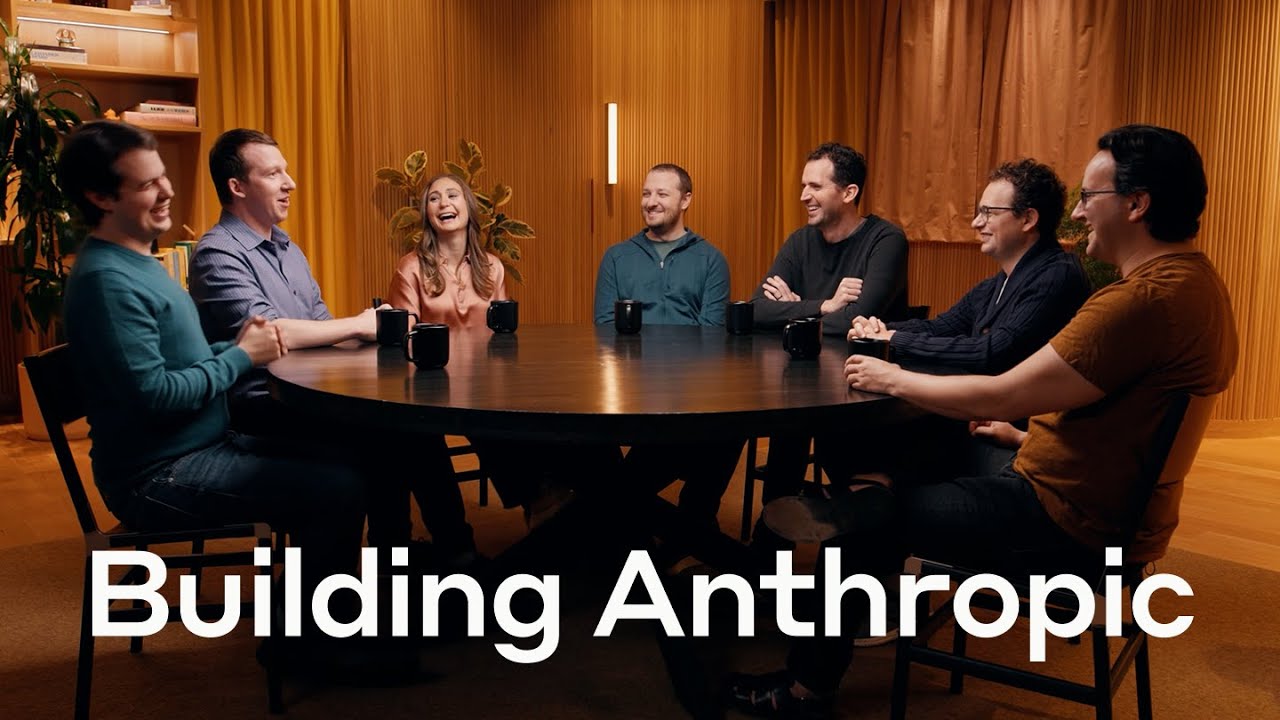
McCandlish left OpenAI with a group of long-time collaborators and co-founded Anthropic in 2021. The cast included Dario and Daniela Amodei, Jared Kaplan, Jack Clark, Chris Olah and Tom Brown. Their recorded conversation from 2024 makes the origin feel less like startup folklore than a knot of shared work, friendship and reluctant pragmatism. Several had moved through physics. Several had helped build the systems whose trajectory now concerned them. Their trust predated the cap table.
At Anthropic, McCandlish became Chief Technology Officer. His name appeared across research on reinforcement learning from human feedback, model calibration, scalable oversight, red teaming and Constitutional AI. The last of these asks a model to critique and revise its own responses according to a written set of principles, then uses AI-generated feedback during training. It is an attempt to make values more explicit and supervision more scalable, though no constitution can spare its authors the trouble of choosing principles.
The work also moved beyond papers. McCandlish helped develop Anthropic's first Responsible Scaling Policy and served as its Responsible Scaling Officer during the initial implementation. The policy borrowed the logic of biosafety levels: as a model approaches specified capabilities, stronger evaluations, security measures and deployment safeguards should apply.
In public, he described the limitations without varnish. Boundaries contain arbitrariness. Evaluations can miss things. A company that both releases a model and judges its safety has an incentive to make the exam too easy. He acknowledged in 2023 that no evaluation could provide total confidence that every risk had been caught. It is not the language of certainty. It is the language of a scientist trying to design around uncertainty before uncertainty becomes an excuse.
The architect returns to the engine room
In October 2025, Anthropic hired Rahul Patil as CTO. McCandlish moved into the newly emphasized role of Chief Architect. Corporate title changes often hide a polite retreat into vagueness. This one came with unusually specific nouns. He would continue to lead pretraining, while adding research productivity and reinforcement-learning infrastructure.
The move placed him closer to the part of the work that has defined his public record: the machinery by which large models learn. Pretraining supplies broad capabilities from vast datasets. Reinforcement learning shapes behavior after that initial education. Research productivity determines how quickly a laboratory can run, interpret and act on experiments. Taken together, the remit covers the factory, the finishing school and the scientific method used to improve both.
It also completes a neat loop. Holography asks how structure in one place can encode a world of another dimension. AI architecture asks how oceans of computation can condense into a model that writes, reasons and sometimes surprises its builders. The resemblance should not be stretched into mysticism; equations do not transfer by metaphor. The working temperament does. McCandlish looks for measurements that reduce surprise without pretending to abolish it.
His public footprint is modest for a founder whose research sits under so much of the industry. There are papers, a handful of policy comments, an X account, a sparse GitHub profile and the long co-founder conversation. The reticence leaves the work to provide the portrait. It shows someone drawn to tractable quantities but willing to enter problems where the quantities are disputed, the institutions unfinished and the incentives impolite.
The responsibility inside the ruler
Scaling laws are sometimes treated as a hymn to inevitability: feed in more resources, receive more intelligence. Their deeper lesson is conditional. Curves describe what happened under specified choices about data, compute and optimization. People still choose the budgets, the objectives, the release conditions and the safeguards. A forecast can support acceleration. It can also tell you when preparation is overdue.
McCandlish now occupies the narrow bridge between those uses. He helps Anthropic build larger systems while arguing that frontier developers need policies capable of constraining themselves. The arrangement invites skepticism, including his own warning about companies grading their own exams. Yet his answer has been to make the criteria more explicit, the conflicts more visible and the policy revisable.
The old thesis title supplies a fitting caption for the career. Depth perception is the effort to recover a larger world from limited evidence. In physics, the boundary carried clues about the bulk. In machine learning, small runs carried clues about giant ones. In governance, today's models carry clues about the systems that may follow. McCandlish's wager is that careful measurement can buy enough foresight to act. The equations make the future less blurry. They do not decide what deserves to be built.