The accounting firm has found another client. Everyone ought to be pleased. Then somebody has to collect the documents, reconcile the accounts, prepare the return and answer the questions. Sabyasachi Mazumdar, known professionally as Sam, has built a business around what happens after the congratulations. For the co-founder and CEO of CLOUDIT Automation & Accounting Services, growth becomes interesting at precisely the moment it becomes inconvenient.
His subject is capacity: how much work a firm can accept, who will actually complete it, and whether the owner can follow its progress without becoming a full-time detective. There is little romance in a missing receipt. There is, however, a business in making sure an experienced accountant does not spend the afternoon looking for it.
Mazumdar approaches that problem as an accounting professional who has moved into entrepreneurship. He argues for automation and international teams, while repeatedly defending the judgment of the people doing the work. The combination explains both his company and the questions he keeps bringing to the profession.
A friendship with an operations department
Mazumdar co-founded CLOUDIT in 2018 with his friend Ashish Jindal, who also goes by Andrew. Their division of responsibilities gives the partnership a practical shape: Sam concentrates on direction and growth; Andrew, the chief operating officer, concentrates on the machinery of delivery. The friendship predates the company. Its commercial expression is a business connecting accounting needs in North America with finance professionals in India and the United States.
Before CLOUDIT, Mazumdar worked across accounting and finance operations. His career includes IBM, Intuit's QuickBooks Online initiative, Thompson Dunavant, Erinaceous Group in the United Kingdom, and LP North America. He has a bachelor's degree in accounting, an MBA in finance and a chartered accountancy background. That is a route through the work he now asks clients to reorganize.
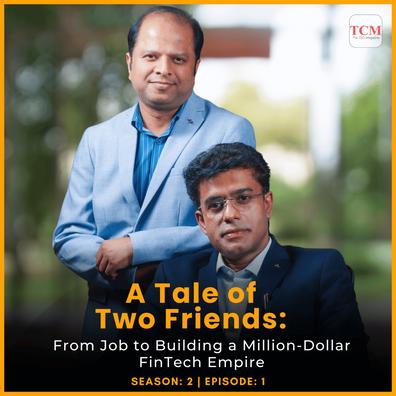
In January 2025, he appeared on a business podcast whose title foregrounded the two friends. It is a useful way into the story. A business selling operational support needs its own working partnership. The person bringing in the next engagement and the person making the existing engagements function have to agree about what the company can deliver.
The client who never got a callback
One of Mazumdar's more revealing observations concerns work that never arrives. Discussing a conversation with CPA Mubarak Shah, he describes firms passing up suitable clients because their partners cannot absorb another engagement. The opportunity disappears before it becomes a number anyone is obliged to explain.
That makes capacity a peculiar management problem. A lost invoice can be pursued. An inquiry left unanswered may simply vanish. A firm can appear busy and respectable while quietly limiting its own future. The calendar is full; the possibilities outside it remain uncounted.
Mazumdar's interest lies in that gap between being occupied and being able to grow. If a partner spends more time preparing and chasing than reviewing and advising, another client adds to an already tangled schedule. Bringing in business and making room for business become separate jobs.
His argument asks firm owners to examine the work beneath the revenue. Where does a document wait? Who notices an exception? Who is responsible for moving a task along? These are modest questions with awkward consequences. They can reveal that the person most qualified to advise the client is also the person reminding the client, for the third time, to send an attachment.
“Nobody puts ‘declined growth’ on a dashboard.”
Sam Mazumdar
January's hire, summer's arithmetic
Tax season gives Mazumdar another way to describe the same problem. In his account, firms recruit when the incoming work becomes urgent. The extra salary feels manageable while demand is high. Later, the rush eases and the expense remains. A decision made for the busiest stretch has become the structure for the whole year.
He also points to consequences beyond salary: owners still trapped in preparation work, confusing responsibilities, hurried recruitment and technology projects deferred while everyone handles the immediate queue. His diagnosis is that capacity deserves to be designed as an operating system for the firm, with staffing and automation arranged around the actual rhythm of demand.
There is an ordinary distinction here between having more hands and knowing what those hands should do. An extra employee can help. So can removing a needless handoff, collecting information earlier or defining the reviewer's role before the deadline arrives. Mazumdar's commercial proposition combines those choices rather than treating recruitment as the only available lever.
For an owner, that changes the question from how many people can be hired this month to how work will move through the practice next month. It also makes responsibility harder to evade. A process has to function when the founder is occupied elsewhere.
- CollectDocuments arrive
- PrepareAI makes a first pass
- ResolveProfessionals review
- ApproveJudgment stays human
The dashboard still needs an accountant
Mazumdar is enthusiastic about AI's usefulness in accounting. He names categorization, reconciliation and identifying patterns as work it can assist. He is equally insistent about the boundary around those capabilities. Clients need someone who understands what a number means for their particular business and can decide what to do next.
In one post, he challenges the idea that an inexpensive AI subscription can stand in for a finance professional. A clean dashboard may coexist with a poor pricing decision, an overlooked contract or a cash problem. His point concerns the distance between producing information and taking responsibility for interpreting it.
It is a distinction that also invites scrutiny of the language firms use. A bookkeeper, controller and CFO have different responsibilities. Treating all three as interchangeable would obscure the very expertise he wants owners to value. His broader case is strongest when the task and the required judgment are specified clearly.
CLOUDIT now describes its technology through Praxa, a practice platform, and Celia, its AI assistant. The stated arrangement puts automated preparation alongside professional review. For Mazumdar, the person remains central to delivery. The software's usefulness depends on what it allows that person to notice, decide and explain.
Four days until payroll
A client story Mazumdar has shared makes his idea of judgment more concrete. A business owner called an accountant with payroll approaching and insufficient cash. In his telling, she already knew the business's numbers. She advised delaying an equipment purchase, identified unpaid invoices and helped the owner pursue payment. Payroll was met.
The story belongs to his account of a client's work, rather than to an encounter he claims to have handled himself. Its appeal is easy to understand. The accountant's value came from knowing the situation before the phone rang and connecting the figures to decisions the owner could make immediately.
A reconciliation was part of the foundation. The memorable service was the conversation. An owner facing a Friday obligation is unlikely to cherish a chart quite as much as a practical sequence of actions.
This is where Mazumdar's operational argument becomes personal. If experienced accountants are occupied with routine preparation, they have less room for the call requiring context. His proposed benefit of reorganizing the back office is time for precisely that kind of attention. The client relationship is the reason for improving the process.
A growing office, a wider circle
The business has also created opportunities for colleagues to lead. At the close of 2024, chartered accountant Jasleen Daswal described taking responsibility for CLOUDIT's expansion into Chandigarh's Mohali area. Her account thanked Mazumdar and Jindal for their support. It supplies a concrete example of growth experienced by someone inside the team: a new office and a new responsibility.
Mazumdar also conducts interviews. An August 2025 CLOUDIT conversation featured Martin D. Eisenstein discussing their work together. Eisenstein's interests include business valuation, operating costs and eventual exits or financing. Asking a collaborator about those subjects puts the accounting work inside the longer life of a business.
The leadership circle includes specialists in tax, finance, mergers and acquisitions, and business development. The range matters to the premise of the company. A practice seeking help with preparation may eventually need a different kind of expertise. No founder can credibly supply every answer alone.
In September 2025, Mazumdar published an article about a thirty-day campaign meeting clients and mentors across the United States. Even its subject is consistent with the work: leave the internal conversation, meet the people using the service, and consider what they are trying to accomplish.
Room to think
There is another scene in Mazumdar's public account of his life: mountains, a horse and a few days away from meetings. He describes the break as a chance to reconsider the combination of people, processes and technology. Even out of the office, the operating model apparently comes along for the ride.
His stated ambition is to give accounting firms the technology and talent to devote more attention to clients. It is an aspiration best judged in ordinary moments: a task whose status is clear, a reviewer with time to review, a business owner receiving an informed answer.
The future Mazumdar describes is full of automation. The outcome he keeps returning to is recognizably human: someone has enough time, enough context and enough responsibility to pick up the phone.