Sam Karu has spent much of his life teaching machines to notice what other machines miss. At UCLA, he studied the tiny physical variations hidden inside radio signals - the imperfections that can identify a transmitter like a fingerprint. At NVIDIA, he worked on TensorRT, the machinery that helps trained AI models run quickly. Now, at Logical, his attention has moved one layer closer to the person at the keyboard: the email that implies a meeting, the meeting that produces a task, the spreadsheet that needs a formula, the draft waiting to be finished.
His wager is that the computer already has enough context to be more useful than it acts. The modern knowledge worker moves through a small archipelago of apps, ferrying facts between them by copy and paste. A chatbot waits offshore until someone assembles the cargo into a prompt. Karu thinks this arrangement is absurdly polite to the machine.
Logical, the San Francisco company he founded with Anushka Idamekorala, is meant to watch the flow of work across the desktop and offer the next useful action. It can suggest an email reply, detect a to-do, connect a calendar opening to a request, or carry information from one app into another. The person still chooses. The cleverness is supposed to arrive before the request for cleverness.
“A truly helpful AI agent must live where the user works: the desktop.”Sam Karu
01 · Before the promptThe engineer who dislikes unnecessary instructions
Karu's objection to prompt-first AI is practical, not ceremonial. Every elaborate instruction is an admission that context has fallen through a crack. You stop the task, open a new window, explain what you were doing, paste the raw material, inspect an answer, then carry it back. The model may be impressive while the ritual around it feels like filing paperwork for a very bright clerk.
His own description is blunter: “Prompt-first AI is a fundamentally flawed paradigm.” Logical's response is a small, repeatable loop. Observe what is happening. Form a useful suggestion. Let the user accept, alter or ignore it. This is not the theater of an autonomous agent ordering lunch and reorganizing a company before noon. Karu has called full automation too unreliable for the present and argued instead for the “AI-enhanced human.” The phrase is less cinematic and much easier to put to work.
apps + actions
next useful step
accept · edit · ignore
That preference for bounded assistance carries the accent of his earlier work. Wireless authorization asks a hard yes-or-no question under uncertain conditions: does this signal belong? Inference engineering asks how to preserve a model's useful behavior while making it run efficiently. Both reward proof, latency and restraint. A proactive assistant adds a social complication: it must interrupt at the right time. Intelligence delivered three seconds too late is an archive. Delivered constantly, it is a mosquito.
02 · KandyA friendship with a very long test period
The co-founder relationship began at age six, when Karu and Idamekorala entered Dharmaraja College in Kandy, Sri Lanka. They later finished first and second in the district's mathematics stream. Their paths separated without quite diverging: Karu went to the University of Peradeniya, Idamekorala to the University of Moratuwa, and both kept moving through engineering toward the United States.
Founder matching is usually discussed with the romance of a classified ad: technical person seeks commercial person, must enjoy ambiguity and alarming bank statements. Karu and Idamekorala had already watched each other solve problems for most of their lives. Their résumé as a pair was not a weekend hackathon. It was accumulated evidence.
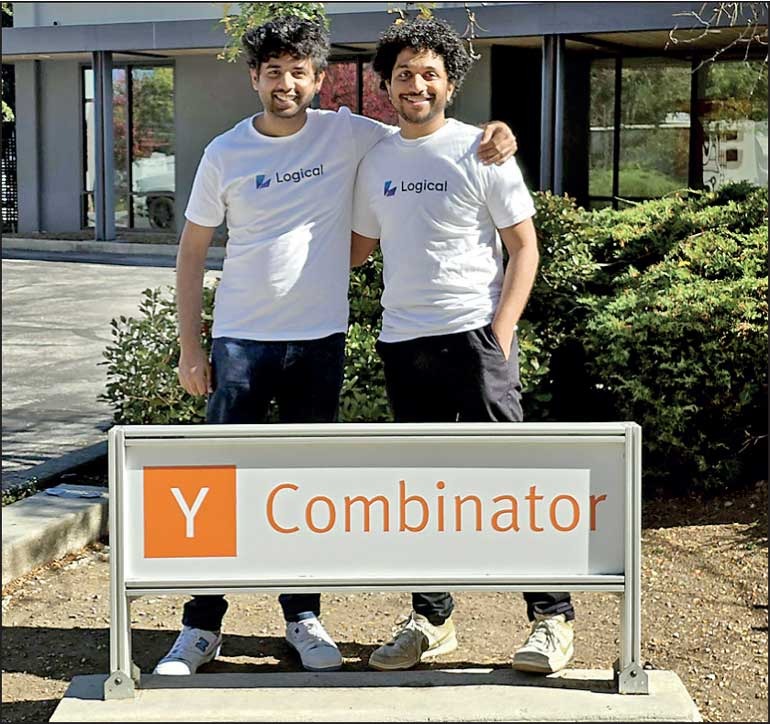
When Karu decided to leave NVIDIA, Idamekorala was the first person he called. Karu expected the pitch to be difficult: his friend was deep in doctoral research on context-aware forecasting. One call was enough. Idamekorala left the PhD path even before the pair entered Y Combinator.
Karu has written about arriving in the United States with “a couple of bags and a dream.” The phrase could drift into founder folklore if the preceding years were not so documented and specific: national exams, engineering faculties, fellowships, labs, papers, commits. Dreams are charming. Transcripts are stubborn.
03 · The long technical apprenticeshipSignals, fingerprints and faster inference
Before desktop copilots, Karu's public work was preoccupied with machines recognizing machines. At Peradeniya, where he earned the gold medal for the strongest performance in computer engineering, his research included AI-driven optimization for wireless networks. A Nokia Bell Labs internship in Belgium placed him inside industry research while he was still an undergraduate.
At UCLA's Cognitive Reconfigurable Embedded Systems Lab, he investigated RF fingerprinting: using variations created by radio hardware to identify a transmitter. The work is full of adversaries and changing conditions. A classifier trained on familiar devices must still reject an unfamiliar one. A system that works on Tuesday should not become gullible on Friday because the channel changed. Karu co-authored research on open-set recognition, generative augmentation, adversarial attacks and faster retraining through information-retrieval methods.
NVIDIA brought the work out of the lab and into the inference stack. Karu spent nearly four years around TensorRT, contributing to software used to optimize and execute deep-learning models. He has described the experience warmly: strong engineers, room to try things, permission to fail, managers who listened, and a front-row seat during NVIDIA's extraordinary rise. Leaving in the middle of an AI boom was therefore not an escape from a bad job. It was the more uncomfortable departure from a good one.
“There’s always been a burning fire inside me, a voice that’s been beckoning me to start my own company.”Sam Karu, on leaving NVIDIA
The ambition had been present for years. What changed was his distance from the user. Academic research produced insight. TensorRT made models faster in deployments around the world. Karu wanted to move closer still, to the moment a person feels technology save a minute or remove a chore. Logical is that last mile turned into a company.
04 · YC, one slideThe demo that nearly had no rehearsal
One early Logical demo at Y Combinator had the agreeable menace of student theater. Karu learned about the presentation that morning. He drove two hours to San Francisco, had office hours immediately beforehand, and presented software with some code written the previous night. The product was less than two months old.
The scenario was deliberately ordinary. An email asks to schedule a meeting and requests a fundraising update. Logical offers free times from the calendar. The user moves to a spreadsheet containing SAFEs, where the software recommends a formula. On returning to the email, a draft waits with both the fundraising summary and an open time slot. Accept. Tweak. Send.
The sequence is more revealing than a vocabulary cloud of agents, context and orchestration. Each handoff removes one piece of administrative glue. The apps remain. The human remains. The wandering between them gets shorter.
Demo Day was even more compressed: a one-minute pitch over a static slide, delivered live. Karu's account is unusually clear-eyed about the mechanism. The pitch supplies a small “nugget of excitement”; the consequential conversations happen after the founder steps away. His first investor conversation finished with a handshake deal within minutes. Other conversations began with the default answer set to no. A founder's job was to change it.
05 · One fewer operationA founder still doing the mathematics
In July 2026, Karu and Idamekorala published a result far from the daily concerns of calendar slots. Their paper gave a new realization for multiplying arbitrary 3×3 matrices using 23 scalar multiplications and 55 additions or subtractions. The prior construction required 56 additions. They provided the straight-line program and exact computational checks.
To a casual reader, one removed addition is a crumb. To an optimizer, the crumb is the meal. The result came from inspecting a known construction, shortening its linear circuits, and proving the count for that fixed orientation. It shows the founders' technical curiosity continuing alongside the startup, but it also makes a neat metaphor for their product taste.
Logical is built around operations that should not be necessary: the repeated explanation, the copied paragraph, the trip from inbox to calendar and back. A startup pitch naturally grows toward the grand future of computing. Product craft often moves in the opposite direction, subtracting one irritating step at a time.
Karu's career has changed its objects without losing that instinct. A radio system should distinguish the right device. An inference engine should execute the model efficiently. A desktop assistant should recognize the next useful action. In each case, context exists. The system's dignity depends on using it well.
Logical is young, and proactive software has a narrow ledge to walk. Too timid, and it becomes another icon awaiting instructions. Too eager, and it recreates Clippy's most memorable talent: appearing. Karu and Idamekorala have chosen the harder middle, where a suggestion must be timely, relevant and easy to refuse.
There is a pleasant modesty hidden inside that large ambition. The computer does not need to replace the person. It needs to notice the open spreadsheet, remember the email, and save the person from explaining the obvious. For someone who has already spent years finding identity in a noisy signal, the next problem looks almost familiar.