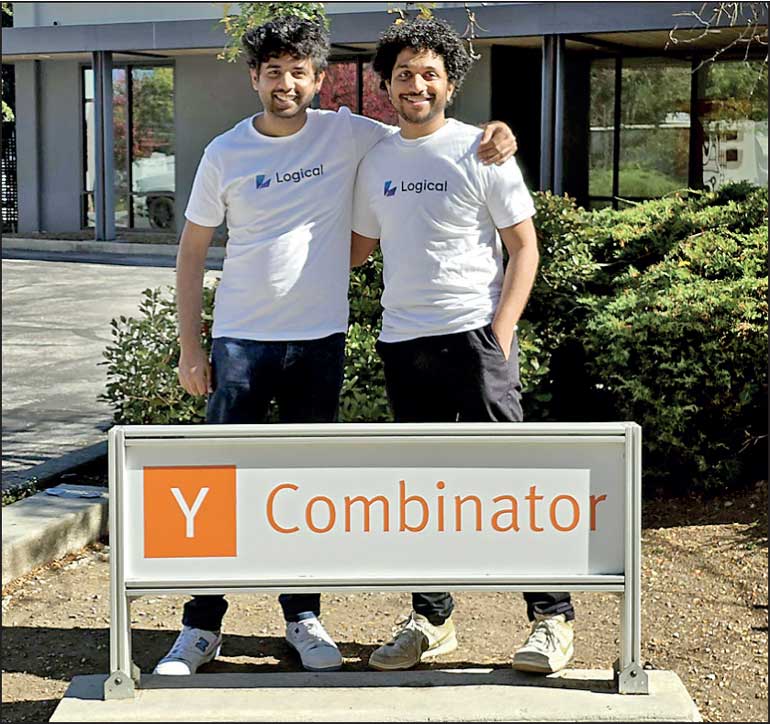
At six years old, Samurdhi Karunaratne met the person who would become his co-founder. The setting was Dharmaraja College in Kandy, Sri Lanka. The company came much later. In between were engineering degrees, physics medals, graduate laboratories, and jobs that took the two friends along separate routes. By the time Karunaratne and Anushka Idamekorala started Logical in San Francisco, their acquaintance had already survived a rather thorough probation period.
Logical makes a proactive desktop AI assistant. It is designed to follow what someone is doing across applications and suggest the next useful action. The ambition sounds simple until you consider how much judgment is packed into the word “useful.” An assistant must understand the task, arrive at an appropriate moment, and leave the person in charge. Knowing an answer is only part of the job.
Six years old, then two different routes
Karunaratne, who also uses the name Sam Karu, became Logical’s CEO; Idamekorala became its CTO. Both grew up in Sri Lanka and studied at state universities. Karunaratne attended the University of Peradeniya, while Idamekorala went to the University of Moratuwa. Their later graduate work took them to UCLA and the University of Virginia respectively. Logical joined Y Combinator’s Fall 2025 batch.
The friendship gives the company a personal beginning. The engineering histories give it a technical one. Idamekorala’s background includes leading B2B software engineering teams and researching context-aware time-series forecasting. Karunaratne brought wireless-AI research and experience optimizing inference at NVIDIA. Their launch account connects those backgrounds to a desktop assistant that can identify intent and offer help without sacrificing speed or quality.
The medal with a decimal attached
Before the startup, there was physics. Karunaratne won gold in Sri Lanka’s Physics Olympiad in 2013, then represented the country at the Asian Physics Olympiad in Singapore in 2014. He won silver there and another silver at that year’s International Physics Olympiad in Kazakhstan. The archived international results list him at rank 48.
His own recollection makes the second medal more interesting than an awards list. The theoretical part went well. The experimental part, he recalls, produced a score of roughly six out of twenty. He missed gold by 0.9 points. A small decimal acquired a large emotional footprint.
“I was in agony, but nevertheless happy about my overall effort.”Samurdhi Karunaratne, recalling the 2014 IPhO
The account allows disappointment and satisfaction to coexist. It also gives the result its proper scale: an international silver medal, earned by a student who could still see exactly where his performance had fallen short. He subsequently volunteered for a short period as an instructor in Sri Lanka’s Physics Olympiad training program. The contest became something he could help other students prepare for.
At Peradeniya, his competitive work moved into programming. He formed Team biteCode in 2015. The team won ACES Coders v6.0 and the Sri Lankan section of IEEEXtreme 10.0 in 2016. His undergraduate record includes First Class Honors, a 4.00 GPA, and the IFS Gold Medal for best performance in computer engineering. The medals changed subjects; the appetite for difficult problems had several places to go.
Teaching a network to recognize a stranger
During research work at Nokia Bell Labs in Antwerp, Karunaratne worked under Haris Gacanin on wireless-network optimization. His publications from that period examined machine learning in wireless mesh networks and AI-driven channel and location optimization. These are practical questions about how a network behaves, where its components sit, and how its configuration might improve.
He moved to Los Angeles for graduate school at UCLA in 2019 and worked in Danijela Cabric’s Cognitive Reconfigurable Embedded Systems Lab. He completed an M.S. in electrical and computer engineering, leaving the PhD path before joining NVIDIA. His research there asked how AI could distinguish authorized radio transmitters from devices it had never encountered.
A closed-set classifier chooses among identities it already knows. That creates an awkward situation when an unfamiliar transmitter arrives: the list of possible answers may itself be inadequate. Karunaratne, Samer Hanna, and Cabric studied open-set approaches that could accept known authorized devices and reject other signals as outliers. A guest should not get admitted merely because the doorman’s list lacks a category for strangers.
The experimental results also show why an AI system needs testing outside its most comfortable conditions. In one study using ten authorized and fifty known unauthorized WiFi transmitters, outlier-detection accuracy reached 98 percent on a same-day test set and 80 percent on a different-day set. Those figures belong to that research setup. The difference gives the work a concrete problem to explain.
Another collaboration produced WiSig, a publicly available dataset with ten million WiFi packets captured from 174 transmitters and 41 receivers over four captures spanning a month. Changing receivers or capture days could degrade a trained classifier’s performance. The dataset gave researchers material for evaluating that problem, including preprocessed subsets, scripts, and examples.
His research explored several ways around practical constraints. Generative outlier augmentation used synthesized unauthorized signals to enrich training data. A separate paper on changing authorized transmitter sets used information-retrieval techniques to avoid repeatedly retraining a model from scratch; the authors reported more than a hundredfold faster retraining while matching the comparison models’ accuracy. With Enes Krijestorac and Cabric, he also investigated how reinforcement learning could help an unauthorized transmitter fool an authenticator. Building a recognition system and testing its weaknesses were both part of the work.
A good job, and a reason to leave
Karunaratne joined NVIDIA in January 2022 to work on TensorRT, its deep-learning inference optimizer. His roles progressed from software engineer to senior software engineer. His responsibilities included the custom-layer plugin framework, graph optimization and compilation, and open-source workflows. After research on what models could recognize, he was working on the machinery that helps models run.
He left in September 2025. His public explanation is striking for its warmth toward the job he was giving up. NVIDIA was his first full-time employer. He described supportive colleagues and opportunities to try ideas, fail, and have his voice heard. He thanked managers Rishi Thakkar and Mayank Kaushik for encouraging experimentation.
His reason for leaving was the persistent desire to own and build something he believed in. The account contains no invented villain. A supportive workplace and a wish to start a company can share the same paragraph. That makes the departure more personal: the decision had to stand on the strength of what he wanted to do next.
“I left NVIDIA to build this.”Sam Karu, on Logical
Logical was founded that September, accepted into YC in October, and admitted to NVIDIA’s Inception startup program in December, according to Karunaratne’s dated updates. Those three months give the transition a clear outline. An engineering career became a founding role, with a childhood friend on the other side of the new company.
The paperclip’s second interview
Logical’s launch description invokes Clippy, Microsoft’s old animated office assistant. The joke is useful because it acknowledges a familiar hazard: unsolicited help can become another interruption. A desktop assistant that appears without a prompt has to earn the attention it requests.
The product is designed to carry context across apps and offer actions such as email drafts, meeting notes, and automatically detected to-dos. Its launch materials describe support for Gmail, Slack, iMessage, and Apple Mail. Logical Lumos is presented as assistance for tasks such as suggesting spreadsheet formulas or explaining highlighted terms. These are the company’s stated capabilities, rather than evidence that every workflow has been solved.
Karunaratne’s explanation of the ambition puts emphasis on timing and restraint. He wants assistance during writing, thinking, meetings, and decisions, while preserving the user’s flow. That leaves a demanding product question: which moment deserves a suggestion? A system can produce an accurate answer and still make itself unwelcome by delivering it while someone is concentrating on something else.
The company also says user data is never sent to Logical’s servers. That is a specific architectural claim, and a meaningful part of its pitch. It should be read at that scope, alongside the product’s own documentation. The broader idea is that understanding a user’s work should come with deliberate choices about where that context goes.
A minute on stage, a line of verse
In his account of YC Demo Day, Karunaratne describes pitching live with one static slide for one minute. The conversations afterward mattered. He recalls the first investor he spoke to agreeing to a handshake deal within minutes, while other conversations began with a default refusal. He also says fundraising has never been his favorite part of being a founder. A short pitch does not imply a short working day.
The two founders kept a mathematical collaboration going as well. On July 28, 2026, they submitted an arXiv preprint giving a 55-addition realization of rank-23 multiplication for two three-by-three matrices. The paper claims an improvement over a 56-addition construction and supplies computational checks. It is a specific research claim, presented as a preprint, with verification material for others to inspect.
Beyond the technical work, Karunaratne keeps a poetry archive in English and Sinhala. He does not describe himself as a habitual poet. His travel page records eighteen destinations across four continents, from Singapore and Kazakhstan to Belgium and Canada. The poems and photographs give his personal website somewhere to wander after the publications end.
That is a fitting place to leave the portrait. A person who has spent years making systems identify, classify, and run efficiently is now building software that must choose its moment. Logical’s challenge is partly engineering and partly manners. The assistant has to follow the work closely enough to help, then exercise the rare courtesy of letting the work continue.