The test comes after the meeting. The advisor has gone, the presentation is closed, and someone on the sales team has to decide what happens next. Which prospect gets attention? Which campaign gets another week? Who understands the reasoning well enough to change it? For a business buying outside expertise, that ordinary moment deserves a place in the brief.
- Bring in experience to support an existing sales and marketing team.
- Work on revenue campaigns and the processes behind them.
- Teach the people who will continue the work.
Sales And Marketing Advisors makes that last point part of its proposition. The Atlanta consultancy describes training at intervals during an engagement, with client self-sufficiency as the aim. It is a modest sentence with substantial implications. If you take it seriously, the work has two audiences: the customer you want to win and the employee who must learn how to win the next one.
A useful place to put the teacher
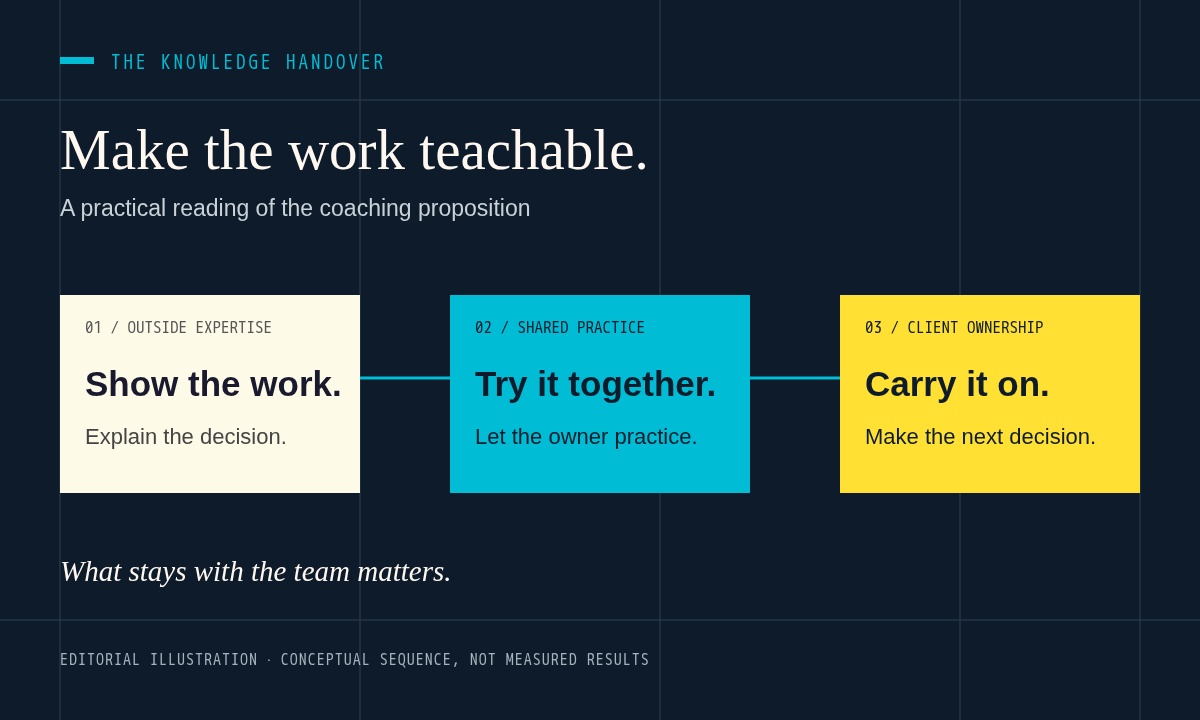
Consider a hypothetical campaign review. An outside specialist can recommend changing the message and send over the revised copy. Or the specialist can sit with the campaign owner, explain the evidence, and have that person make the change. The immediate output might look much the same. The second approach also gives the employee a decision to practice.
This is the practical appeal of putting instruction inside a live engagement. A question has consequences while the work is happening. Someone has to choose, act, and see what follows. Waiting until the final presentation to explain everything asks the client to reconstruct decisions after their context has faded. Training along the way offers a chance to catch misunderstandings early.
“coaches who supplement your resources”
How the company describes its role
The company positions its partners as support for established teams. Its description names three reasons those teams might need help: time, skill, and experience. That distinction is useful. An overloaded manager needs capacity. A newcomer needs instruction. A capable team facing unfamiliar territory needs judgment. A good buying conversation should establish which shortage is actually holding up the work.
The campaign, and the machinery underneath
The firm describes experience in building revenue campaigns, streamlining processes, and developing working methods. Those activities belong together. A campaign gives a team something to execute; the surrounding process determines whether people can execute it consistently. Looking at both invites a more specific conversation than simply asking for more sales.
For a prospective client, specificity might mean choosing one troublesome handoff. Imagine marketing passes an inquiry to sales, but neither side has agreed what makes it ready. A sensible brief would name the decision, assign its owner, and establish how the team will recognize improvement. This is an illustrative buying exercise, rather than a reported engagement. Its value is that everyone can point to the same piece of work.
The service is expertise delivered through consulting engagements. Buyers are engaging people to support a commercial function. That places the firm in the market for outside sales and marketing help, where the relevant comparison depends on the assignment: a campaign agency, a specialist advisor, or an experienced leader brought in for part of the week.
Experience with a working history
There is a concrete glimpse of technology marketing experience in Kelly Bevan’s public profile, which associates him with Sales And Marketing Advisors. A recommendation from Aleksander Szlam recalls work at Melita International on country-specific marketing, conferences, customer training, and product launches. Another, from Art Franks, describes introducing Mitel’s SX200 Digital in the United States.
These are recollections of earlier professional work, separate from results delivered by this consultancy. Their interest lies in the tasks themselves. Product launches require explanations customers can use. Country-specific programs require choices about audiences. Customer training requires someone to understand a product well enough to teach it. That is a more informative picture of experience than a long string of marketing vocabulary.
For someone considering the firm, the useful follow-up is to connect experience to the assignment. Who will do the work? Which earlier problem resembles yours? How will the person who owns the campaign participate? A relevant example and a clear working arrangement tell a buyer more than a broad promise of growth.
Put the learning in the brief
The firm’s coaching emphasis suggests a practical way to evaluate a proposal. Ask for two descriptions of success. One concerns the commercial work: the campaign, process, or decision being improved. The other concerns the client team: what its members should be able to do independently by the end. Both deserve an owner and a review date.
- What changes? Name the work and the evidence you will review.
- Who practices? Give someone inside the team responsibility.
- What stays? Specify the knowledge and routines the team should retain.
Budgeting should cover that participation too. Alongside the proposed consulting fee, a buyer should account for time spent preparing information, reviewing decisions, and practicing new routines. Those are real commitments even when they do not appear as a separate invoice. Comparing proposals on price alone leaves out part of the effort required to make coaching useful.
The approach also asks something of management. Someone needs room to learn and authority to continue. A team seeking complete delegation should examine whether a collaborative engagement fits its immediate needs. Teaching has little opportunity to stick if the designated owner never gets to make a decision. That is a condition of the model, rather than evidence of a failure at this firm.
The idea a reader can borrow is straightforward: make knowledge transfer a scheduled activity while decisions are still being made. Let the internal owner explain the next move and its reasoning. Then give that person a chance to act. For Sales And Marketing Advisors, self-sufficiency is part of the pitch. For the buyer, it can become a concrete acceptance test: the team knows what to do next.