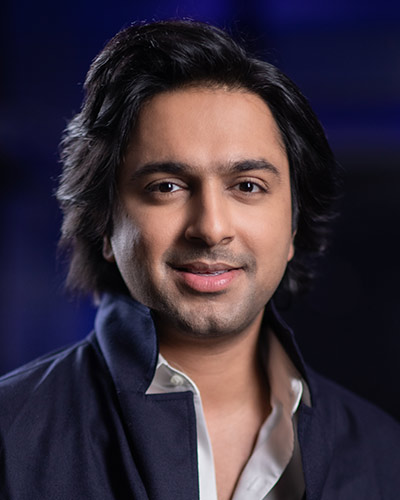
Profile
The CISO's Central Cockpit
Somewhere in the $200 billion cybersecurity market - a market crowded with point solutions, vendor sprawl, and dashboards that tell you what happened but not what to do about it - Saket Modi spotted something unusual. CISOs were drowning in data and starved of decisions. They had fifty tools and zero answers.
His response was Safe Security: not another security tool, but the intelligence layer that sits above all of them. One system. One risk score. One place where every exposure, every control gap, and every vendor relationship collapses into a number that a board can act on. Modi calls it the "central cockpit" for the modern CISO - a single pane of glass where cyber risk becomes an informed business decision.
// The cockpit analogy isn't accidental. Pilots don't manage engines individually. Neither should CISOs.
In 2025, Safe Security raised $70 million in Series C funding led by Avataar Ventures - with John Chambers, Sorenson Capital, Eight Roads, and Susquehanna Asia Venture Capital all leaning back in. Total funding crossed $200 million. Annual revenue sits at $72.5 million. The company's revenue has grown triple digits for three consecutive years. These are not the metrics of a startup finding its footing. They are the metrics of a category being won.
"This is a defining moment in our pursuit of CyberAGI. When we launched our platform in 2020, we carefully selected a market that would be the foundation of cyber risk management."
- Saket Modi, on the Series C announcement
The Series C came with an announcement that would have sounded absurd in 2012: the world's first fully autonomous Continuous Threat Exposure Management (CTEM) solution. Fifty AI agents. Neural networks. Autonomous prioritization. Real-time remediation. Modi's term for the destination is CyberAGI - not general artificial intelligence, but cybersecurity-specific intelligence capable of contextual understanding, autonomous decision-making, and risk reduction without constant human intervention.
From Kolkata to Palo Alto
Origin Story
The Ethical Hacker Who Couldn't Wait to Graduate
Saket Modi was born in Kolkata in 1990, the son of a businessman who taught him early that commerce and creation are the same thing. He enrolled in the LNM Institute of Information Technology in Jaipur to study computer science in 2009 - and by the time his classmates were studying for finals, he was already charging IIT campuses across India for two-day workshops on ethical hacking.
Those workshops weren't an extracurricular. They were the prototype. He was running experiments on what it would take to build a business on top of a technical skill most of the country barely understood.
The founding bet
In 2012, while still in his final year of engineering, Modi co-founded Lucideus Tech with Vidit Baxi and Rahul Tyagi. The company was incubated at IIT Bombay. It started as a cybersecurity training firm and pivoted into services within twelve months.
Lucideus' early promise wasn't a product. It was an insight: cyber risk wasn't being measured. Companies were spending on security and had no way to know if it was working. No score. No benchmark. No board-level answer to the question "how exposed are we?" Lucideus moved to fill that void - and named its framework after the answer it was trying to provide: SAFE.
The government noticed. In 2014, Modi participated in a Ministry of Human Resource Development committee developing vocational cybersecurity courses under the National Skills Qualifications Framework. Two years later, when India's National Payments Corporation launched BHIM - the country's unified payments app, used by hundreds of millions of people - it was the 25-year-old Modi's team that led the security assessment.
// He assessed India's national payments infrastructure before most people his age had assessed a career choice.
That same year, he launched "Secure Digital India" - a personal campaign that trained over 10,000 students across 50+ colleges in 30+ cities in parallel with the government's Digital India initiative. It was part civic project, part lead generation, and entirely on-brand for a founder who would later describe his rule for building relationships: "Start by giving, don't start by asking."
The Turning Point
When John Chambers Called
John Chambers ran Cisco for twenty years. He turned a $70 million company into a $500 billion one. When he writes checks into cybersecurity startups, people pay attention.
In 2018, Chambers led an investment into Lucideus. His reasoning was characteristically blunt: most security tools gave you data. Lucideus gave you a risk score - the thing a CEO or board actually needed to make a decision. "The CEO would probably struggle," Chambers said. "And that's what Modi got, that others didn't." It wasn't a compliment about technical depth. It was a recognition that Modi understood the buyer differently than almost everyone else in the market.
"Start by giving, don't start by asking."
- Saket Modi's philosophy for building relationships and advisors
The Chambers-backed Lucideus was named "Top Innovation of the Year" by Forbes and "Emerging Cybersecurity Vendor of the Year" by Frost & Sullivan the same year. In 2021, Lucideus became Safe Security - rebranding around its flagship platform - and raised a $33M Series A led by British Telecom and Chambers. The renaming wasn't cosmetic. It signaled a shift from services to product, from project to platform.
The acceleration continued. In 2023, Safe Security acquired RiskLens - the company built around the FAIR (Factor Analysis of Information Risk) model, the dominant standard for cyber risk quantification - and raised $50M in Series B funding from Sorenson Capital. FAIR gave Safe Security a standards-based foundation under its proprietary risk engine. It also gave it credibility with financial services, insurance, and regulated enterprises who needed defensible numbers, not opinions.
The Funding Journey
Capital Raised
Building the Stack
Total funding: $200M+ | Lead investors include Avataar Ventures, Sorenson Capital, British Telecom, John Chambers
2025 Moves
Acquiring Balbix. Building CyberAGI.
Safe Security's most consequential move in 2025 wasn't the Series C. It was what came after: the acquisition of Balbix, a Gartner-recognized Visionary in Exposure Assessment Platforms and one of the few companies that had mapped asset vulnerabilities to business impact with real technical depth.
The logic was surgical. Safe Security started from the risk side - quantifying cyber risk in financial terms. Balbix started from the exposure side - cataloging every asset, every vulnerability, every attack surface. Together, they can answer the question that no single vendor had answered before: given what's exposed right now, what is the actual business impact, and what should we fix first?
Balbix founder Gaurav Banga joined Safe Security as President of CTEM. It was the kind of integration that signals a real merger of roadmaps, not a bolt-on acquisition.
The CyberAGI Thesis
Modi's goal isn't to build a better dashboard. It's to build a system that can perceive threats, reason about risk, plan remediation, and act - without waiting for a human to click "approve." Fifty AI agents. Real-time. Autonomous. That's CyberAGI.
The timing matters. In 2024, Safe Security launched its Third-Party Risk Management (TPRM) product with Agentic AI. Within months, 50% of existing customers adopted it. That adoption rate - in enterprise SaaS, where procurement is slow and switching costs are high - suggests the platform isn't just winning new customers. It's becoming load-bearing infrastructure for the ones it already has.
At RSAC 2026, Safe Security reported its most successful conference ever: triple the conversations and post-conference follow-ups compared to 2025. In cybersecurity, where the conference circuit is as much a market signal as a sales channel, that number tracks with a company whose moment has arrived.
Leadership Philosophy
First Principles, Talent Density, and 16.5-Hour Days
Modi describes himself as a geek and a nerd - someone obsessed with understanding how systems work from the ground up. That's not a personal brand. It's the source code for everything at Safe Security.
His framework for product-market fit is brutally simple: "If you told your customers tomorrow that I'm switching off the product, would your customers beg you to not be able to do that?" That's it. Not NPS. Not retention curves. Not logo churn. Would they beg?
"If you told your customers tomorrow that I'm switching off the product, would your customers beg you to not be able to do that?"
- Saket Modi's test for true product-market fit
His view on teams is equally unambiguous. He grew revenue 6x in two years while the headcount moved from 200 to 190. Not a typo. He cut headcount while multiplying revenue. The principle is talent density - fewer people doing more, better, faster. "We're obsessed with talent density," he says. The culture follows the math: if you want a team of ten who outperform a team of fifty, you have to build differently.
He leads by example in the most literal sense. "If I expect someone to work 16 hours a day, then I have to work 16 and a half hours at least." That's not a management philosophy. That's a commitment device. It makes demands on himself first, and uses those demands to set the team's floor.
// He grew up watching his father run a business. He internalized that owners don't clock out.
Recognition
The Lists, the Pitch, and the Prime Minister
🏅
40 Under 40
Fortune Magazine
🏆
30 Under 30
Forbes India
🎓
35 Under 35
Entrepreneur Magazine
🏉
Best IT Startup
National Entrepreneurship Awards 2016
🌍
National Startup Awards 2021
Govt. of India
🌟
Category Leader
Forrester Wave CRQ 2025
At the National Startup Awards 2021, Modi was felicitated by Shri Piyush Goyal, India's Minister of Commerce. What followed was unusual even by the standards of a startup award ceremony: a live pitch to Prime Minister Narendra Modi about Safe Security, broadcast on national television. The pitch wasn't scripted as a performance. It was a distillation of a decade's work.
He has addressed the boards of Citigroup, HSBC, and Visa on cybersecurity. He has spoken at Mobile World Congress, CeBIT, Forbes Under 30 Global Summit, and TED conferences. His subject doesn't change: cyber risk is a business problem, and the industry has been solving it like a technical one.
Quickfire
Five Things Worth Knowing
01
He was born on July 31 - the same date Safe Security closed its Series C in 2025. Exactly 35 years apart.
02
Indian media called him the "Indian Firewall" early in his career. He was 22.
03
He led the security assessment of India's BHIM payment app - used by hundreds of millions - at age 25.
04
He trained 10,000+ students in cybersecurity across 50+ colleges and 30+ cities in a single campaign in 2016.
05
Revenue grew 6x in two years while Safe Security's headcount shrank from 200 to 190. Talent density in practice.
Career Arc
Thirteen Years, Marked
2009
Enrolled at LNM Institute of Information Technology, Jaipur - Computer Science Engineering. Began conducting ethical hacking workshops at IIT campuses across India as a side business.
2012
Co-founded Lucideus Tech with Vidit Baxi and Rahul Tyagi, incubated at IIT Bombay, starting as a cybersecurity training company while still in final year of engineering.
2013
Expanded Lucideus into cybersecurity services. Began serving Fortune 500 companies globally with a focus on quantifying digital risk.
2014
Joined Government of India committee (Ministry of HRD) to develop vocational cybersecurity courses under NSQF.
2016
Led security assessment of BHIM app for National Payments Corporation of India. Won "Best IT Startup" at National Entrepreneurship Awards. Launched "Secure Digital India" campaign across 50+ colleges.
2018
Secured investment led by John Chambers. Named "Top Innovation of the Year" by Forbes and "Emerging Cybersecurity Vendor of the Year" by Frost & Sullivan.
2021
Rebranded Lucideus to Safe Security. Raised $33M Series A led by British Telecom and John Chambers. Pitched live to PM Modi at National Startup Awards on national television.
2023
Acquired RiskLens to establish leadership in cyber risk quantification. Raised $50M Series B from Sorenson Capital.
2024
Launched Third-Party Risk Management (TPRM) product with Agentic AI. 50% of existing customers adopted TPRM within months of launch.
2025
Named Category Leader in Forrester Wave for CRQ (Q2). Raised $70M Series C led by Avataar Ventures. Launched world's first autonomous CTEM. Acquired Balbix. Total funding exceeded $200M.