Breaking - Harmonic Security closes $17.5M Series A led by Next47 $24.5M raised in 18 months Two-time cyber founder, one repeated thesis RSA Innovation Sandbox finalist 2024 Bristol MEng. BAE alum. San Francisco operator. Digital Shadows acquired by ReliaQuest for $160M (2022) Breaking - Harmonic Security closes $17.5M Series A led by Next47 $24.5M raised in 18 months Two-time cyber founder, one repeated thesis RSA Innovation Sandbox finalist 2024 Bristol MEng. BAE alum. San Francisco operator. Digital Shadows acquired by ReliaQuest for $160M (2022)
YesPress No. 047 - Founder Files

Alastair
Paterson

The man with the calm Bristol accent who built a $160M cyber company at a kitchen table, then went and started another one - because watching people paste payroll into ChatGPT was apparently too much to leave alone.

Alastair Paterson
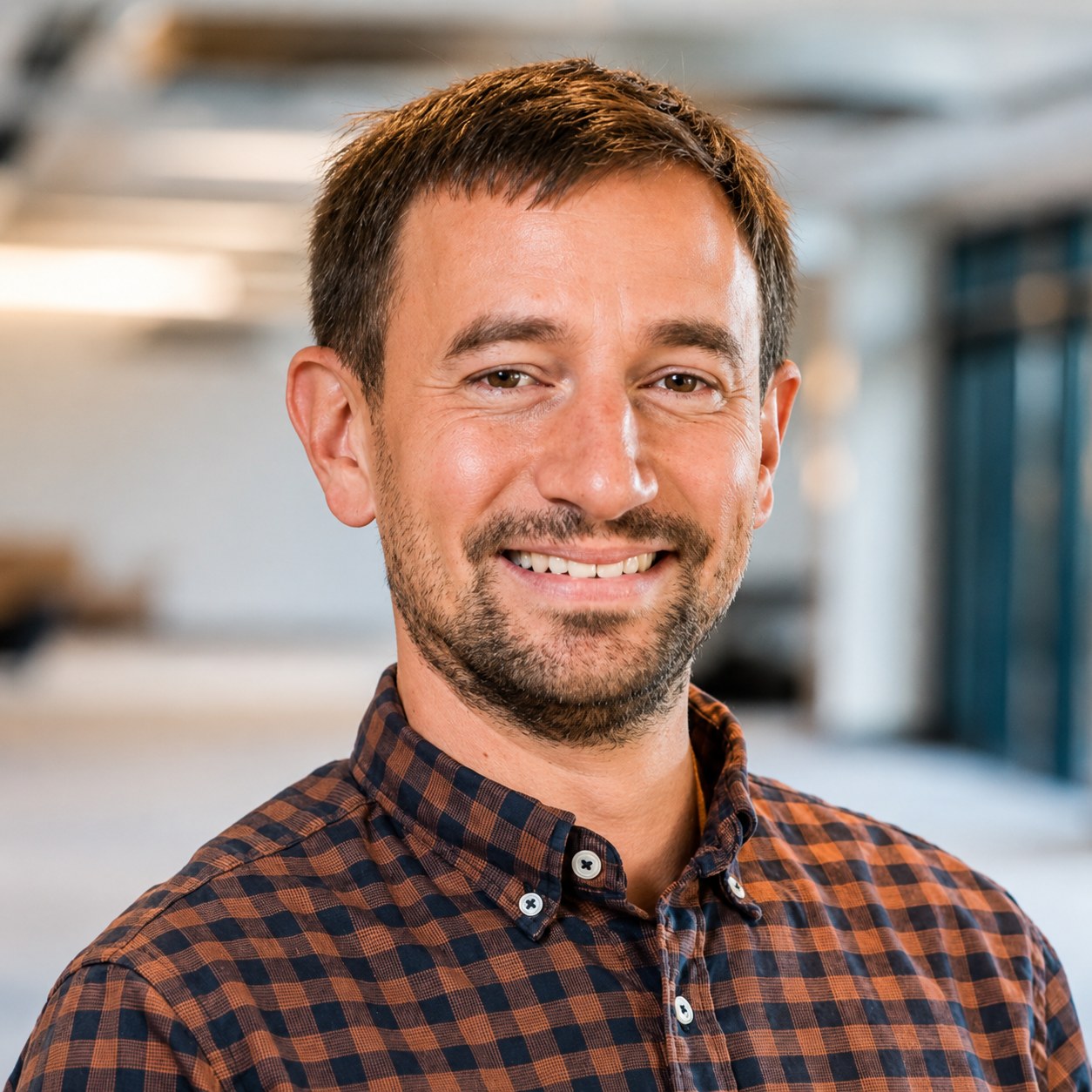
Photograph caption · in the Vincent Musi style

"Alastair Paterson, who learned at BAE Systems that you can map a threat in a spreadsheet but you cannot stop a human with a policy - and who, having sold one company that proved the point, now runs a second one designed to prove it again."

— YesPress, San Francisco
The Lede

Coach, not cop.

In a coworking room off Market Street in San Francisco, the CEO of a sixty-eight-person company is explaining, with the patience of someone who has had to explain it a hundred times, why the security industry has been losing for thirty years. The product on the wall behind him is a set of small language models. The thesis is older than the product. Humans will route around the rules. Block the front door and they will use a phone. Block the phone and they will email it to a personal account. The job, Alastair Paterson believes, is not to lock the door. The job is to stand in the hallway and say, gently, "are you sure you want to do that?"

This is Harmonic Security. It is his second cyber company. The first, Digital Shadows, started in 2011 at a London kitchen table when he was still in his twenties, bootstrapped for roughly four years, raised venture money, expanded into the United States, and sold to ReliaQuest under KKR in July 2022 for one hundred and sixty million dollars. Eleven years, one exit. He took eighteen months off, then went back to work.

Harmonic launched publicly in October 2023 with a seven million dollar seed led by Ten Eleven Ventures. By July 2024 the product was live. By October 2024 the company had closed a seventeen-and-a-half million dollar Series A led by Next47. The headline number on this profile - twenty-four-and-a-half million dollars in total funding - is the sound of a founder skipping the dating phase.

Why now, why again, why this. The honest answer is the boring one: every company Paterson has talked to in the last eighteen months has employees pasting customer data, legal contracts, and unreleased code into chatbots they were not asked to use. Shadow IT became shadow AI in roughly the time it took for ChatGPT to become a verb. Existing data-loss tools, built on regex and keyword lists, do not know the difference between a customer record and a coffee order. Harmonic is building models that do.

By the Numbers

A founder, measured.

$160M
Digital Shadows exit (2022)
$24.5M
Harmonic total raised
68
Harmonic employees
11
Years running Digital Shadows
2x
Cyber companies founded
1st
Class MEng, Bristol
The Story

An engineer goes looking for trouble.

Before there was a kitchen table in London, there was a desk at BAE Systems Detica. Paterson had finished a first-class MEng in computer science at the University of Bristol and gone, like a lot of bright British engineers in the late 2000s, into defence consulting. His title was International Propositions Manager. The translation: he sold big-data risk projects to FTSE 100 companies and the kind of government clients you do not list on a CV. He learned what threat intelligence actually looks like before threat intelligence had a market.

The Digital Shadows years

The co-founder was James Chappell. They had worked together at Detica and decided, in 2011, that the open internet had become a hostile place for any company that did not know what was being said about it on the parts of the network it did not own. Digital Shadows began as a service: humans reading forums and pastebins for clients who could not. It became a product, SearchLight, in 2014, after the first venture round. By 2015 Paterson had moved to the Bay Area to open the US office, and Financial News had named him one of the forty most influential people in European FinTech. Computer Weekly had called him a rising star two years earlier.

Bootstrapping for four years before raising matters to him. It still shapes how he runs companies. Harmonic's seed-to-Series-A path looks lavish on paper, but everyone who has worked with him will note the same thing: the headcount stayed deliberately small for the first product release, and the company shipped to revenue before scaling go-to-market.

The eighteen-month gap

After the ReliaQuest acquisition closed in July 2022, Paterson spent the next year doing what successful founders are not supposed to admit doing: he watched. He had a thesis forming. The thesis was that the same dynamic that produced shadow IT in 2010 - employees adopting tools faster than security teams could write policies for them - was now producing something worse. The tools were not Dropbox and Slack. The tools were models that ingested whatever you fed them and used it, sometimes, to train. He started talking to CISOs. The conversations were repetitive in a way that founders learn to recognise as a market.

Harmonic and the heretical idea

The product Bryan Woolgar-O'Neil and Paterson built together is not a chatbot blocker. It is a set of small, purpose-built language models that sit between an employee and any AI tool they choose to use, including unsanctioned ones. The models classify what is about to be shared - is this a customer record, a piece of legal language, a credential, a healthcare identifier - and if it is sensitive, the system interrupts with a nudge. Not a block. A nudge. "Are you sure? Here is a sanctioned way to do this." If the employee insists, the system can escalate. If they reconsider, no policy was triggered, no ticket was filed, no shame was issued.

The bet is that coaching scales. Paterson likes to point out that pure blocking does not catch everything and frustrates the people you are trying to protect, who then forward the document to a personal email account and the problem is now invisible. He has been making this argument since Digital Shadows. The audience has finally caught up.

The British operator in San Francisco

Paterson sits on the board of GBx, the network of British founders working out of the Bay Area, and is a member of Founders Pledge. He has mentored at CyLon, Europe's first cybersecurity accelerator. In a Computer Weekly interview he argued that British security chiefs are "too polite" for startups - that CISOs need to give sharper feedback to founders and founders need to take it. It was an unflattering thing to say about his own peer group. It was also correct, which is why the headline travelled.

What he is working on now

Harmonic's product is in active use by thousands of employees across customer companies. The company was an RSA Innovation Sandbox finalist in 2024. The team is roughly split between San Francisco and the United Kingdom, with engineering weighted toward London. Paterson talks publicly about three things: the gap between AI adoption and AI governance, the failure of legacy data-loss prevention, and the specific risks of healthcare-sensitive data ending up in chat windows. He is building, in other words, the same company he built the first time - identify a shadow risk, build the tool the existing vendors are too slow to build, sell it to security leaders who are tired of being the people who say no.
Timeline

Fifteen years, two companies.

Pre-2011

International Propositions Manager at BAE Systems Detica. Big-data risk projects for government and FTSE 100 clients.

2011

Co-founds Digital Shadows in London with James Chappell. Kitchen table. Twenties. No outside funding for the first stretch.

2013

Named a Computer Weekly UKtech50 Rising Star.

2014

Digital Shadows raises venture capital and launches SearchLight, its digital risk protection product.

2015

Moves to San Francisco to open the US office. Named to Financial News' 40 Most Influential in European FinTech.

2022

Digital Shadows acquired by ReliaQuest, backed by KKR, for $160M.

2023

Co-founds Harmonic Security with Bryan Woolgar-O'Neil. $7M seed led by Ten Eleven Ventures (October).

2024

Harmonic launches its data protection product in July. Closes $17.5M Series A led by Next47 in October. Named an RSA Innovation Sandbox finalist.

2025

Speaks at RSAC 2025. Appears on Daniel Miessler's Unsupervised Learning podcast. Engineering and go-to-market continue scaling across US and UK.

In His Own Words

Four sentences that explain the company.

"Policy alone isn't going to solve this. You have to focus on education and coaching, and then controls."

Expert Insights, Harmonic interview

"A pure blocking approach is probably not going to catch everything and may end up frustrating employees, leading them to use their own devices or forward things to themselves."

RSAC 2025 fireside

"We've been building our own language models specifically focused on data protection - accurate enough to sit in line with employees and nudge them towards a safe way of getting their job done."

Unsupervised Learning podcast

"We've spent billions of dollars and decades of effort and data protection doesn't work."

Public remarks, 2024
Infographic

Where the data goes.

The shadow-AI problem Harmonic is built for, in five rough strokes. Bars are illustrative, drawn from the industry conversations Paterson has been pointing at since 2023 - the kind of thing that should appear in a finished YesPress chart with a proper source citation, and that here serves as a visual map of the company's pitch.

Customer data
High
Source code
High
Legal & contracts
Med-High
HR / payroll
Medium
Credentials
Medium

"The frustrating part isn't that employees are reckless. It's that the tools we gave them for years assumed they would be." - paraphrased from Paterson's RSAC remarks.

Scrapbook

Fun, useful, slightly random.

Origin

Digital Shadows began at a kitchen table in London. Paterson was in his twenties. He has told the story in roughly that order, every time.

Patience

Bootstrapped Digital Shadows for about four years before raising a single round.

Repeat

Has now moved from the UK to the Bay Area twice - once for Digital Shadows, again for Harmonic.

Sharp

Publicly argued in Computer Weekly that British security chiefs are "too polite" for startups.

Community

Board member at GBx, member of Founders Pledge, former mentor at CyLon.

Handle

His X handle is his surname spelled out - @patersonae.

Share

Send this to a CISO.