BREAKING Benchling powers 200,000+ scientists across 900+ companies FOUNDED 2012, by two MIT undergrads who got tired of paper notebooks VALUATION ~$6.1B at last reported round QUOTE "Software may be eating the rest of the world, but it has failed science." STILL writing code on weekends, allegedly BREAKING Benchling powers 200,000+ scientists across 900+ companies FOUNDED 2012, by two MIT undergrads who got tired of paper notebooks VALUATION ~$6.1B at last reported round QUOTE "Software may be eating the rest of the world, but it has failed science." STILL writing code on weekends, allegedly
Profile - The Founder Files

Sajith
Wickramasekara

The undergraduate who watched a Cambridge biology lab run on paper, Excel, and crossed fingers - then left school to rebuild the software underneath it. Fourteen years later, his platform runs the data behind a meaningful slice of the world's drug discovery.

Co-Founder & CEO, Benchling San Francisco MIT EECS (leave of absence)
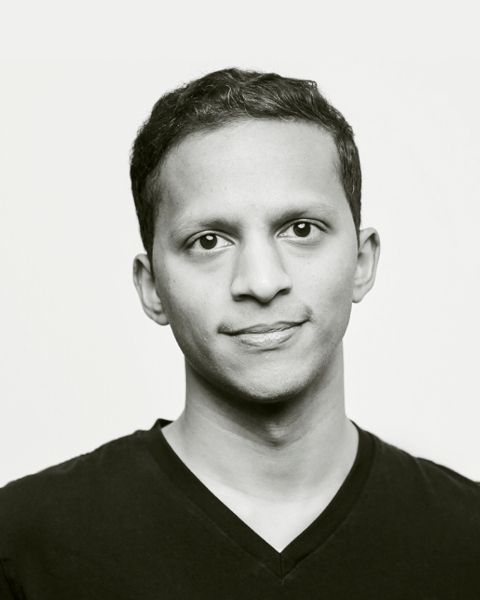
FILE 001 - sajithw Sajith Wickramasekara, co-founder and CEO of Benchling
The Story

A bench scientist's software problem.

Picture a 21-year-old MIT student moonlighting in a synthetic biology lab around 2011. The genomes are designed in the cloud. The instruments cost more than a house. The protocol that ties it all together lives on a coffee-stained printout in a three-ring binder. This was the disconnect that lodged in Sajith Wickramasekara's head and refused to leave.

He and his classmate Ashu Singhal sketched a fix in their dorm. A web-based DNA design tool, then a lab notebook, then a place for sample data, then a whole platform - the order matters less than the obstinacy. By 2012 he was on leave from MIT's electrical engineering and computer science program. The leave never ended. Benchling did.

Today the company he started in a dorm sells to twenty-something of the world's largest pharma companies, hundreds of biotechs, and thousands of academic labs. The R&D Cloud, as Benchling calls it, has become the Notion-meets-Salesforce of the bench: notebook, registry, inventory, workflows, and APIs that let internal tooling teams build on top. Some 200,000 scientists log in.

The interesting thing about Wickramasekara is what he didn't do. He didn't pivot to crypto in 2018, or to LLM wrappers in 2023. He didn't IPO at peak ZIRP. He didn't hand off the CEO seat after Series B. He has run Benchling, mostly quietly, for the entire fourteen-year arc - and the company has grown into a category-defining piece of biotech infrastructure while he gave roughly the median number of interviews per year for someone in his position.

That quietness reads, on closer inspection, as taste. He talks about curiosity as a hiring criterion. He talks about the moat of being the system of record. He doesn't talk about himself. The Sri Lankan-American kid from Raleigh who built the digital lab notebook biotech needed has, by all available evidence, stayed exactly that.
Benchling, by the numbers

200K+
Scientists on platform
900+
Companies served
$414M+
Total funding raised
~$6.1B
Last reported valuation
The Arc

From Raleigh to Folsom Street.

2007 - 2009
Research assistant at Duke University Medical Center, while still in high school at the NC School of Science and Mathematics.
2009
Stints at Liquidia Technologies, a nanotech / drug delivery spinout near Research Triangle.
2008 - 2012
Studies electrical engineering and computer science at MIT. Builds software in biology labs. Notices what isn't there.
2012
Takes a leave of absence and co-founds Benchling with Ashu Singhal. Y Combinator-adjacent vintage; cloud-native from day one.
2017
Series B led by Benchmark; Miles Grimshaw joins the cap table and later describes the founders as "a really hard and rare combination."
2021
Series F values Benchling around $6.1B. The R&D Cloud is officially a category.
2022 - 2025
Expands into AI workflows, deeper integrations with instruments, and platform extensibility. Stays CEO. Keeps shipping.
2026
Featured speaker, BIO International Convention. Still building the system of record for the lab.
By The Numbers

Where the capital came from.

Approximate funding trajectory (cumulative, $M)

Seed era~$1M
Series A~$15M
Series B (2017)~$50M
Series C/D~$200M
Series F (2021)~$400M+

Source: aggregated from public filings and press. Figures are cumulative and approximate.

Loose pages from the binder.

RALEIGH, NC

Grew up in Raleigh. Attended the North Carolina School of Science and Mathematics, the magnet boarding school that has produced an outsize share of American science founders.

THE CO-FOUNDER

Ashu Singhal, his MIT classmate, is President of Benchling and the other half of the original pair. Two engineers who could ship - and explain - what scientists actually needed.

THE THESIS, EXPANDED

Biology is increasingly an engineering discipline. Engineering disciplines run on systems of record. Benchling is the bet that the lab gets one too, eventually.

A long game, played slowly.

Most software founders who survive a decade have rotated through three personas by now - the founder, the operator, the public figure. Wickramasekara skipped the third one. He gave the a16z podcast a careful walk through the platform's evolution. He sat with TechCrunch's Equity to talk about why early customer moats are underrated. He told Lattice that hiring for curiosity beats hiring for credentials. Then he got off the stage.

What he optimizes for, by his own description, is the moat that comes from being the place the data lives. Once a pharma R&D org has a decade of experiments registered in Benchling, the cost of leaving isn't a migration project - it's an institutional memory project. He has been patient about earning that position one team, one customer, one workflow at a time.

The product surface has accordingly expanded outward from the original electronic lab notebook: registry, inventory, requests, workflows, an app platform, and now a layer of AI-assisted tooling. None of these were the loudest possible bets. All of them were the obvious ones, in order.

He hires the same way. Benchling's leadership page reads like a careful curation: ex-Stripe, ex-Salesforce, ex-AWS, with deep biotech veterans woven in. The implicit theory is that you cannot fake fluency in either software or science, so you hire both kinds of people and force them to talk.

Three Ideas He Keeps Returning To

What he actually says.

ON SCIENCE

Software has failed the lab.

His founding sentence, more or less. The whole consumer internet ran on web apps while a researcher kept gels in a binder and titrations in Excel. The gap was an invitation, not a complaint.

ON MOATS

Build a moat around your first customers.

The TechCrunch interview line. Early customers don't pay you because of features. They pay you because you understand their workflow better than they do. Defend that, then expand.

ON HIRING

Curiosity is a hiring criterion.

From an Instagram clip and several podcasts. The job changes so often that pedigree erodes. What survives is the person who wants to learn the next thing on their own.

A Short Diagnostic

Why the boring wins.

There is a version of this story where a charismatic founder rides the synthetic biology hype cycle, spins out a foundry, and posts dramatic Twitter charts. Wickramasekara declined that version. The Benchling pitch instead is unglamorous: be the source of truth, the API, the audit trail. Make the regulator's job easier. Make the scientist's morning faster.

The result is a SaaS company in a market that wasn't sure it wanted SaaS. Biopharma is famously cautious. Validation requirements are stringent. Procurement cycles are measured in quarters. Benchling won partly because it took validation seriously from the start, and partly because the founders were patient enough to learn what made enterprise pharma's IT teams say yes.

You can spot the pattern in the company's product cadence. Each year a few sober expansions - a new module, deeper instrument connectivity, more APIs, eventually an app marketplace - rather than a marquee reinvention. The cumulative effect is a platform that is hard to dislodge, because it is the place every other tool plugs into.

And so the founder. Slow speaker, careful writer, generous with credit to his co-founder. He is the rare CEO whose company is more famous than he is, on purpose. That is a strategy. It also reads like a personality.

Platform surface, in modules

Notebook2012
Molecular Biologyearly
Registrycore
Inventorycore
Workflows / Requestsadded
App Platform / APIadded
AI workflowsrecent
Out There

Where to find him.

Share this profile