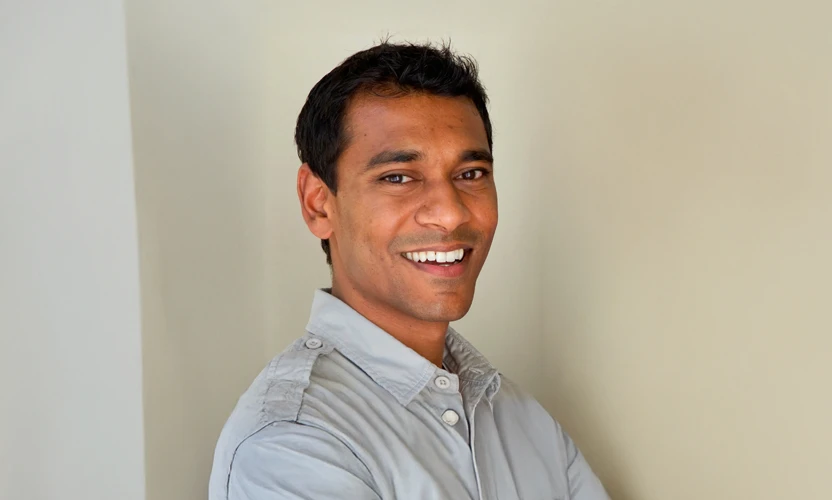
Mid-Stride
The meeting is at 9am Monday. No agenda. Five partners, equal economics, no hierarchy. It is, by design, one of the strangest partner meetings in venture capital. Nobody presents a deal memo. Nobody lobbies for votes. Benchmark's Monday ritual runs on trust accumulated over years - and Eric Vishria walked into it in July 2014 as the first new partner the firm had added in over six years.
He was 35. His last startup had been acqui-hired by Yahoo. He had never raised a fund. He was about to write his first check as a professional investor into a company called Confluent, backed by the creators of Apache Kafka, betting on a future where data streaming would be as fundamental as compute. Nobody believed the market was that big. He believed Jay Kreps when Kreps said it was.
When Confluent filed to go public in 2021, the market had caught up to the thesis.
The Real Education Happened During the Crash
Before venture, Vishria collected bruises most VCs only read about. He graduated Stanford - Mathematical and Computational Science - young, fast, and ambitious, then landed in the orbit of Ben Horowitz at Loudcloud in the late 1990s. Loudcloud was going to run the infrastructure of the internet. Then the internet imploded.
The company's market cap went from $4 billion to $40 million. Most people left. Vishria stayed. He watched Horowitz and Marc Andreessen make the hardest pivot in startup history - turning a cloud infrastructure business into a software company called Opsware, selling it to Hewlett-Packard in 2007 for $1.65 billion. By then, Vishria was VP of Marketing. He was 28.
Even the shittiest dinghy will fly in strong enough wind.
He absorbed something from those years that most investors learn from the outside looking in: the texture of near-death. The specifics of what it feels like when a company's entire narrative collapses and founders have to rebuild a story from whatever is left. When Vishria sits across a table from a founder now, he is not reading a pitch deck. He is reading a person under pressure.
He Built a Browser During a Financial Crisis
In October 2008 - literally as Lehman Brothers was collapsing - Vishria left HP's comfortable VP perch and co-founded RockMelt with Tim Howes, a fellow Opsware veteran who had also been at Netscape. The timing was, charitably, aggressive.
RockMelt was a social web browser that embedded your Facebook friend feed, real-time, into the browser chrome itself. Marc Andreessen backed it as an angel. Andreessen Horowitz, Accel, and Khosla Ventures piled in. When it launched in November 2010, the tech press treated it like a challenger to Chrome.
It never became the next browser. The pivot to personalized news aggregation kept the team alive but narrowed the exit. Yahoo acquired RockMelt in 2013 for somewhere between $60 and $70 million - primarily to acquire the talent. Vishria spent a few months as VP of Media Products, long enough to collect the exit experience, short enough to know he was done operating.
He Lost a Bet. He Paid With His Hair.
When Confluent CEO Jay Kreps handed Vishria an ambitious growth forecast in 2018, Vishria was skeptical. Too aggressive. He pushed back. They made a bet. Confluent "obliterated the plan." In February 2019, Kreps shaved Vishria's head - in public - and Vishria posted it on Twitter. His caption, essentially: technical founders often understand their business better than the people writing them checks. Not every investor posts their mistakes for 19,000 followers to see.
Benchmark: Equal Economics, No Hierarchy, One Rule
Benchmark is unusual in ways that never get fully captured in press coverage. Five partners. No junior investors making introductions. No Managing Partner with veto power. No fund of funds LP relationships that shape which deals get done. Each partner owns the same percentage. The Monday meeting has no agenda because the partnership runs on a specific kind of mutual trust - and when it breaks, partners leave.
Vishria joined this structure as the youngest and newest partner, inheriting a culture that had already produced Uber, Snapchat, Twitter, and Dropbox. He was expected to find the next tier himself, with his own thesis, his own relationships, no safety net of a scout network or a big platform team to pre-qualify deals.
His first major bet was Confluent. His second was Cerebras Systems, the AI chip company building the world's largest chip, which joined his board in 2016 when AI hardware was still a niche conversation. His portfolio also includes Benchling, the life sciences R&D platform; Contentful, the headless CMS; Amplitude, the product analytics platform that went public in 2021; and a growing roster of AI-native companies including Fireworks AI and Greptile.
How He Thinks
Vishria's investment frameworks are unusually honest about what investors actually control - which is not much. He does not believe in thesis-driven investing in the traditional sense: "Entrepreneurs have the thesis. It's our job to assess whether we believe the thesis or not." This sounds obvious. In practice, most VCs spend enormous energy constructing market maps and sourcing within them. Vishria reverses the arrow.
His "slope over starting point" principle - "the only thing that matters is the slope" - applies to how fast a founder learns and adapts, not where they start. He would rather back a founder who is wrong on Day 1 but updating fast than one who has a polished answer for every question at the seed stage.
Foundation models are the fastest commoditizing asset in history.
On AI specifically, he is calibrated in a way that makes him sound contrarian without being bearish. He has been publicly skeptical of "co-pilot" startups that wrap model APIs with thin interfaces - pointing out that incumbents with massive distribution advantages will crush these products in time. He distinguishes between "experimental revenue" and real ARR. He thinks NVIDIA's chip dominance won't last. He thinks value is consolidating at the application layer, not the model layer.
In April 2025, at The Information's conference, he warned about what he called an "unparalleled capital implosion" brewing in AI - a specific concern about capital concentration and valuation multiples that aren't grounded in durable business models. Coming from someone who has watched two technology bubbles inflate from the inside, it carries weight that a purely financial observer's warning would not.
The Traits He Looks For
He talks about hyper-curiosity and hyper-competitiveness as the two traits he sees consistently in the people he's backed. Not vision boards. Not TAM slides. The willingness to learn faster than the market moves - and the will to win even when winning is hard to define.
He also talks about the importance of admitting when he is wrong. He has been publicly candid about passing on Scale AI - one of the most consequential AI infrastructure companies of the past decade - calling it a significant missed opportunity. Not many VCs with his profile will say that out loud.
His advice for careers: "Never take a job you are fully qualified for." He attributes the line to Tim Howes, RockMelt's co-founder. He applied it at Loudcloud, at RockMelt, and at Benchmark. None of those bets were obvious at the time. That's the point.
The Quiet Side of the Table
Vishria does not run a podcast. He does not maintain a Substack. He is not on the conference circuit the way some of his peers are. His Twitter account has ~19,500 followers - modest for a General Partner at one of Silicon Valley's defining firms. The appearances he makes on podcasts like 20VC and the Logan Bartlett Show tend to be dense with frameworks and light on performance.
He has described his approach to board membership as concentrating value in "two or three critical decision moments per year" rather than showing up at every meeting with a full agenda. The rest is relationship-building, emotional steadiness, and knowing when to ask the question that the CEO hasn't asked yet.
Bill Campbell - the legendary coach to Steve Jobs, Larry Page, and Eric Schmidt - was an important mentor. That lineage shows. Campbell's central insight was that great coaching was not about giving answers. It was about helping people find their own clarity under pressure. That is, functionally, what the best board members do. Vishria has learned to do it quietly.