Before there were factories to connect and investors to persuade, there were four conversations on a computer screen. Enriko Groen, who began studying computer technology with Said Ouissal in Enschede in 1994, remembers watching his classmate move between internet chat sessions. Groen wanted to know what he was using. Ouissal introduced him to IRC. The two shared an enthusiasm for Amiga computers; Ouissal was already involved in the bulletin-board scene.
It is a small memory with a long afterlife. The attraction was already there: computers doing something more interesting because they could communicate. Groen’s recollection follows that friendship through hosting experiments and networking jobs. Long before Ouissal had a company whose name required an explanation, he was helping another person find his way around the internet.
Today, the Palo Alto-based founder and CEO of ZEDEDA works on a different sort of conversation. Factories, ships, stores and energy sites produce data that software can use immediately. Sending everything away to be processed introduces delays, costs and dependence on a connection that may disappear. The computer beside the equipment needs some independence.
That puts Ouissal in an oddly familiar position. After a career helping information travel, he is building a business around deciding how much of it should stay put. The internet has grown up. It now has machinery to look after.
An education in moving things around
Ouissal graduated in 1998, with a computer science degree from Saxion University of Applied Sciences in the Netherlands. He has described the choice facing graduates then as working on the millennium bug or working on the internet. He chose the internet. The distinction had the advantage of leaving him something to do after January 1, 2000.
His working life subsequently crossed several layers of the network. At Redback Networks, he held systems engineering leadership roles from December 2001 to June 2009. Ericsson followed, with responsibility for strategy and customer engagement. At Juniper Networks, he became a vice president of product management in 2012. In 2014 he moved to Violin Memory, initially working on product management and strategy, and later leading worldwide field operations.
The job titles matter because they put him on both sides of a technical sale. Engineering asks whether a system can work. A customer asks whether it can work here, with this equipment, these people and this budget. Infrastructure has a way of making both questions unavoidable.
His company biography credits him with two issued patents and five spoken languages. His experience included transatlantic internet backbones, broadband connections to homes, mobile networks and the facilities behind cloud services. Those changes made remote computing more useful. They also supplied a close view of its practical conditions: capacity, distance, reliability and the cost of keeping everything running. ZEDEDA, founded in 2016, grew out of that background.
The awkward business of uploading the world
The company’s name carries a piece of Ouissal’s Moroccan heritage. He says ZEDEDA derives from a Moroccan word associated with newness and innovation. The problem behind it was rather less poetic: connected equipment was generating large amounts of data, while networks had been arranged to deliver information more comfortably than they could upload it.
Think of the difference between watching a film and asking every camera, sensor and machine in a business to send its observations elsewhere. The direction of travel changes. So does the amount of information competing for attention. A better connection helps, but it does not remove every reason to process information locally.
Ouissal’s answer was cloud-based orchestration for distributed computing. The orchestration service helps deploy and manage applications; the work itself can happen near the equipment producing the data. A remote site can use local computing while remaining part of a centrally managed fleet. In this arrangement, the cloud still has a job. It does not need to do every job.
The distinction sounds modest until somebody has to maintain the installation. A software demonstration can run on one carefully prepared machine. A business needs updates, security and visibility across many sites, including sites without a resident computer specialist. The unglamorous questions become the business: which software is running, who is allowed to change it, and what happens when the network fails?
That is why Ouissal’s story keeps returning to operations. The appealing part of connected machinery is what it might accomplish. The expensive part is persuading it to keep accomplishing that on a Tuesday, after an update, somewhere far from the people who designed it.
Where does the thinking happen?
Process information near the equipment. Central services can manage the fleet and receive selected results, while local computing reduces dependence on a round trip.
Conceptual illustration. Both arrangements can be combined; workload requirements determine the design.
A foundation other people can build on
One consequential decision arrived in public in May 2019. ZEDEDA contributed the initial code for Project EVE to LF Edge, part of the Linux Foundation. EVE, short for Edge Virtualization Engine, provided a way to separate applications from the particular hardware underneath them. Different workloads could run in virtual machines or containers, managed through common interfaces.
This choice gives the founding story a useful complication. Ouissal was building a commercial company, while helping establish an open foundation that others could use. For industrial customers with many kinds of equipment and long replacement cycles, a common layer can make changing applications less dependent on changing the machinery beneath them.
In practical terms, the attraction is room to maneuver. A company may need one hardware supplier at one location and something different at another. Its software requirements may change before its equipment does. An open foundation makes that diversity a design consideration from the beginning.
The strategy also requires company. Co-founder and chief architect Erik Nordmark is part of ZEDEDA’s leadership; the wider effort involves hardware companies, software developers and industrial specialists. No single participant manufactures every device, writes every application and understands every production process. Ouissal’s platform has to fit into other people’s work. Its usefulness depends partly on how well it lets those people keep their choices.
“Think big, start small.”
Said Ouissal / on bringing ideas to life
Seventy-two million reasons to keep it practical
By February 2024, the proposition had attracted a $72 million Series C round led by Smith Point Capital, the investment firm founded by former Salesforce co-CEO Keith Block. ZEDEDA said the financing brought its total raised to more than $127 million. These were company financing figures, distinct from anything about the founder’s personal wealth.
The announcement included a more revealing pair of measures. For the preceding year, ZEDEDA reported annual recurring revenue growth above 250 percent and growth in managed nodes above 300 percent. Those are historical company-reported increases, rather than a forecast. They show the two demands an infrastructure business has to satisfy: customers paying for the service and more equipment actually coming under management.
For a founder, that creates a particular obligation. The sales conversation may begin with a proposed application, but the relationship can last through multiple generations of applications. Customers want confidence that the management layer will still be there as their requirements change.
The investors also connect the business to the places where its software is meant to work. Porsche Ventures and Chevron Technology Ventures participated alongside financial investors. Porsche and ZEDEDA began working together in 2021 on possibilities for data-driven vehicle maintenance. A service center is a useful reminder that digital infrastructure often ends beside an ordinary physical task. Somewhere, a car needs attention. The information has to be useful there.
revenue growth
under management
Company-reported increases for the preceding year. Historical growth, not a projection.
The conversation moves onto the factory floor
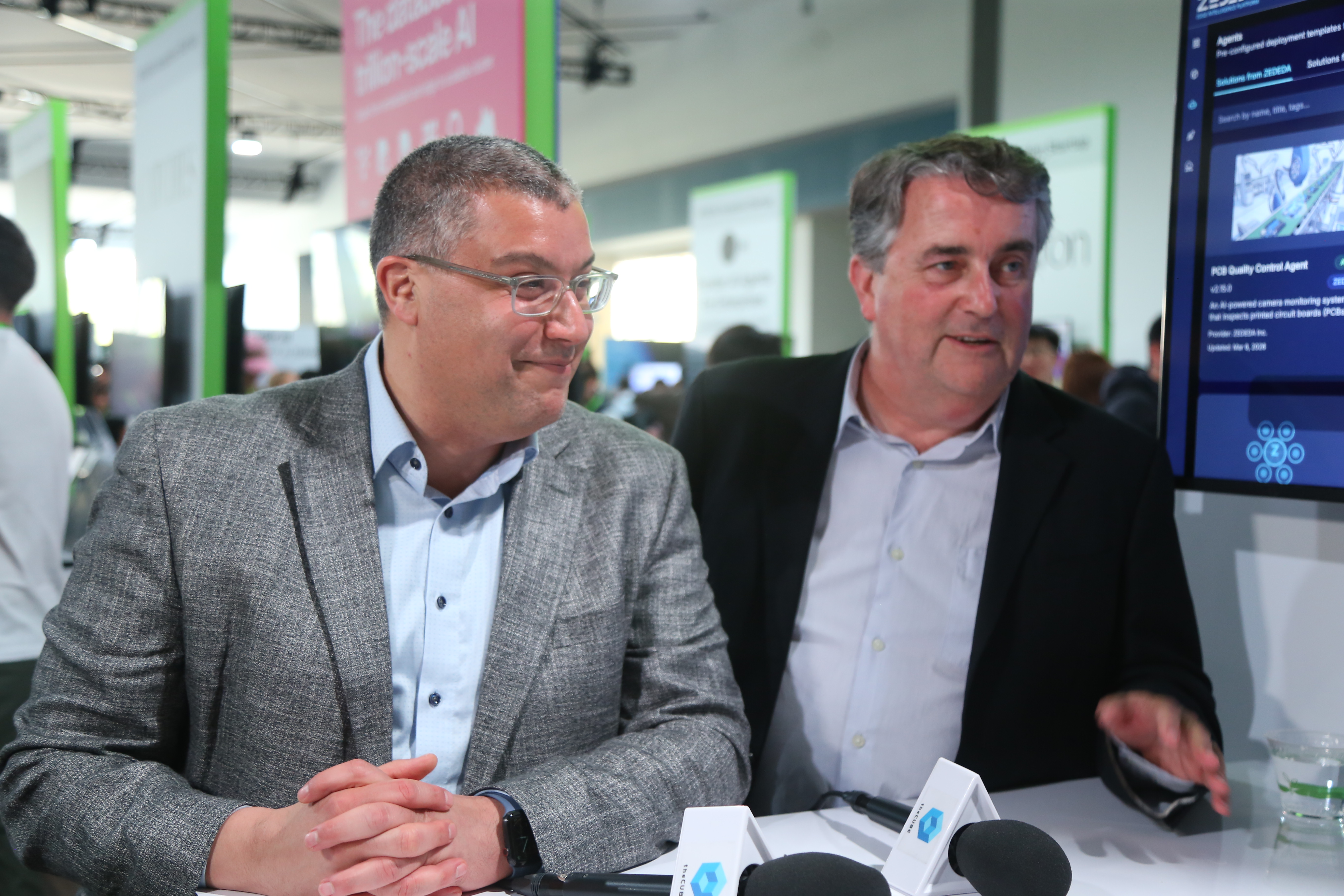
In March 2026, Ouissal and colleague Padraig Stapleton discussed the next phase at NVIDIA GTC. ZEDEDA had introduced its Edge Intelligence Platform, extending its infrastructure work toward deploying AI models and agents. The direction followed the company’s existing concern with running software across distributed locations.
The examples were refreshingly specific. Stapleton described deployments in more than 100 countries, including maritime work with Maersk. Ouissal discussed a customer using conversational language models and computer vision across hundreds of car washes, with plans for a much larger rollout. The planned expansion should be read as a plan; the existing installations are the useful starting point.
Car washes are an excellent corrective to the tendency to describe artificial intelligence as though it lives exclusively in a research laboratory. Water, vehicles, queues and equipment have schedules of their own. A model becomes commercially interesting when it helps a real operation function, under the conditions that operation actually has.
In September, ZEDEDA and chipmaker Ambarella announced a partnership connecting Ambarella’s processors with EVE-OS and ZEDEDA’s management platform. Its emphasis was deployment across distributed devices, including keeping models current and secure. Better silicon and better models still leave the practical question of maintaining the fleet. Ouissal’s business occupies that interval between an intelligent device and an operation that can depend on it.
A room full of people with actual machinery
On September 15, 2026, Ouissal opened ZEDEDA’s TRANSFORM event in Houston around intelligence at the edge. The gathering brought together participants from Toyota Motor North America, SLB, Intel, HP, Lenovo and other companies dealing with industrial operations. The subsequent account emphasized the distance between detecting a problem, understanding it and taking action.
It is a useful distinction for reading Ouissal’s aspirations. In his March 2026 writing, he described customers wanting AI where their businesses operate. He positioned ZEDEDA as the infrastructure, inference and orchestration layer enabling that work, while enterprises retain control and visibility. It is an ambition that will be tested at individual sites, through repeated use.
There is patience built into that proposition. Equipment can remain in service for decades. Connectivity varies. An industrial operator has reasons to ask more questions before delegating a decision. The opportunity Ouissal describes depends on earning permission gradually, through systems that people can inspect and manage.
His early startup recollections offer a smaller version of the same concern with making an idea tangible. Asked about a worthwhile $100 purchase, he remembered framing ZEDEDA logos and inspirational pictures before a customer meeting. The pictures later served as reminders of the company’s beginnings. Even a business concerned with remote infrastructure once had to consider what was hanging on the office wall.
He also had a proposed business to give away: a Moroccan restaurant in the Bay Area. Evidently, some forms of local service remained undersupplied. It is a pleasing detail beside all the talk of distributed computing. You can move processing closer to the work. Dinner, too, benefits from being within reach.