Prabhat Sharma wanted to search his logs without acquiring a second occupation. The requirements were modest: software that used little memory, kept its search data on disk, installed easily and came with a usable interface. In December 2021, he published his findings. The search for something small had produced a rather large survey of other people’s search engines. It had also produced his own: Zinc.
There is a particular sort of annoyance behind this kind of project. A tool does the job, but looking after the tool begins to compete with the job itself. Sharma had liked Elasticsearch and recommended it to customers. He also knew its appetite for resources and configuration. His question was practical: could searching a collection of logs demand less of the computer and less of the person sitting in front of it?
That question eventually became OpenObserve, where Sharma is founder and CEO. It also offers a useful way into his story. Before the funding announcements and the petabyte-scale deployments, there was an engineer comparing alternatives for his own needs. He did the shopping, inspected the shelves and decided to make something.
First, register the company. Then admit the mistakes.
By April 8, 2022, Sharma had another set of findings to share. He had recently started Zinc Labs Inc. and was writing down the administrative steps. The subject matter had changed from indexing to incorporation. His instinct to leave instructions for the next person had survived intact.
The diary was wonderfully unceremonious. He described buying a $799 lifetime package from Clerky, obtaining a virtual office through Regus and choosing Brex Cash after researching banking options. He liked being able to issue a separate virtual card for each vendor. The little smile attached to that observation did more to convey early startup life than a photograph of a glass conference room could have done.
He also recorded a mistake: expecting Carta to handle his SAFE notes, paying for it and then doing the signatures manually through DocuSign. He wished a clearer sequence of tools and tasks had existed when he began. A founder who can explain infrastructure still has to learn the paperwork. Sharma made the lesson public while it was fresh, complete with the wasted effort.
“I wish I had this when I was starting up first time.”
Prabhat Sharma, April 2022
An AWS architect crosses to the other side
Before OpenObserve, Sharma worked at AWS as a solutions architect, specializing in containers and Kubernetes. He helped both startups and large enterprises design systems. That job placed him close to the people who had to keep software running after installation, when the demonstration was over and the awkward questions began.
In May 2022, ZincSearch announced $3.6 million in seed funding led by Nexus Venture Partners, with Dell Technologies Capital and other investors participating. Abhishek Sharma of Nexus joined its board. The project had accumulated more than 7,900 GitHub stars in five months. Engineers were paying attention to a search engine built with Go and VueJS that promised a smaller operational burden.
The underlying complaint was already clear. Companies needed to search growing volumes of machine-generated data, but the work and expense involved could make that data difficult to use. For Sharma, the commercial opening came from a problem he understood as a customer-facing engineer. The people who bought the software and the people who maintained it both had reasons to want a different arrangement.
A simpler screen has machinery behind it
OpenObserve’s launch in May 2023 broadened the job. Logs record events. Metrics track quantities over time. Traces follow requests through a system. Sharma wanted these different views available together, with dashboards and alerts, rather than requiring a collection of separately maintained tools.
His design decisions were specific: Rust for the backend, columnar storage and object storage, with compute separated from stored data. These choices put engineering effort into the platform so users could spend less effort operating it. The launch goals included getting started in minutes and allowing people to bring existing SQL skills to advanced queries.
One detail in the launch essay is especially revealing. Sharma enjoys learning, but objects to repeatedly learning new ways to do the same task. A fresh query language might be an absorbing subject for its creator. For the engineer investigating an incident, it is another thing standing between a question and an answer. His preference for familiar skills makes simplicity a matter of respect for someone else’s time.
The company in the comments
An open-source founder has colleagues who never appear on the payroll. In August 2023, Sharma wrote about Mark Percival’s GitHub Action for sending workflow logs into OpenObserve. It let teams retain and examine the output of their software builds, looking for recurring failures and delays. Here was a contributor extending the product into another corner of a developer’s day.
That same month, Sharma explained a Serilog integration built by Konrad Kaminski-Pawlak. It connected applications using the .NET logging library to OpenObserve. These were concrete additions, with names attached. Community meant someone noticing a missing connection and building it, then another person explaining how to put it to work.
For a profile of a founder, such posts are useful evidence of where his attention goes. Alongside larger architectural arguments, Sharma publishes instructions for small, necessary tasks. The work is cumulative. A platform becomes useful partly through the less glamorous business of fitting into the systems people already have. A working connector rarely gets a champagne reception. It does, however, get used.
Free software still has bills
Sharma’s enthusiasm for open source comes with a business argument. OpenObserve changed its license from Apache 2.0 to AGPL 3.0 in November 2023. When he explained the decision in January 2024, he connected it to the company’s ability to keep investing in development and capture some of the value its software created.
He described an approach combining an open-source product with commercial offerings. Users would have access to a functional platform, while enterprise needs could support a business around it. The reasoning exposes a tension every such founder must handle: wide adoption is valuable, and maintaining the thing being adopted requires money.
His September 2024 discussion of charging extra for enterprise single sign-on explored a similar tension. He laid out objections to the practice alongside the expense of development and support, and the role paid features can play in funding a free tier. Whatever a reader thinks of those choices, Sharma is willing to discuss the economics in public. Making infrastructure affordable does not remove the need to make a company solvent.
From a $35 computer to a cloud’s limits
By April 2025, Sharma could point to a striking range of users. He reported more than 3,600 active deployments and described OpenObserve running both on $35 Raspberry Pi computers and across large enterprise clusters. Its GitHub repository had passed 15,000 stars. The small installation and the large one were using the same binary.
Those figures matter as a dated snapshot. Stars measure attention; deployments indicate use. Neither alone tells the full story of a company. The contrast between the home project and the production cluster does show how far his original concern with resource requirements had traveled. An engineer’s dislike of unnecessary overhead has uses at more than one budget.
At the other end of that range, scale creates problems an ordinary test cannot expose. In a March 2026 KubeCon interview, Sharma discussed encountering undocumented Google Cloud limits while operating at petabyte scale. The engineer who had helped people use cloud infrastructure was now explaining what happened when his own platform pressed against its boundaries. Simplicity for users had led him into distinctly complicated territory.
The person away from the query window
Sharma lives in the San Francisco Bay Area. His public speaker biography mentions reading and spending time with his children. His author biography lists interests in liberal arts and economics alongside machine learning and systems architecture. Those interests sit comfortably beside the software: questions about scarce resources and how people use them are close to the center of his work.
On his personal website, he introduces himself through several roles: builder, father, husband, son. The technical inventory follows, including Go, Python and JavaScript. It is a compact ordering of priorities. The person who describes systems for a living leaves space in the introduction for relationships that require no architecture diagram.
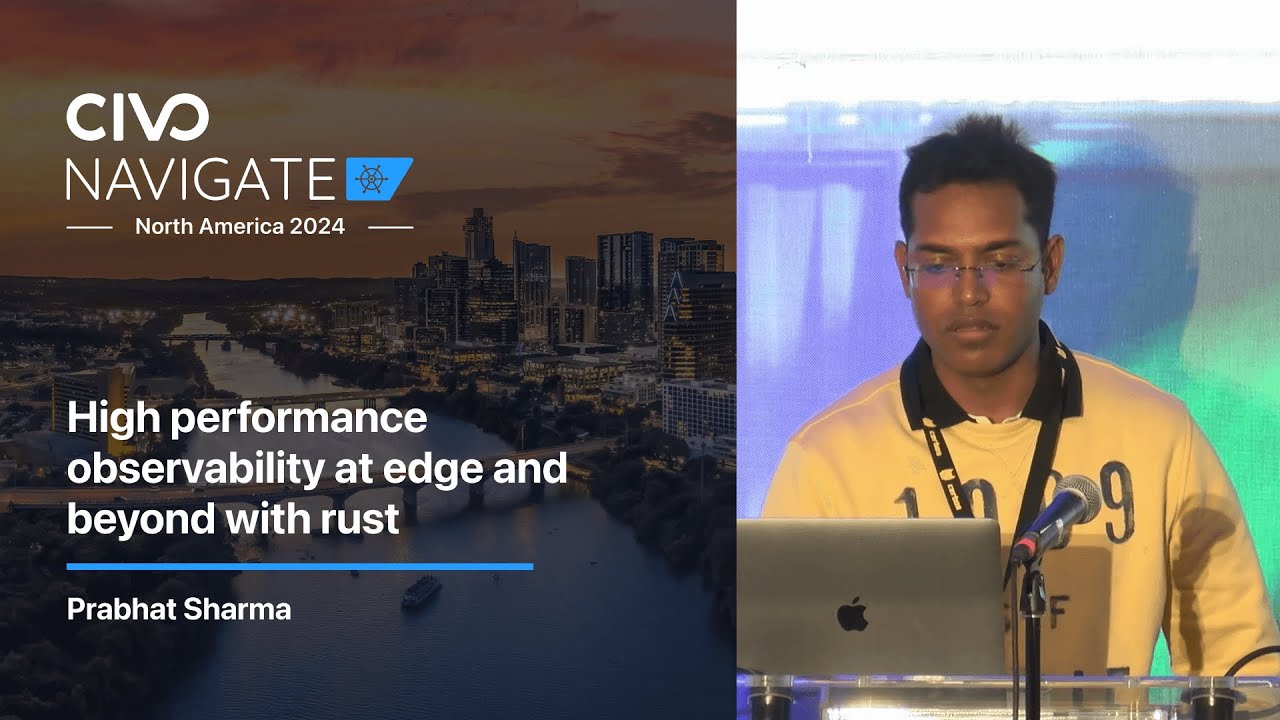
His talks provide another setting for the same explanatory habit. At Civo Navigate in Austin in 2024, he discussed high-performance observability with Rust, including Apache Arrow DataFusion. In June 2026, he and OpenObserve’s Shani Shoham joined Brandon Whichard on Software Defined Talk. The format changes from code examples to conversation; the subject keeps returning to how engineers can understand what their systems are doing.
Keeping the evidence, handing over the search
In April 2026, OpenObserve announced a $10 million Series A led by Nexus Venture Partners and Dell Technologies Capital. Sharma reported more than 7,000 organizations using the platform. The announcement also introduced a group of AI capabilities: an AI SRE, anomaly detection and observability for applications built around large language models.
His stated ambition now extends beyond making information easier to query. He wants software to help investigate operational problems and reduce the manual work of interpreting telemetry. It is an aspiration with a clear relationship to the early project: keeping data is useful when someone, or some system, can turn it into an answer.
The change in scale is substantial. The recurring question is familiar. Sharma began with the burden of running a search engine; he is now working on the burden of searching through what the engine keeps. His early founder diary offered instructions that might spare another person an avoidable mistake. OpenObserve asks how much more of the work software can take off their hands. The paperwork, presumably, still has a few ideas of its own.