Sai Gundavelli had a search engine to sell. The prospective customers had an awkward question. Before they could search their corporate information, they needed to understand what information they possessed. The demonstration had run into a problem that a better search box could scarcely solve. It was the sort of conversation in which a salesperson might arrange another meeting. Gundavelli began reconsidering the business.
He had taken Google’s search technology into enterprises, hoping to bring a familiar capability behind the corporate door. People liked the proposition. They struggled to find a budget for it. In his recollection, those conversations pushed him toward identifying, organizing, securing and archiving enterprise data. Search would have to wait while someone sorted out the cupboards.
That detour runs through the story of Solix Technologies and its founder and CEO. Today, Gundavelli talks about enterprise AI, intelligent agents and the architecture beneath them. Earlier, he talked about old databases and application performance. Across the changing vocabulary, a stubborn practical question remains: how does a company make its accumulated information useful?
A mechanical engineer in the back office
Gundavelli’s formal education offered no obvious prediction of a career in corporate archives. He earned his bachelor’s degree at Osmania University and a master’s in mechanical engineering at the University of Oklahoma. His working life took him into enterprise applications, including roles at Cisco Systems and Arix. The organizational machinery became his subject.
At Cisco, where he says he worked from 1991 to 1996, he helped implement enterprise resource planning software. These are the systems that keep a business’s transactions and operations moving, often with considerably less applause than the products being sold. For an engineer interested in how things fit together, they provided an education in corporate scale.
He remembered a Cisco small enough for encounters with John Chambers in the cafeteria, yet already planning for much greater size. Its applications had to support the company it intended to become. Gundavelli took away an ambition of his own. He wanted to build “something that I would be proud of” at “70 years old.”
His first entrepreneurial plan was quite specific. After leaving Cisco, he started an enterprise application implementation business in 1996 and worked with Oracle. He called the ambition a “mini-KPMG.” It was a consultant’s opportunity seen through an implementer’s eyes: other companies would need the work he had learned to do.
- Osmania → OklahomaEngineering education
- 1991–1996Enterprise applications at Cisco
- 1996His first implementation business
- SolixOrganize the information underneath
The economics of the garage
The implementation business preceded the search pitch and the move into enterprise data management. Working with applications had put Gundavelli close to the material that companies generate simply by existing: transactions, records, reports and years of history. Building the system was one job. Deciding what to do with everything it retained was another.
His explanation of archiving was pleasantly domestic. Frequently used possessions belong in the living room; things needed less often can go in the garage. Companies, too, benefit from distinguishing what is active from what must remain accessible. Otherwise the equivalent of every old suitcase gets a permanent place beside the sofa.
For customers using Oracle or PeopleSoft, he described an immediate set of difficulties. Accumulated records made backups take longer and complicated disaster recovery. Keeping historical material on the same busy systems also carried computing and licensing costs. Archiving offered a purchase that could be justified in operating terms. The value had become easier to explain than enterprise search alone.
Early progress still required persuasion. One prospective customer wanted proof that the product would work. Gundavelli and his team developed the software while explaining why companies should buy it, including through articles about the operational problem. Customer education belonged beside engineering on the task list. A technically sound answer needed a question that buyers recognized as their own.
Keep work moving
Active records stay available to everyday applications.
Give history a home
Less active records move into an accessible archive.
A conceptual illustration of Gundavelli’s analogy. No performance or savings figures implied.
When the competition grew larger
Gundavelli funded Solix with his own money and angel investment. He said a previous venture capital experience at another company had discouraged him from repeating that route. One introduction brought an early million-dollar check. By 2015, he put the angel funding total at roughly $8 million. Those were company financing figures, a measure of resources available to build and sell software.
Meanwhile, competitors acquired much larger parents. He identified HP, IBM and Informatica among the companies that bought rivals. He recalled the adjustment as disorienting. Solix was facing organizations with resources and distribution it could not simply reproduce. An engineering preference was meeting an uncomfortable sales reality.
His response divided the work into practical choices. Most engineering development was in India. Marketing received investment. Salespeople were hired against the leads available, rather than in the hope that hiring alone would produce demand. Alliances extended the company’s reach. These were decisions about how a smaller organization could afford to keep participating.
Technology offered another opening. Solix moved its archiving approach onto big data infrastructure, widening the proposition beyond the earlier database model. Gundavelli emphasized storage and computing economics, broader enterprise archiving and pricing choices. His recurring question was “Why Solix?” A customer had alternatives; the product needed to earn its place.
The next step followed from the information already being moved. If an archive could hold historical data, bringing active information alongside it opened possibilities for analytics. Gundavelli described preserving access even after an application was retired. Removing an old system did not have to mean losing the ability to ask questions of its records.
He also discussed OEM partnerships with Kronos and EDT as routes into other customer environments. Looking back in 2015, he described the first five years as a struggle to build the product and educate the market. Larger deals arrived later. The sequence gives his story its proportions: years of explanation before the bigger numbers.
A question from the classroom
In 2018, Gundavelli visited the CU Denver Business School to speak with undergraduate and graduate students about AI. His message was welcoming toward the technology. “It is time to partner with machines and build the future,” he said. This was years before the present wave of enterprise chatbot demonstrations made such discussions routine.
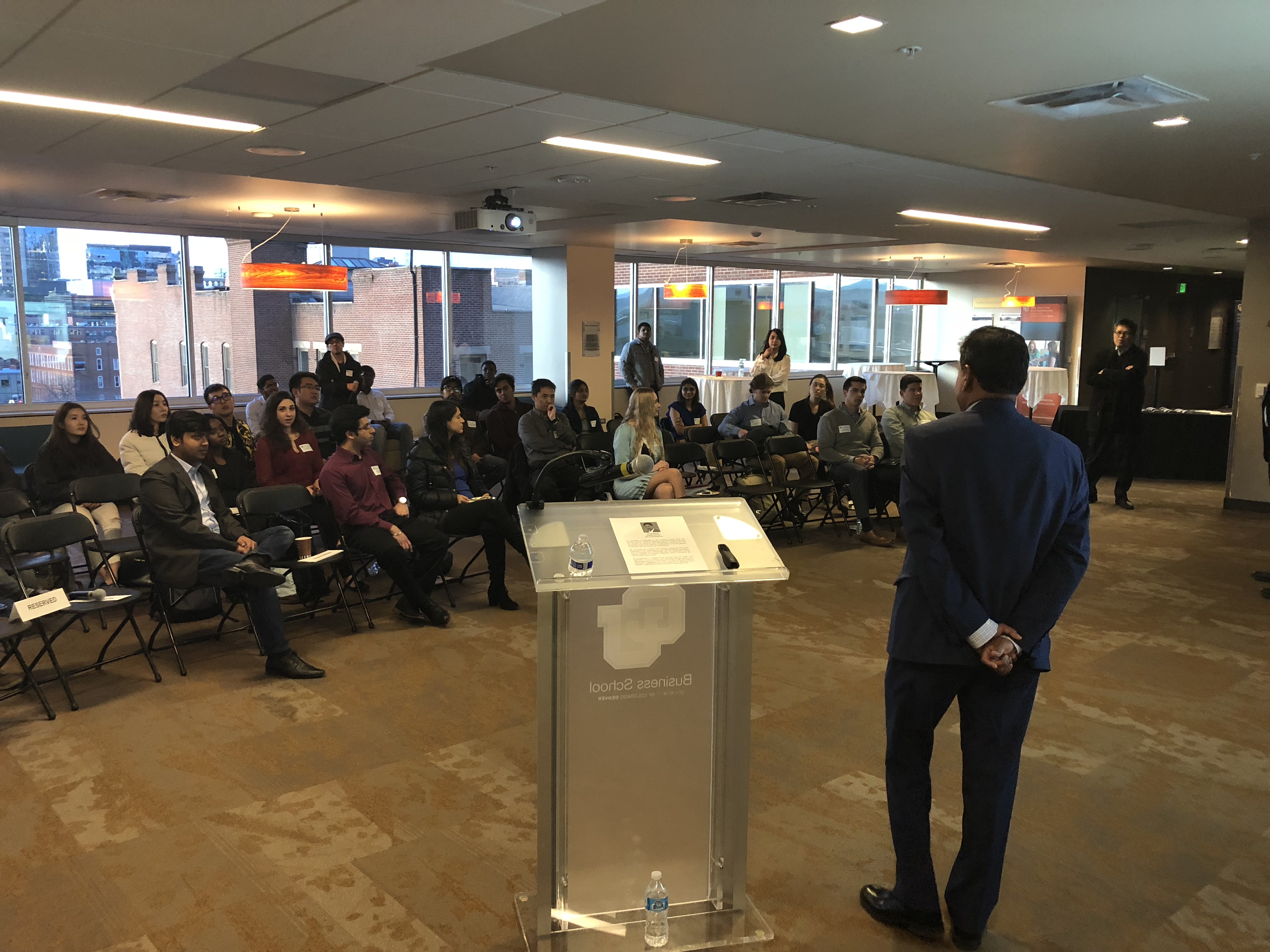
A student asked what he looked for in candidates. Gundavelli named passion, IQ and energy, putting passion first because he considered it something a company could not teach. It is a useful small detail about an executive whose public biography otherwise contains a great many platforms and applications. Presented with a room of potential recruits, he emphasized their interest in the work.
There are less technical glimpses, too. A 2005 profile described his enjoyment of old Hindi movies and time with his children. That snapshot belongs to its moment, but it interrupts the usual executive vocabulary rather well. Even someone occupied with corporate storage could spend an evening returning to an old film. Keeping things has its pleasures.
The school supplies came first
The family also figures in the origins of Touch-A-Life Foundation. Gundavelli’s son Tej was a high school student when he learned that a school friend was homeless. The immediate needs included sneakers for gym and school supplies. Tej began a local effort to help students, and he and his parents, Sai and Veena, expanded it into Touch-A-Life.
The foundation’s approach centers on connecting people who need something specific with people able to provide it. A contribution can involve goods, time or skills as well as money. The organizing idea is direct enough to understand without a presentation: make the need visible, then make a suitable response easier.
There is a resemblance to Gundavelli’s enterprise work, though the people and stakes differ. Both require useful connections between information and action. A business needs to locate a record. A donor needs to understand a request. Technology earns its role through what someone can do next. In the family story, that next step began with school supplies.
The archive returns to the conversation
In January 2026, Gundavelli set out his case for building enterprise AI into data, governance and workflows. He placed information architecture at the beginning, followed by enterprise AI, governance, marketplaces, agents and AI-assisted development. John Ottman, Mark Lee and Kishore Gadiraju were among the colleagues he named in describing the effort.
His ambition now includes systems that can work with a company’s own information and support decisions across its operations. It brings him back to the difficulty that complicated the search pitch. Useful answers require information that has been organized well enough to find, understand and use responsibly. A natural-language interface still depends on what sits underneath it.
“Why Solix?”
Sai Gundavelli’s recurring product question, described in 2015
As of October 24, his next announced gathering is SOLIXEmpower 2026, scheduled for October 28–30 at UC San Diego’s Qualcomm Institute. He is due to open the conference. Its agenda brings enterprise AI together with data governance, application retirement, demonstrations, workshops and a student hackathon. The old work and the new ambitions share the program.
That is a fitting place to leave him: preparing for another room of people with questions. The career began with engineering, passed through application implementation and changed direction when buyers could not explain what data they had. The archive has kept him busy ever since. Now the software promises to hold a conversation with it.