The Data Keeper Fortune 500 Trusts
Kon Leong started ZL Technologies in 1999 - the same year Google incorporated - betting that the real problem wasn't search. It was governance. Twenty-five years later, that bet is paying off in federal contracts, Fortune 500 renewals, and a platform that manages enterprise data up to 1,000 times faster than conventional approaches.
The company is quiet by Silicon Valley standards. No splashy rebrands, no pivot announcements, no breathless press releases about disruption. Instead, ZL Technologies has spent more than two decades deepening its position in a corner of enterprise software where the stakes are enormous and the tolerance for failure is essentially zero: unstructured data governance, eDiscovery, compliance, and records management for some of the largest organizations on earth. Toyota. Wells Fargo. Allstate. Sony. The US Department of Defense.
Leong's insight was deceptively simple. Every enterprise generates mountains of unstructured data - emails, instant messages, documents, call recordings, collaboration data. This isn't the clean, structured data that SAP manages. It's the messy, human stuff: the conversations, the decisions, the institutional memory of an organization. And nobody was managing it well.
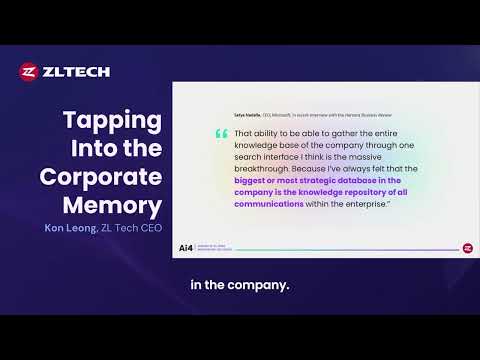
"Our role is to help convert the vast repository of all human communications data into enterprise memory and knowledge."
- Kon Leong, CEO, ZL TechnologiesHis platform's core innovation is in-place management: instead of copying data to analyze it (the conventional approach that balloons storage costs and creates compliance nightmares), ZL manages data right where it lives. The result is analysis up to 1,000 times faster, storage reduction through virtualization of up to 90%, and a compliance posture that eliminates the risk created by redundant copies. When Leong says "the proliferation of redundant copies significantly increases costs and compliance risks," he's not making an abstract argument. He built the alternative.
The generative AI moment has been, for Leong, a strange kind of vindication. As every enterprise scrambles to answer "What's our AI story?", the bottleneck turns out to be exactly the problem he's been solving since before anyone was calling it big data. Where is the enterprise data? How do you make it AI-ready while maintaining governance, privacy, and regulatory compliance? In 2024 and 2025, Leong took those questions to the AI4 conference stage, where his answer - rooted in 25 years of execution - carries a weight that no newcomer to the space can match.
In April 2025, ZL Technologies and Carahsoft announced a strategic partnership that puts the ZL platform in front of US government agencies through NASA SEWP V and ITES-SW2 federal contracts. For an enterprise that has been DoD-certified for classified records, it's a natural expansion. For Leong, it's evidence that the problem he identified in 1999 is only getting bigger.
"Without alignment, governance becomes a food fight between departments."
- Kon Leong, on enterprise data strategyHe received an honorary Doctor of Science from his undergraduate alma mater, Concordia University, in November 2017. The citation honored his pioneering work in big data technology and information governance - recognition from the institution where, decades earlier, he combined a Computer Science degree with a Business Administration concentration, building the dual fluency in technology and business that would eventually define his career.
ZL Technologies serves clients across financial services, healthcare, government, and legal industries. Its platform handles everything from FOIA requests to legal holds to privacy regulation compliance. The 250+ person team operates with offices in the US, Japan, Korea, and the EU. The company has been bootstrapped since its Series A in 1999 - an almost unprecedented feat of capital discipline for a Silicon Valley software company that has outlasted several boom-and-bust cycles in the enterprise software market.
"Without alignment, governance becomes a food fight between departments," Leong said at a 2025 industry presentation. It's the kind of line that lands because it's observational rather than aspirational. Leong has seen enough enterprise data disasters to know exactly what he's talking about.