A company can possess the answer to a customer’s question and still manage to give two different replies. The branch knows one version. The call centre knows another. The customer, who has committed the innocent act of asking twice, now has a small research project. Sagi Eliyahu has spent years discussing this particular form of corporate self-sabotage. It is an unglamorous problem with an unusually long future.
In 2019, the KMS Lighthouse CEO described organizations distributing inconsistent information across their service channels. A person’s experience could depend on which employee picked up, or which department supplied the material. His concern was plain: a business should be able to agree with itself before asking the customer to believe it.
By 2026, the conversation had acquired a new cast of characters: generative AI, autonomous agents and software expected to do more than retrieve a document. Eliyahu was still following the same thread. An answer could arrive faster, sound smoother and remain wrong. Fluency had become easier to buy. Agreement required work.
An accountant learns to cross borders
Eliyahu’s route into this business began in finance. He worked at KPMG in corporate finance, managing technological financial consulting. He is a certified public accountant and holds an MBA from Israel’s College of Management Academic Studies, specializing in the management of technological corporations. Those credentials place business operations alongside technology in his professional background.
At Aman, he took responsibility for international business. His work included establishing branches in Russia, Poland and Kazakhstan. That is a different kind of technology education: the product has to become a functioning operation somewhere else. Local relationships, customers and colleagues matter. A presentation can cross a border in an email; a business takes more arranging.
His later writing about global teams gives that experience a recognizable continuation. In 2024, he argued that international organizations benefit from drawing on knowledge held across their workforce. The point extends beyond having colleagues in several time zones. Their experience needs a route into the decisions being made elsewhere. Otherwise, geographical reach can leave a company with more places to misplace what it knows.
- Corporate financeTechnological financial consulting at KPMG
- International operationsOverseas business development at Aman
- Knowledge managementCEO of KMS Lighthouse
The answer leaves the filing cabinet
His explanation of Lighthouse has often started with a person doing a job. A contact-centre employee needs to respond to a caller. A bank employee needs precise information at the counter. Someone working in the field needs access on a mobile device. These were examples he used in a filmed conversation with LaShawn Fugate. The product’s purpose became legible through the interruption it was meant to remove.
There is something revealing about that choice of examples. They put the knowledge problem at the moment of use, with another person waiting. A beautifully organized repository is little consolation if the employee cannot find the relevant answer while the conversation is happening. The software has to fit the work closely enough to become useful under those conditions.
In his 2021 writing on documentation AI, Eliyahu returned to the employee who knows the needed information exists but cannot locate it. Anyone who has searched an internal drive can supply the atmosphere. The file name promises certainty; the contents offer archaeology. His business addresses the distance between having information somewhere and being able to use it now.
A shorter journey to the customer
When he discussed KMS Lighthouse’s development in 2021, Eliyahu described moving its solutions to the cloud. He connected that change to deployment speed, integrations and the ability to work remotely. This was an operating decision with consequences for how a customer could adopt the software. The journey from agreement to use deserved attention too.
The international ambition was explicit. He wanted to extend the company’s success in Israel into other markets, describing expansion across North America, Europe and Asia. His previous work at Aman gave that ambition a practical backdrop. He had experience building operations beyond a home market before taking on this particular expansion.
Marketing also received practical treatment. In a published account of its work with KMS Lighthouse, agency SAGE described refining the brand and website, defining buyer audiences and developing lead-generation activity. Eliyahu credited the engagement with an 80 percent increase in the company’s pipeline over eight months. It is a client testimonial about a particular project, rather than an audited measure of the whole business. Still, it shows a CEO willing to discuss the machinery of finding customers.
Pipeline increase over eight months, as reported in Eliyahu’s testimonial about KMS Lighthouse’s work with SAGE.
The team gets an invitation
Eliyahu’s public leadership advice has a recurring interest in participation. In 2021, he made the case for considering motivation and potential when hiring, alongside conventional experience. He also argued that leaders should explain decisions, including decisions their colleagues might dislike, and remain willing to consider a better suggestion. Authority, in that account, comes with some conversational obligations.
Two years later, he offered a concrete example from KMS Lighthouse. When a new client came aboard, he described involving research and development, sales, marketing and customer success. The arrangement gave different parts of the organization a place in the same outcome. A customer relationship could become visible beyond the department that signed it.
This is where his management interests meet his product interests. Both involve making useful knowledge available across boundaries. A colleague who understands the customer’s problem can make a different contribution from one who sees only an assigned task. An employee who can raise an objection gives the organization a chance to learn something before the customer does. The parallel is a reading of his published ideas, rather than a claim about every meeting inside the company.
“Be brave, take on big projects and change things.”
Sagi Eliyahu, 2021
His public posts add a less formal note. Writing about a visit to the UK team, he described the pleasure he takes in meeting colleagues and partners in different countries. He named people, thanked them and signed off with the sort of encouragement that appears repeatedly in his updates: “Let’s enjoy and win.” The flexed-biceps emojis do their own small share of the travelling.
A familiar question in a London room
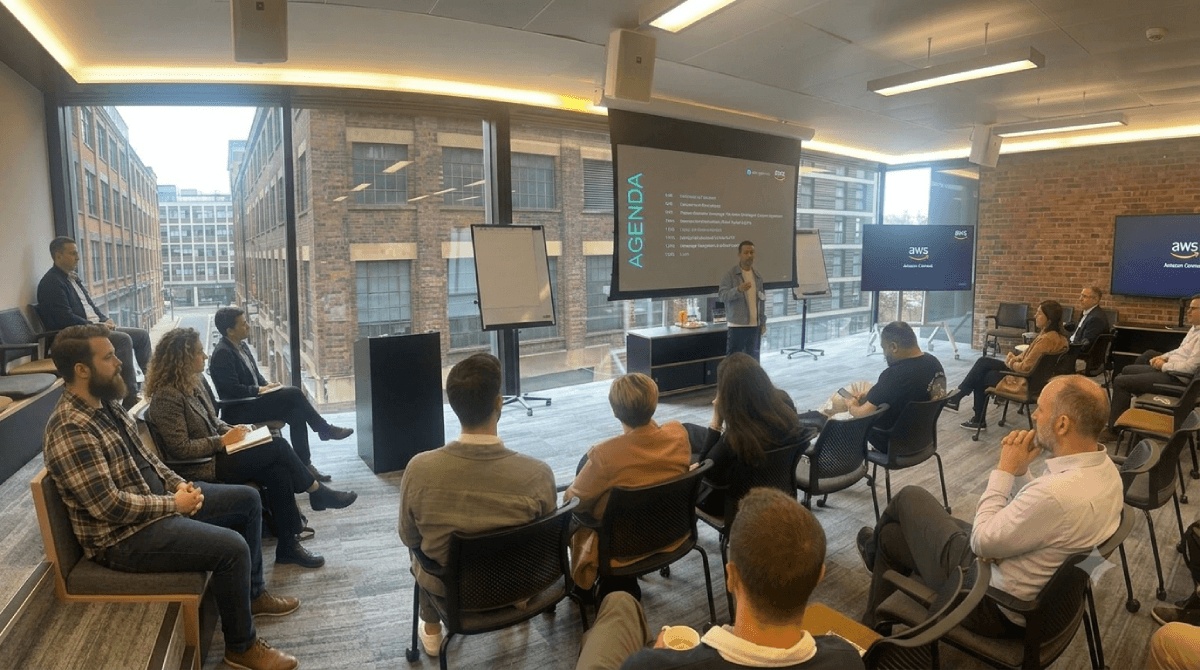
At Connect Your Knowledge London 2026, an event organized with Amazon, Eliyahu spoke about enterprise AI and trusted answers. The discussion included hallucinations, deployment and integrations with Amazon Connect and Amazon Q. The setting placed his longstanding concern inside a newer technical conversation: how to make generated responses dependable enough for everyday business use.
His writing that year made the underlying case in several ways. In March, he discussed knowledge management as the structure supporting practical enterprise GenAI. In June, he proposed evaluating knowledge articles through automated scoring, including whether information remained current. The suggestion moves attention toward the quality of the material an AI system is allowed to use.
That gives the maintenance work a different status. Reviewing an article, resolving a contradiction or retiring an old instruction can sound like administrative housekeeping. Once an AI system retrieves the material, those decisions help determine what the business tells its customers. The dusty policy document has acquired a microphone. Someone should probably check the date.
A conceptual guide to the argument, rather than a product architecture or performance claim.
What happens after the handoff
By September 2026, Eliyahu was writing about service environments in which autonomous AI agents and human employees work together. One of his concerns was the transition between them. When a case reaches a person, the context and relevant information should travel with it. The customer should not have to reconstruct the conversation for the benefit of the organization’s internal divisions.
His July description of KMS Lighthouse’s direction also connected governed content with agents able to retrieve, reason and act within boundaries. That was the company’s stated approach. It presents a demanding operating brief: as software takes on more responsibility, the knowledge and controls around it have to carry more responsibility too.
Recognition arrived that summer when KMS Lighthouse announced its Tier 1 vendor designation for knowledge management implementations in STKI’s 2026 Israeli IT market study. Eliyahu responded by emphasizing the knowledge foundation enterprises need for AI. Even in an announcement built around recognition, his preferred explanation returned to the material underneath the response.
The arc of his career is easier to follow through that continuity than through a succession of fashionable terms. Finance, overseas operations, cloud adoption and AI all involve turning capabilities into something people can rely on. For Eliyahu, the next chapter remains attached to a very ordinary test. A customer asks the business a question. The answer holds up when they ask again.