Dinner has a surprisingly efficient opposition party. Six people can agree that they are hungry, agree that they should go out, and agree on almost everything except where. One objection is enough to send the whole committee back into session. Saad Nadhir built Urban Plates with that troublesome last vote in mind. A restaurant might win the steak enthusiast and still lose the table. The person saying no matters.
Nadhir wanted a menu broad enough to keep the group together and varied enough to bring it back. His phrase for the problem was to “minimize that veto.” It is a modest-sounding ambition for someone whose career includes Blockbuster, Boston Chicken, Mexican discount stores and American wireless retail. Yet it gets unusually close to what interests him: the little decisions that determine whether a large business works.
Urban Plates, which he founded with John Zagara, opened in Del Mar, California, in 2011. Its origins lead back much further, to a family grocery business around Detroit and a lawyer whose client eventually suggested a different career. The route to this particular dinner counter included a considerable amount of other people's shopping.
A lawyer takes the other side of the counter
Nadhir grew up in the Detroit area working in his family's grocery business. Retail arrived before the executive titles. He later earned business and law qualifications, including a law degree from the University of Detroit in 1980, and moved to Dallas to practice real estate law.
The next turn came through a client who was a Blockbuster franchisee. The client suggested that Nadhir join the company. There is something pleasingly untidy about that transition: the person advising a business becomes someone responsible for running one. A professional connection opened a door that a carefully ordered career plan might never have included.
Nadhir has described himself as “an entrepreneur who happened to be a lawyer.” The description fits the sequence without pretending that legal practice was wasted time. Stores need sites, agreements and counterparties. Real estate law was hardly an eccentric preparation for a working life spent helping businesses occupy more addresses.
A career with several checkout lanes
- 1980University of Detroit law graduate
- 1980s-90sBlockbuster development and international operations
- 1992Partners acquire Boston Chicken
- 2011First Urban Plates opens in Del Mar
- 2026CACC Businessperson of the Year
Before the plates, the videotapes
At Blockbuster, Nadhir worked in development in the Midwest and then in international development and operations. His responsibilities took him into a business of joint ventures, licensing and stores across different countries. A shop selling an evening's entertainment had to make sense locally while belonging to a recognizable chain.
Then came prepared dinner. In 1992, Nadhir and fellow investors acquired Boston Chicken when it was still a small chain. Scott Beck, another Blockbuster veteran, was among his business partners. The move connected two consumer habits: taking a movie home and taking a meal home. Both businesses offered an answer to a familiar evening question.
Boston Chicken became Boston Market and expanded beyond 1,000 locations. Its story also included a 1998 bankruptcy and an eventual sale to McDonald's. Those events belong alongside the expansion in any account of Nadhir's career. Opening stores and sustaining a restaurant business are related tasks, but the second keeps going long after the opening celebration has been cleared away.
Years later, as he built Urban Plates, Nadhir emphasized establishing the economic model and infrastructure before accelerating. The appeal of a national restaurant brand remained. So did the practical question of what each additional restaurant would require.
Two grocers reconsider the restaurant
Zagara brought a grocery background of his own, having owned a natural-foods retail concept. Before opening Urban Plates, the partners studied food trends and restaurant formats. They considered the prepared-food displays associated with markets as well as the convenience of fast-casual dining. The resulting restaurant borrowed from both shopping and sitting down to eat.
That combination helps explain why Nadhir's earlier grocery experience belongs near the beginning of the story. A market lets people look before committing. A restaurant has to translate that browsing into a meal and a workable service routine. Urban Plates put food in view and gave customers choices along a serving line.
The first Del Mar location became the starting point for a chain that spread through California. A Pasadena opening announcement in 2016 described an operation with its own pastry chefs and more than 20 kinds of desserts made each day. The menu included plates, salads, sandwiches and braises. Even dessert had been given ample room to forestall disagreement.
The breadth had a purpose. Nadhir was trying to accommodate different appetites within one visit. There is a difference between admiring a restaurant in isolation and persuading everyone in a car to stop there. His business had to pass the second test, repeatedly.
A tray, with hospitality attached
One of the more revealing early staffing decisions was the hiring of a former maître d' from Per Se to lead hospitality training. Urban Plates customers carried trays. The company nevertheless thought there was something useful to learn from a dining room associated with a very different kind of evening.
Nadhir paid attention to greetings, uniforms, the way employees answered the phone and the experience online. These are small encounters that can seem incidental on an organizational chart. To a customer, they are often the entire interaction. A warm welcome requires no explanation; a cold one tends to write its own review.
There was also the kitchen work behind the display. Roasting nuts, preparing dressings and producing meals in-house put demands on the team long before a guest reached the counter. The customer could enjoy choice only if the operation could deliver it at a sensible pace. Nadhir's interest in execution made the menu a staffing and preparation problem as well as a culinary one.
Joe O'Donnell, who joined the leadership team as chief operating officer, pointed to recruiting as a central part of the enterprise. The restaurant employed an in-house recruiter. Finding people who wanted to work in this particular kind of kitchen was part of building the concept, rather than an administrative task to finish afterward.
“We’re always nervous. It’s good to stay that way.”
Saad Nadhir, on the restaurant market in 2018
The useful discomfort of another opening
By 2018, Urban Plates had 15 restaurants and announced a $38 million loan from Goldman Sachs Specialty Lending Group. It planned another 25 units over three years. The ambition was substantial, particularly in a period when other fast-casual businesses were struggling.
Nadhir's response was the nervousness he considered useful. He described a business building its processes and infrastructure before attempting more rapid expansion. The numbers attached to financing announcements are easily remembered. The work those numbers are meant to support is less theatrical: developing locations, preparing managers and getting the same operating routines to function somewhere new.
A restaurant opening is a public event. Readiness is harder to photograph. In Nadhir's account of growth, it deserved attention anyway. His later expansion announcements would continue to pair ambition with the practical requirements of building a pipeline of sites.
The return visit gets a price
Urban Plates introduced Plate Pass in 2021. A subscription gave regular guests a financial reason to keep returning. The original program charged $10 a month and offered entrees for $10 or less. It turned the familiar restaurant loyalty proposition into a purchase of its own.
At the beginning of 2023, the company changed the arrangement: $5 a month for a 20 percent discount on eligible purchases. The revised benefit extended beyond the subscriber's entree to other people on the same check, within the program's limits. A group choosing dinner had entered the arithmetic again.
“People are making tough choices and we want to make Urban Plates an easy choice,” Nadhir said when announcing the change. The subscription was intended to give diners savings while giving the restaurant repeat business and membership revenue. It asked a pointed question: how much of a customer's next dinner could a restaurant earn in advance?
The mechanism suited a founder interested in frequency. A broad menu might help secure tonight's agreement. A paid discount could influence next week's decision. Whether ordering at a register or through an app, the guest still had to decide that another visit was worthwhile.
and refinancing debt
at the time of the announcement
August 2023 snapshot - these figures describe that announcement, not current trading.
In August 2023, Urban Plates closed $27 million in financing from funds managed by Morgan Stanley Expansion Capital. It had 17 restaurants at the time. Digital orders accounted for half of orders after several years of technology investment. The dining room and the takeaway meal were now accompanied by a substantial business arriving through a screen.
Nadhir was still working on the relationship between the experience and its delivery. The food line made a meal visible. Digital ordering made it accessible elsewhere. Both required the restaurant behind the interface to perform.
The dinner business, and the people around it
Restaurants have shared Nadhir's working life with other retailers. He co-founded Waldo's Dollar Mart in Mexico and developed its first 75 stores before selling his interest. He also led PCS Mobile Solutions, which reached 72 locations across seven states. Blue Link Wireless, where he is founder and CEO, extends that career in wireless retail.
The categories change, but his responsibilities repeatedly involve locations, employees and direct dealings with customers. That is a useful way to understand a résumé that otherwise appears to wander. The businesses need people who can deliver an experience reliably, at more than one address.
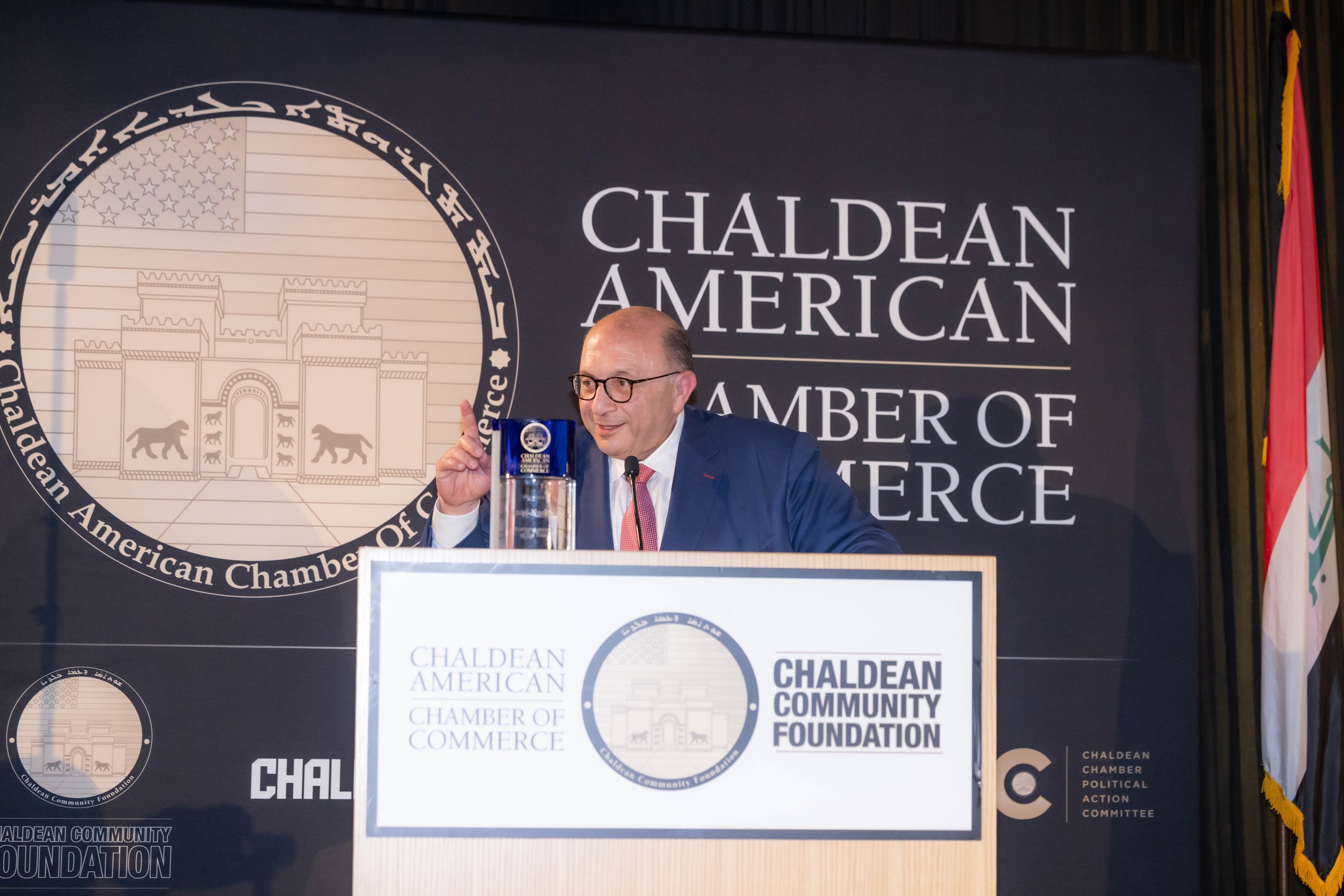
On April 23, 2026, the Chaldean American Chamber of Commerce honored Nadhir as its Businessperson of the Year at Shenandoah Country Club in West Bloomfield. The recognition brought his business career back to the Michigan community where his early retail experience began. The chamber also highlighted his support for education and mentorship.
His connections to education include service on the University of Detroit Mercy's board of trustees. The institution that helped prepare him for law thus appears again in his life after decades spent running businesses. The career has taken several turns; some of its relationships have endured.
For all the stores and financing, the Urban Plates idea remains easy to recognize. Someone wants a proper dinner. Someone else wants something different. Nadhir would like them to come through the same door. After a career spent expanding the number of places people can shop, he is still attending to the moment they choose one.
Follow the story
- Explore Urban PlatesRestaurant website and menus
- Saad Nadhir on LinkedInVerified professional profile
- Blue Link Wireless leadershipExecutive biography
- Watch: Nadhir tells his career storyRestaurant Leaders Lunch, December 2025 · LinkedIn video
- From legal practice to retailDetroit Mercy Law, Fall 2016 · PDF
- The thinking behind the dinner vetoQSR, July 2017
- The Plate Pass changesUrban Plates announcement, December 2022
- The $27 million financingMorgan Stanley Expansion Capital, August 2023
- The April 2026 awards dinnerChaldean News · Event photographs