The chief carried two radios, one pressed to each ear. Ryan Litt asked the obvious question and received a wonderfully strange answer: no, the chief could not listen to two conversations at once. He was listening for intensity. Somewhere in the overlap of dispatches and clipped voices, a change in tone might reveal that a firefighter was in trouble. The ritual was practiced, improvised and fragile. For Litt, it also contained a product specification.
He had arrived at the fire station with Patrick O’Connor, a former volunteer firefighter whose research into responder tracking had already consumed enough late evenings to name a company after them. The pair were touring stations around the United States with support from a National Science Foundation grant. Their question was deliberately plain: what happens after a person leaves the truck?
Assignments may be tidy at departure. Emergency scenes are not. Crews move. Conditions turn. More agencies arrive. The commander’s picture of the scene is assembled from radio calls, handwritten notes, memory and judgment. Litt and O’Connor kept finding the same gap between the plan and the lived event. They phrased the challenge another way: “How do we help when things don’t go according to plan?”
The useful detour
Litt’s route to that question had been pleasingly indirect. A Buffalo native, he grew up fiddling with early versions of Microsoft software on his parents’ computer, using floppy disks and figuring out how to reach the video games. When he toured the University at Buffalo, a newly opened computing center settled his choice of school. Computer science became the anchor, while mathematics, neuroscience and an interest in artificial intelligence pulled at the same larger curiosity: how could machines approximate the work of a mind?
There was also music. Litt founded a musicians’ coalition on campus and played in a band that briefly signed with Columbia Records and toured the country. The brush with the record business did not replace computing, but it gives his biography a useful offbeat measure. Bands are coordination machines. Everyone has a part, everyone must listen, and the performance cannot be paused while the group updates its spreadsheet.
He returned his focus to computer science and graduated in 2005. At a Buffalo company building web portals for internet service providers and cable companies, he got proximity to the chief executive and a look at how decisions made at the front of a business traveled back to developers. In 2008 he moved to The Buffalo News, working on the difficult passage from a print institution to a digital one.
That work became concrete during the 2009 crash of Colgan Air Flight 3407, when readers across the country turned to the newspaper for immediate information. Litt later described an “epiphany of impact” in seeing that code could meaningfully affect people’s lives. Software had ceased to be merely clever. Under pressure, it became civic infrastructure.
The government guy meets the fire guy
After the newspaper, Litt joined Constellation Software. His work put ordinary municipal tasks online for thousands of towns: utility payments, parking tickets, the small transactions through which people most often encounter local government. His division grew beyond 100 people. He invested energy in Buffalo’s startup community and accumulated a nickname, “the government guy.” Later came Bak USA, where purpose-built computers added manufacturing to his education.
That nickname made its way to O’Connor in 2017. O’Connor entered a co-working space at the Buffalo Niagara Medical Campus looking for someone who could help turn a fire-service problem into technology. He was directed to Litt. Their scheduled half hour became three hours. O’Connor brought direct knowledge of the field and a grim reason for pursuing the idea. Litt brought product, software, project-management and public-sector experience. Market research told them the tool they imagined did not exist. They both left their jobs.
The first version was not summoned from a pitch deck. They recruited a roboticist to interpret human movement and a software architect from Litt’s earlier career to visualize it. Then, in a meeting, Litt walked around the room. The prototype followed him on screen. It was an unglamorous little miracle: a dot moved because a person had moved.
A patron saint in the software
The product matured into FLORIAN, named for the patron saint of firefighters. Its ambition is to give an incident commander a living view of responders and resources rather than a stack of partial clues. When a department is dispatched, compatible devices can become visible to the system. Personnel appear on the commander’s screen. Data from maps, weather, hydrants and other tools can join the same view. After the event, tracking and audio shut off.
The distinction that matters is not the quantity of data but its arrangement. A commander does not need a lavish dashboard while a scene is changing. The interface must answer practical questions quickly: Who is where? What are they doing? Which route is open? Who can reach the next task? Litt once called the underlying stream a “metaphorical fire hose of communication.” The joke is accurate enough to be architecture.
By late 2025, the University at Buffalo reported FLORIAN in use at 36 fire stations. The system had also appeared at stadiums, festivals and large public events, places where geography and crowds complicate even routine dispatch. During the Southern California wildfires in January 2025, 3AM and T-Mobile distributed phones and tablets equipped with FLORIAN to deployed responders. In these environments, a small error in direction can become miles of lost time.
The company’s technical circle widened as well. A NextNav partnership added vertical location, addressing the stubborn fact that a latitude and longitude do not tell a commander which floor someone occupies. Microsoft work explored AI that could identify intensity in voice traffic. More recent integrations have aimed to pull radio location data into the same shared view. FLORIAN’s product philosophy is increasingly device-agnostic: the useful screen wins only if the existing equipment can speak to it.
Credibility is the real trophy
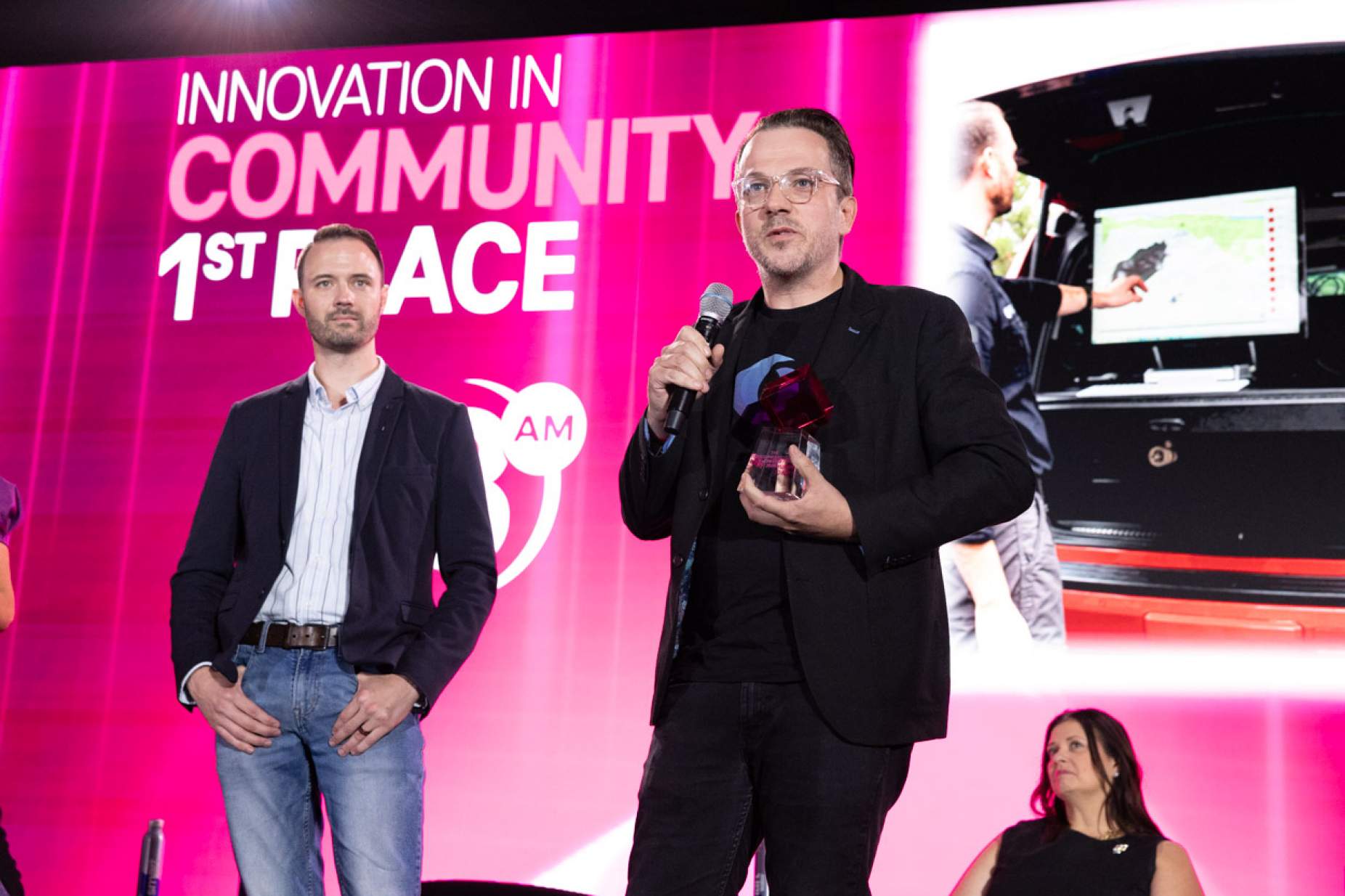
The award followed a period of growing visibility. Litt joined Malcolm Gladwell on a live episode of Revisionist History, recorded at Mobile World Congress Las Vegas, to discuss AI, connectivity and public safety. In 2025 he spoke about automated personnel location at FDIC International. 3AM appeared repeatedly on the GovTech 100 and received a Buffalo Business First Inno Fire Award. A $750,000 investment from the Western New York Impact Investment Fund was earmarked for expansion.
Yet Litt has offered a better measure of progress. His most meaningful professional achievement, he told UB, is being introduced by firefighters as a friend to the fire service. It is a revealing preference. Public-safety customers are not a market segment that politely tolerates a founder learning in public. The software enters a culture built on practice, trust and consequences. Friendship, here, is evidence that the company listened long enough.
Litt still returns to the university to mentor entrepreneurs and judge engineering pitches. 3AM has hired UB graduates and worked with university researchers and labs. For four early years, the company operated from the UB Downtown Gateway building. Buffalo, in other words, is not a decorative location line. It is the network through which the government guy met the fire guy, found engineers and kept building.
He talks about the city with the mixture of affection and defiance familiar to hometown builders. Buffalo is small, he has said, but it has “a lot of charm and grit.” The company’s ambition now reaches beyond it: more countries, more categories of emergency management, more equipment feeding a common view. The geographical expansion is easy to place on a slide. The harder work remains intimate.
Make the scene legible
Litt’s career can be read as a sequence of translation jobs. Turn a newspaper into something the web can carry at speed. Turn municipal bureaucracy into a service a resident can use. Turn human motion into coordinates. Turn a storm of signals into a decision. The band, perhaps, belongs here too: turn many separate parts into one intelligible performance.
The founder lesson is not to wait for a cinematic revelation. It is to study the odd thing an expert does to make an inadequate system work. A radio against each ear. Magnets on a board. A chief listening for fear because location is uncertain. These workarounds are compressed knowledge. They explain both what matters and what is missing.
Litt noticed one. Then he and O’Connor spent years earning the right to replace it. FLORIAN is still an evolving piece of public-safety infrastructure, accumulating integrations, agencies and use cases. Its promise is modest in phrasing and difficult in practice: when an emergency refuses to follow the plan, give the people directing the response a picture they can trust.