Every Monday, Ryan Gavin asks his computer a management question. Not a request for a forecast or a fresh slogan. He asks where his team is struggling, and where his attention could help. Slackbot can answer because the clues are already scattered across channels, plans and conversations. It knows the team. It has seen the priorities. It can assemble the five places where a leader might be useful before that leader begins the weekly pilgrimage through meetings.
The ritual is a neat summary of Gavin's career. He has spent more than 25 years around products that promise to organize complexity: a search engine for the web, a device that fused Microsoft's software with its own hardware, cloud services that put machine learning within reach of developers, a freight network matching trucks with loads, and now a collaboration platform trying to become the conversational front door to work. His job, whatever the title, has usually been to locate the human question inside the technical system.
Today he is an executive vice president at Salesforce and chief marketing officer of Slack, with a remit that stretches through global growth systems and small-business marketing. The long title is revealing. Gavin is a marketer in the older, roomier sense of the word: part storyteller, part product operator, part owner of the number everyone has agreed matters this quarter.
“It's the long-term memory of the company.”Ryan Gavin on Slack's accumulating record of work
The twenty-year apprenticeship
Gavin arrived at Microsoft before graduation had quite finished with him. At Seattle Pacific University, where he studied business administration and management, he completed two Microsoft internships. He graduated magna cum laude in 1998 and entered a company that was about to spend two decades teaching him how new technology becomes normal.
His Microsoft years wandered productively across developer tools, consumer services, Windows, Internet Explorer, Bing and Surface. The old Windows blog still preserves a small time capsule of posts under his name: Xbox Music, Bing apps, Reading List, Internet Explorer 11 and the launch machinery around Windows 8.1. The products carry the smell of another era, but the assignment feels current. Make a suite of interlocking technologies coherent. Explain why a customer should care. Then attach that explanation to distribution.
One career, four kinds of complexity
At Bing, public biographies credit Gavin with helping take the search business to profitability while it handled more than five billion searches a month. With Surface, he ran a multibillion-dollar commercial business and sustained double-digit growth. Both jobs required more than promotion. Bing had to earn a habit in a market where habit already had a name. Surface had to make Microsoft's sudden interest in building computers feel credible to businesses accustomed to buying Windows machines from somebody else.
In 2018, he crossed Lake Washington for Amazon Web Services. Machine learning was already fashionable; making it usable by ordinary enterprise developers was another matter. As general manager for AI and machine-learning marketing, Gavin worked across a portfolio that included SageMaker. The category demanded a peculiar kind of restraint. A marketer had to convey genuine technical consequence without allowing the vocabulary to float away on a cloud of abstraction. The question was not whether machine learning sounded important. The question was whether a developer could do something useful with it by Friday.
Then the software met a truck
Convoy offered a sharper test. Gavin joined the Seattle freight startup in 2019 as vice president of global marketing and communications. He later became chief marketing officer and head of marketplace growth, then chief growth officer. The business connected shippers with carriers, using data and automated pricing to squeeze waste from a system full of empty miles, volatile rates and stubborn physical constraints.
Cloud software enjoys clean metaphors. Freight has weather, diesel, loading docks, holiday demand and a driver who may reasonably decide that a route is not worth the trouble. During the pandemic, Gavin said that two or three years of learning were compressed into nine months. Truck costs swung with roughly four times the volatility of the stock market. The experience moved him deeper into operations. By 2022 he was leading Convoy's combined shipper-facing organization, spanning marketplace growth, marketing and communications.
His current biography puts the commercial marketplace above $650 million and credits his tenure with improving unit economics by more than 2,000 basis points. Yet the revealing document from those years arrived after the numbers stopped mattering. Convoy ceased operations in 2023. Gavin published a farewell that was, in effect, a field guide to his colleagues.
He described a sales leader's steadiness, a communicator's emotional intelligence, an operator's analytical storytelling and an engineer's instinct to act like a business owner. He offered to talk, day or night, with anyone who wanted to hire them. His own verdict on the failed adventure was brief: given the chance, he would do it all again. When a company disappears, title and hierarchy evaporate first. Gavin used the remaining attention to make other people visible.
Asked which task he would never automate, Gavin chose sending love and appreciation to the team.
The office gets a memory
Slack brought him back to enterprise software in 2024, though not exactly back to familiar ground. The chat app acquired by Salesforce was being recast for an age of agents: pieces of software that do not merely retrieve an answer but take action. Gavin's pitch rests on one word that sounds almost modest beside artificial intelligence. Context.
A model can be trained on oceans of data and still know remarkably little about why Tuesday's launch meeting went sideways. A useful workplace agent needs the permissions, vocabulary, history and interpersonal map of an organization. Much of that material lives in conversation. Slack, in Gavin's formulation, is not merely where colleagues type. It is where the company leaves a running account of what it knows.
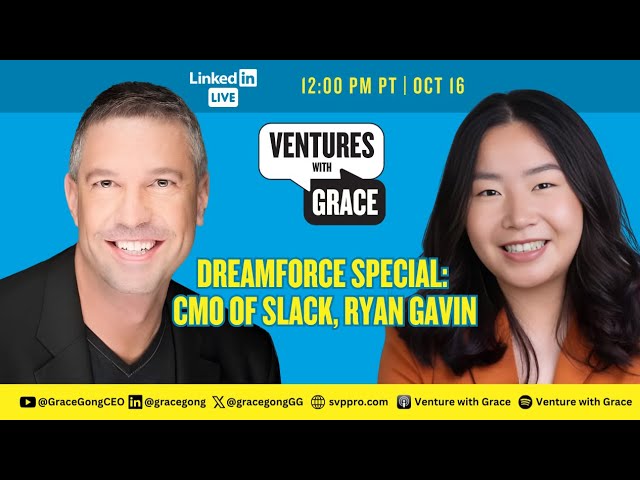
He felt the advantage as a newcomer. Slack's enterprise search let him question roughly ten years of company history that he had not lived through. He could find the original presentation a founder made to an account or ask the basic questions a new executive might hesitate to raise in a crowded room. He has said that he now sends fewer than five emails a week, preferring a shared record to knowledge trapped in private inboxes.
This explains the Monday question. It is not impressive because a bot summarizes messages. It is impressive if the summary directs finite executive attention toward the people and decisions that need it. Software begins to resemble management infrastructure: institutional memory with a conversational interface.
“Agents are trained on data, but that context is what turns agents into true teammates - and that context lives in conversations.”Ryan Gavin at Dreamforce 2025
The marketer as an operator of agents
Gavin expects the job descriptions inside marketing to loosen. People often define themselves by the channel they run: events, email, analytics, creative, brand. He would prefer “business driver,” a person who may code one day, design the next and assemble a small agency of specialized agents around a customer problem. It is an expansive view, but it comes with a sober clause. Humans do not get to surrender responsibility for quality simply because a machine produced the draft.
That combination of curiosity and accountability is more useful than either the carnival barker or the scold. Gavin argues that AI should be multiplayer. When one employee discovers a better workflow, the advantage should become a team capability rather than a private trick. Slack's ambition is to host that exchange, allowing agents from different vendors to sit in the same rooms as the humans and business systems they assist.
He predicts that within a few years some workers may talk to agents as often as they talk to human colleagues. It is a provocative forecast, and the details deserve scrutiny. Agents can be inconsistent. Permissions matter. The cheerful instruction to “just ask” conceals difficult work in governance, data architecture and trust. Gavin does not deny those constraints; his answer is to inherit the controls and context of the place where work already happens, then make the interface ordinary enough that people do not require a fresh manual.
The career comes full circle here. Search taught him that an interface can be a question. Surface taught him that software becomes different when joined tightly to its environment. AWS taught him how to make a technical capability legible to enterprise buyers. Convoy taught him that a model eventually meets the unruly world. Slack asks him to combine the lessons while the category is still wet paint.
For all the talk of digital coworkers, Gavin's rule about gratitude lingers. Use the agent to retrieve the forgotten decision. Let it scan the channels you could never read. Ask it where the team is stuck. But when somebody has done good work, send the note yourself. A company may need a better memory. People still need to know that another person noticed.