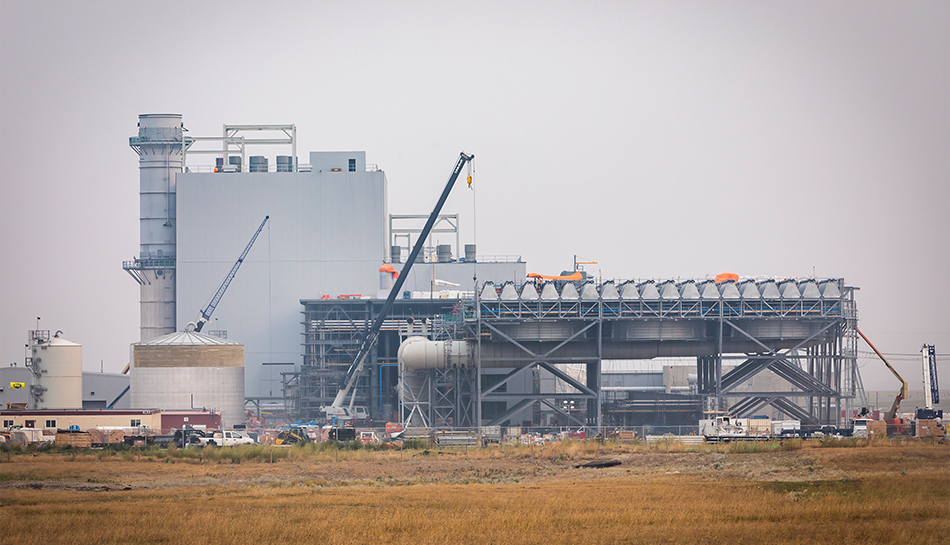
The easiest way to understand Ryan Dunlop's work is to begin with what eventually disappeared. Trenches were opened, utilities were laid, foundations were excavated and the ground was shaped to drain. Then much of it was covered. Above that hidden layer, SaskPower's Chinook Power Station rose from the prairie near Swift Current. The finished plant is steel, stacks and generation capacity. Dunlop's part of the record is closer to the dirt: the conditions that let everything else stand.
Dunlop is a civil and mining professional based in Martensville, Saskatchewan. His current listing places him with Peter Lucas as a civil consultant and superintendent supporting Cameco's sustaining projects, CMO and Technical Services. He has also announced a Civil Field Superintendent position with Cameco's CMT Technical Services team at Key Lake. The move keeps him close to the same kind of problem he has spent his career solving: how to turn an engineered plan into orderly, safe work in an industrial environment.
His public biography is compact. It says he has more than 15 years across civil, mining, oil and gas work. The more revealing document is his description of Chinook. It reads less like a résumé than a site walk. Stripping and grubbing. General grading. Roads and laydown areas. Fencing, drainage, culverts and retention ponds. Excavation around the main power block. The nouns keep arriving because a working site is made from dozens of systems that must coexist before the signature equipment can do anything at all.
The project beneath the project
Construction stories usually point upward. We photograph cranes because cranes make progress legible. Civil work asks the eye to look down. At Chinook, Dunlop recorded the installation of 20,000 linear metres of underground HDPE, carbon-steel and Air-Pro piping. The services included gas, compressed air, steam, storm sewer, wastewater, potable water, sanitary lines and fireline. Put end to end, that underground run would stretch from downtown Saskatoon to the northern edge of Martensville, with distance left over.
Each line created an interface. A trench could conflict with a foundation. A delivery could arrive before a laydown was ready. A drainage decision could change the condition of the next workface. These are ordinary construction risks, which is precisely why they matter. They rarely announce themselves as strategic problems. They arrive as a muddy access road, a late excavation or a crew waiting for another crew to clear the area.
The superintendent lives inside those interfaces. Drawings express intent. Crews bring trade knowledge. Equipment creates physical limits. Weather edits the plan without asking permission. The field leader has to keep the system readable to everyone: what is ready, what is blocked, who owns the next move and which hazard changed since yesterday.
Eight systems underfoot
This is where Dunlop's detailed project list becomes a useful management lesson. Big outcomes are downstream of small conditions. A reliable handoff does not need drama. It needs a work area that is genuinely ready, a scope boundary that is understood and a problem surfaced early enough to remain cheap.
“I was very proud and gracious to be a part of this project.”Ryan Dunlop, on the Chinook Power Station work
The unglamorous scope
Dunlop's account does not stop with earthworks and pipe. It includes site security, snow removal, dust control, loading and unloading, housekeeping, carpentry support and heavy-equipment operators. That collection might look miscellaneous from outside the fence. On site, it is the operating system.
Snow is not weather when it blocks access; it is schedule. Dust is not atmosphere when it limits visibility or affects neighbouring work; it is control. Housekeeping is not cosmetic when clutter creates hazards or slows a crew; it is production. A load that cannot be received at the right place and time turns procurement success into field congestion. The superintendent's range expands because every overlooked service eventually introduces itself as somebody else's delay.
A field handoff, simplified
The value sits in the arrows. Most field risk appears where one scope becomes another crew's starting condition.
Chinook offers a large canvas for this work. Construction began in January 2017. The completed station was a $605 million investment with 353 megawatts of capacity. SaskPower says more than 600 people worked on the site at peak construction; Dunlop's own account puts the peak above 750. Those figures likely reflect different moments or definitions on a changing project. What matters for the field is the coordination burden: hundreds of people, multiple employers and many scopes sharing finite space.
The plant's combined-cycle design adds another layer to the picture. A gas turbine generates power first. Its hot exhaust is then captured to make steam, which drives a second generator. The arrangement extracts more useful work from the same fuel than a simple-cycle plant. For the civil team, the elegant thermodynamic idea arrived as a dense physical reality: equipment foundations, pipe corridors, underground services, drainage paths and access that all had to agree with one another.
Early progress gives a sense of the pace. Within the first months, the wider project had removed dirt equal to 35 Olympic swimming pools, driven 1,300 steel piles, placed 3.5 kilometres of underground conduit and piping, and poured 1,850 cubic metres of foundation concrete. Those are whole-project figures, not Dunlop's personal totals. They show the environment in which his civil scope moved: many permanent decisions being made quickly, with little room for one buried conflict to become a later surprise.
The station also carried a local dimension. More than $140 million in contracts went to Saskatchewan companies, including more than $9 million connected to Indigenous contractors, suppliers and workers. Dunlop singled out the jobs provided to local companies, contractors, local people and Indigenous groups. Pride in the build, in his telling, included who had a chance to participate.
Safety as a way of sequencing work
Dunlop wrote that the main priority, regardless of the size of the task, was maintaining a safe workplace. He credited the combined Allan Construction, Burns & McDonnell and contractor team with reaching one million hours without a lost-time incident. The milestone belongs to a group, not to one manager. Still, his emphasis says something about how he reads a project.
Safety at this scale cannot be stored in a policy binder. It has to show up in sequence. Has the excavation been protected before another crew enters? Is the haul route separate from foot traffic? Does the next shift know what changed? Is pressure to recover time creating a new exposure? The useful part of a safety culture is not the slogan. It is the quality of the next decision.
This is also why safety and productivity are often closer than they first appear. Clear access helps people move and reduces risk. Clean laydown areas improve material handling and visibility. Defined ownership prevents both delay and confusion. Early reporting gives a team more options. The same discipline that prevents an incident can make the schedule more believable.
A superintendent's product is confidence: the next crew can arrive, understand the conditions and begin without inheriting a surprise.
From Swift Current to Key Lake
Dunlop's current chapter takes that field logic into Saskatchewan's mining sector. Peter Lucas describes its business as project delivery for industrial environments, supported by mentorship, project tools and teams that can begin assignments quickly. Dunlop is listed as a civil consultant and superintendent supporting Cameco sustaining projects and technical services. His own update names Key Lake and a Civil Field Superintendent role with Cameco's CMT Technical Services team.
The asset has changed, but the operating questions rhyme. Sustaining work happens around facilities that already have obligations, constraints and established routines. The task is rarely to build on an empty page. It is to introduce change without losing control of what is already running. That makes interfaces, access, sequencing and communication even more valuable.
A career like Dunlop's is easy to flatten into titles: superintendent, consultant, field superintendent. The project list restores the texture. His work exists where a drawing meets frost, where a pipe route meets a foundation and where one contractor's finish becomes another contractor's start. It is management expressed through physical conditions.
There is an appealing modesty in that kind of work. Once the job is finished, the temporary services leave. The trenches close. The drainage works quietly. The road feels inevitable. Visitors see the plant, not the decisions that prepared the ground for it. The absence of surprise becomes the achievement.
Dunlop's record suggests a practical standard for project professionals: look beneath the visible milestone. Ask what had to be true first. Someone had to clear the ground, resolve the conflict, line up the service, make the workface safe and hand it forward. Large infrastructure is built from that accumulation. The skyline comes last.