On a mine site, the missing person is never merely a missing person. A scheduler arrives late and the forecast blurs. A project engineer leaves and takes six months of context along. A construction manager who looks perfect on paper turns out to be allergic to ambiguity, contractors or twelve-hour days in February. The resulting delay costs more than a recruiter’s fee. This is the narrow, expensive problem Peter Lucas has spent 15 years learning to sell.
The Saskatoon company provides project managers, engineers, controls specialists, procurement people and advisers to mining, energy and heavy-industrial owners. Founder and CEO Jared Peterson started it in 2011. Today, LinkedIn shows 61 employees, and the company operates through three service models: a managed Project Management Office, specialists seconded into client teams, and advisory work for thornier questions in reliability, risk, governance and execution.
The useful distinction is what Peter Lucas is not. It is not a giant engineering house hired to design everything and hand over a binder. It is not a staffing agency that disappears once a chair has a body in it. The company wedges itself between the two - more personal and embedded than the former, more technically managed than the latter. Its people are meant to behave like part of the owner’s team, while still drawing on mentorship and tools back at Peter Lucas.
The opening
The resume pile was never the product
Peter Lucas says the normal recruiting, hiring and onboarding cycle can run about 10 weeks; it advertises the ability to begin delivery in as little as three. Speed alone would be a dangerous pitch in a uranium mine or power station. The mechanism matters: a roster of vetted professionals, matching that considers experience and team fit, then support after placement. The firm calls the software layer beneath this process the Bench.
Built by an in-house team, the Bench gives clients a view of candidates’ skills, strengths and experience. Its project-focused personality testing attempts to answer the question ordinary resumes dodge: will this person work with this particular group under these particular constraints? A revamped public beta arrived in December 2024 with a resume parser, while a database of completed projects and internal forums were described as upcoming features. The ambition is modest but smart - turn scattered institutional memory into something searchable.
Three ways into the same problem
This only works because Peter Lucas chose a market where context is costly. Its published work reaches across scoping, feasibility, estimating, engineering, procurement, scheduling, cost control, contractor coordination, quality, safety, commissioning and operational readiness. Those are less a menu than a map of all the seams where a capital project can leak time.
“What stood out…was how their responses to our request for potential staffing was well structured and catered to our specific requirements.”Booker Kenny, SaskPower manager of generation construction
Proof in the dirt
A business built inside other people’s projects
The customer list explains the operating model better than any pitch deck. At Nutrien’s Allan potash mine, embedded project and engineering professionals support underground and surface capital initiatives. At New Gold’s New Afton site, the work has included procurement, contracts, forecasting, reporting, scheduling and a document-management system. At Vale’s Thompson Mine Expansion, Peter Lucas staff developed work packages, coordinated construction, watched contractors and reported into the project team.

Advisory work travels a different route. Cameco’s northern reliability and maintenance teams have used Peter Lucas for consulting, coaching and mentorship intended to build internal capacity, identify risks and improve maintenance practices. Saskatchewan’s Water Security Agency first used the firm for project coaching and PMO support; Peter Lucas later announced a management assignment on the Grant Devine improvement project. SaskPower says its relationship grew from estimating services to contracts across transmission, distribution and generation construction.
The most concrete public case is a greenfield dry-fertilizer transload facility. Peter Lucas says it oversaw design and execution of the US$23 million project, which reached operation in the second quarter of 2024 - less than 15 months after approval, including contractor mobilization and commissioning. The photo is pleasingly unromantic: a large building, raw ground, rail cars and several machines getting on with it.
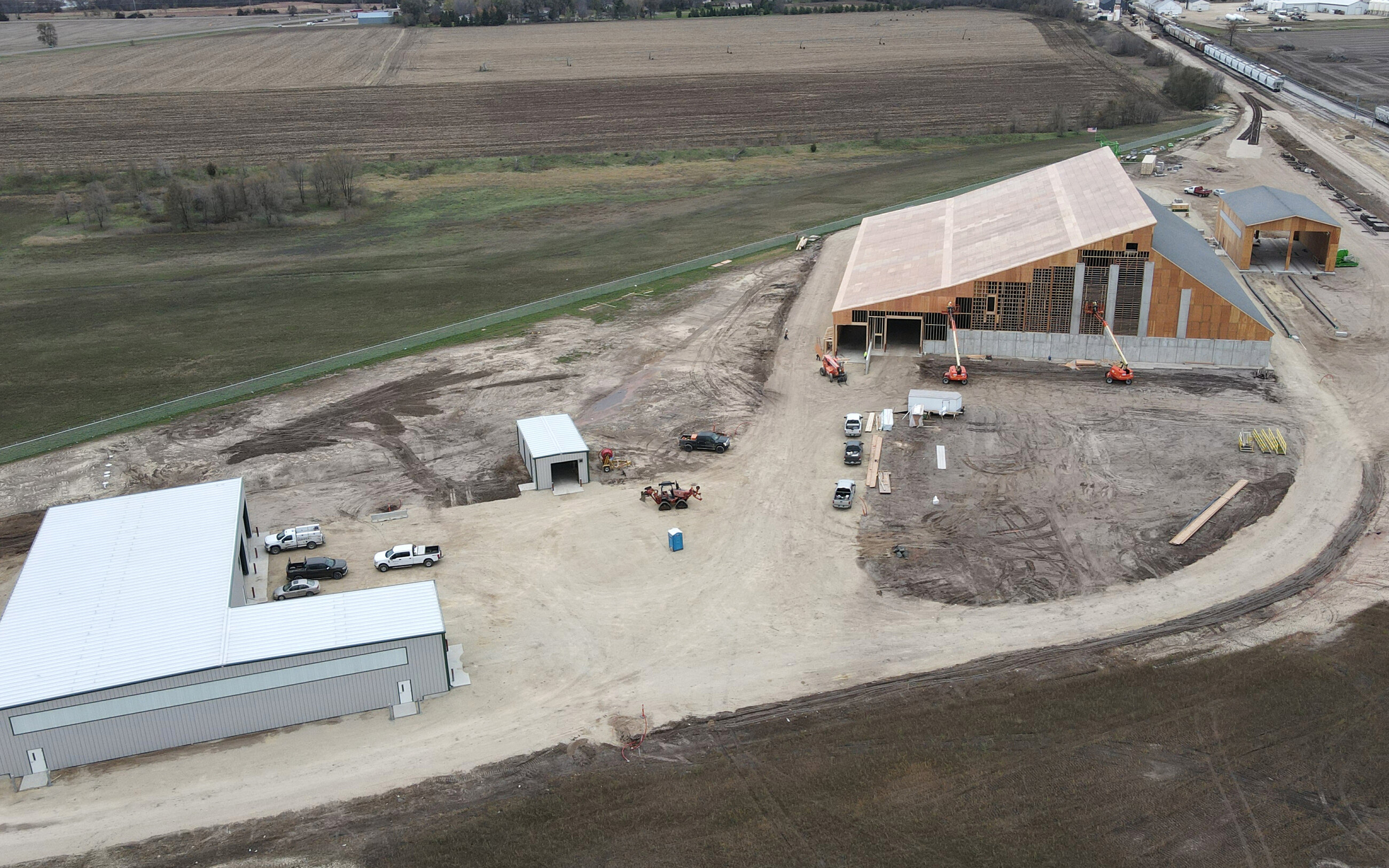
What did it cost? The facility cost is public; Peter Lucas’s fees are not. Neither the company nor credible public records disclose its revenue, valuation or outside funding. That absence fits a privately held professional-services business whose economics are more likely to live in utilization, bill rates and repeat accounts than venture rounds.
The business underneath
Sell capacity first. Earn continuity second.
The company makes money from managed project engagements, specialist advice and the time of professionals placed into client organizations. The first purchase may be urgent capacity - an estimator, project manager or controls lead needed now. The durable purchase is continuity. A good embedded specialist learns the site, preserves decisions, builds relationships and stops every new phase from beginning at zero.
That logic makes the company’s claimed repeat rate above 90 percent its most revealing metric. Peter Lucas has worked with Nutrien since the company’s inception. New Gold support began in 2022. SaskPower expanded a narrow estimating relationship across three business units. This is account growth by usefulness, not novelty.
Culture is part of the delivery system. Peter Lucas advertises mentorship, benefits, professional development and more stability than solo contracting, while giving employees access to varied assignments. Its published values are Respect, Trust and Integrity, Pride, Courage and Growth. The firm won an NSBA Team Building Award in 2022, the same year it ranked number 156 on the Globe and Mail’s Canada’s Top Growing Companies list. In 2024, operations leader Keira Sawatzky received a national CIM young-leader award; her work included developing the company’s internal mentorship program with attention to women in non-traditional roles.
There is no documented cinematic failure that changed management’s mind. The more defensible reading is observational: industrial owners repeatedly suffer from slow hiring, weak handoffs and knowledge loss, so Peter Lucas steadily built machinery around those failures. The Bench formalizes matching. Mentorship supports the person after the match. The PMO preserves a repeatable delivery method. Each piece answers a failure mode visible in the customer’s organization.
The clever bit is not finding an engineer. It is making borrowed expertise compound instead of evaporate at closeout.
Steal this carefully
The five-part playbook
Pick a narrow problem where delay is expensive and judgment cannot be bought by the kilogram.
Keep a qualified bench warm before demand arrives. Speed is inventory disguised as service.
Match for the work and the team. Credentials open the door; operating fit keeps the project moving.
Support people after placement. Mentorship converts a transaction into a managed outcome.
Capture what completed work taught you. A repository, forum or plain checklist beats heroic amnesia.
Begin with a small wedge, then expand only when the client can point to value already delivered.
The conditions are important. Peter Lucas is strongest when an owner needs capable people integrated into an existing organization, wants to retain control of decisions and values long-term site knowledge. It also benefits from industries where projects recur - sustaining capital, expansions, reliability programs and infrastructure portfolios - because each engagement makes the next match easier.
Good fit
- Owner-led capital programs
- Specialized, changing scopes
- Recurring project portfolios
- Knowledge retention matters
Wrong wrench
- Fixed-price turnkey delivery
- No owner-side leadership
- Lowest hourly rate wins
- One-off commodity staffing
It is a poorer fit when a buyer wants one contractor to assume a fixed-price turnkey scope, when the owner has nobody capable of directing embedded staff, or when procurement treats every project professional as an interchangeable hourly rate. A three-week start is also less meaningful when the role is generic and plentiful. The model earns its keep where the learning curve is steep and a mismatch is expensive.
Peter Lucas now has a growing presence in Kamloops, British Columbia, led by procurement expertise and local relationship-building. That expansion points toward more Western Canadian mining work, but the underlying bet has not changed. Mines, utilities and industrial plants will keep running projects. Their org charts will keep developing temporary holes. The firm that fills those holes quickly, remembers what happened and helps the borrowed expert act like an owner has a durable reason to exist.
It is not a glamorous formula. That may be the attraction. In a market full of enormous equipment and heroic renderings, Peter Lucas sells the connective tissue - the person who notices the schedule is fiction, the handoff that keeps a decision alive, the controls that make bad news visible while it can still be useful.
Go deeper
Explore the company, its public project portfolio, current opportunities and the interview in which Peterson discusses the growth of Peter Lucas from a startup into a 60-plus-person team.