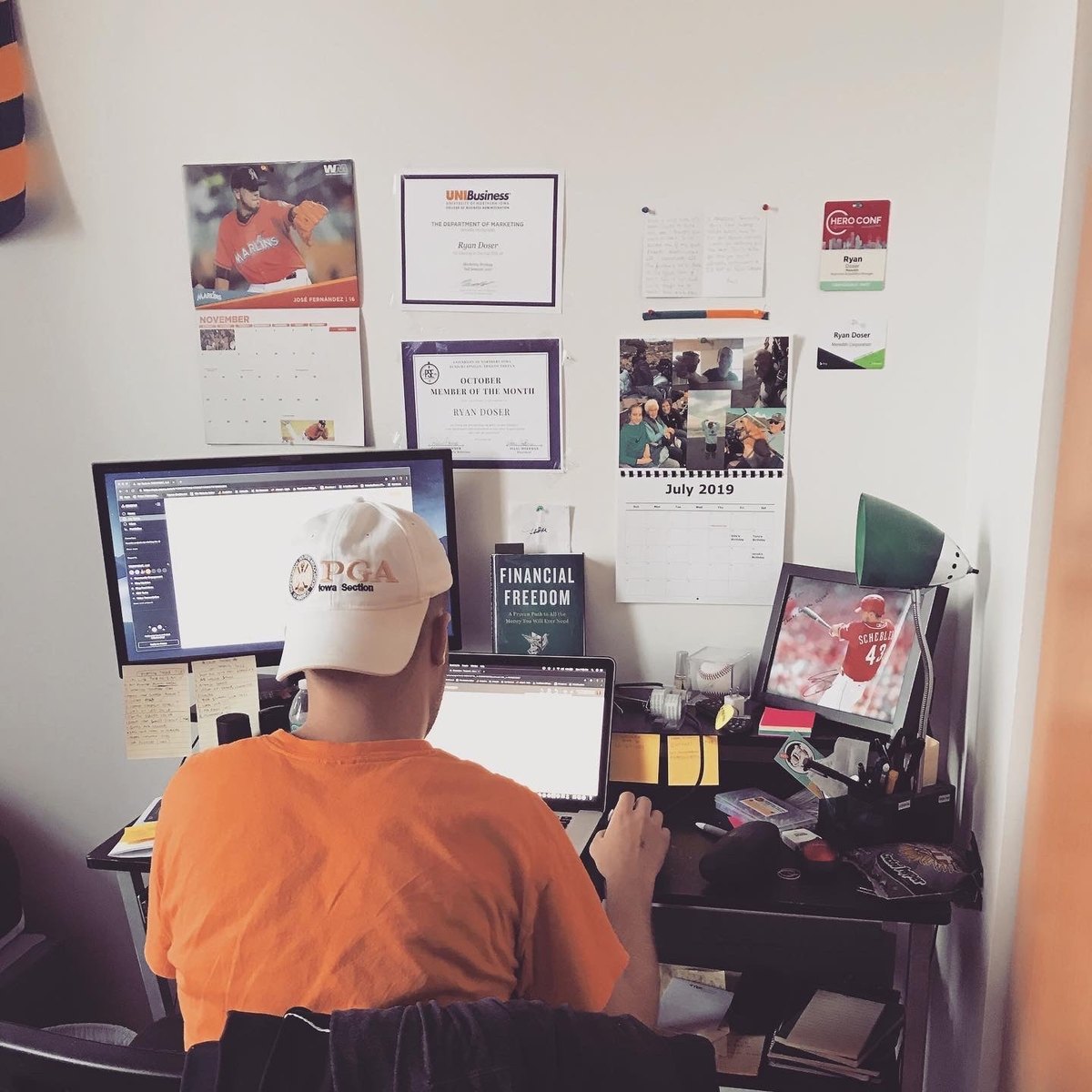
The calendar says July 2019. A baseball player hangs over a narrow desk. Two screens compete for room with notes, certificates, a lamp, and a book titled Financial Freedom. The photograph Ryan Doser took on his first day working for himself is a better business portrait than a boardroom could offer. His back is to the camera, his cap pulled low, his attention on the laptop. There is no staff, no grand office, and no evidence that the next seven years have been written. There is simply a person at work.
Doser had left a paid media job at Meredith Corporation, where he handled campaigns for titles including People and Better Homes & Gardens. He had already been building side blogs, learning SEO, affiliate marketing, and email by trying things and watching what happened. When the first client arrived, he chose the uncertain route. He was 23, he later wrote on LinkedIn. The compact desk became the headquarters of a business he called ThriveOneFive Media.
A T-shirt site was an early clue
The appetite for making a small project measurable was already visible at the University of Northern Iowa. Doser studied marketing there between 2014 and 2018. In his senior year, he built an ecommerce site for a homecoming T-shirt project and led the online marketing. His LinkedIn record says the campaign sold more than 850 shirts in three weeks, generated over $12,000, and drew more than 10,000 page views. Those are modest numbers by magazine-company standards. For a campus project with a short selling window, they are refreshingly concrete.
That same year, his Pi Sigma Epsilon team won a national award for social media strategy. Earlier, in 2014, he placed first in Iowa and eighth nationally in a digital media production contest. These projects did not forecast AI marketing. They did reveal a habit: build the thing, put it in front of people, and count what follows. At Meredith, he learned the discipline of paid search on large media brands. Outside work, he experimented with WordPress sites. Each side of that education had a use when he went out on his own.
What happens when the headcount stays at one?
A small agency is often described as a prelude to a larger one. Doser has resisted that script. On his site, he says he runs a six-figure marketing agency solo. He explains the decision with a line crisp enough to fit on the edge of his desk: “Systems beat headcount.” He worries that adding people can dilute the quality attached to his name. That is his judgment about his own operation, rather than a rule for every business. It has shaped how he works, what he teaches, and what he sells.
The work has moved across several kinds of marketing. His agency once emphasized paid campaigns, WordPress development, and local SEO. Today, he describes projects involving commercial search, AI search visibility, websites, and automations. A client may need a useful service page; another may need a clearer path from a YouTube video to an article or newsletter. The tools change. Doser keeps looking for a repeatable way to do the next assignment without letting speed decide the quality.
“Systems beat headcount.”Ryan Doser, on the design of his solo agency
That choice has an amusing side effect: a marketer who describes himself as non-technical now spends much of his day inside a coding tool. In a 2026 conversation with Audrey Chia, he said the terminal initially made him hesitate. He started anyway, learned by working on real projects, and now builds reusable instructions for research, SEO, design, and content. He presents the awkward beginning as part of the lesson. There is no need to have been a programmer at 12 to learn how to make a useful workflow at 30.
The camera did not erase the SEO brain
When Doser began posting regularly to YouTube around 2022 and 2023, he brought along a search marketer’s instinct. He looked for questions people were already asking, then made long videos that answered them. In the Chia interview, he called the path from zero to 1,000 subscribers “a dog fight.” The phrase is more useful than a tidy growth chart: it admits that searchable, careful work still takes time before anyone notices.
He argues that a tutorial targeting a specific query can keep being found months after publication. A review of an AI tool might appear in YouTube search, Google results, and a later blog post. That is a different rhythm from reacting to every product announcement. The audience on his channel has grown to more than 39,000 subscribers, and his site reports over 3 million views. Those figures are his published counts, and they sit beside a more revealing claim: the videos that have brought him consulting, affiliate revenue, and community members were often built around keywords.
His content has become a working part of the agency rather than a separate stage act. He records a process, explains it, and can turn the result into an article, newsletter, or client conversation. In an interview with Olivia Mansion, he demonstrated how one video can become a search-focused post with screenshots and links. The demonstration matters because the underlying task is visible. Viewers can see where a human decision belongs and where software saves time.
Doser has said that his agency made up about 70 percent of his revenue when he spoke with Chia in April 2026. The figure is self-reported, but it explains the emphasis of his tutorials. A video is valuable to him when the technique survives client work. He is unusually candid about the incentives facing creators whose main business is the audience itself. His version of credibility is mundane and fairly demanding: try the workflow on a deadline, then show people the parts that hold up.
Building in publicA newer search experiment, in plain numbers
In February 2026, Doser says his personal site began from zero search authority. Six months later, screenshots on his about page showed 5,770 Google Search clicks and 890,000 impressions, along with 12,100 AI citations tracked in Bing Webmaster Tools. These are measurements from his own dashboards, presented by him. They show the scale of the experiment he is willing to put in public view. They also explain why AI search has become a prominent part of his consulting: it is a problem he has been working through on his own pages.
His approach to those pages favors clear answers, comparison pages, structured information, and subjects tied to a buyer’s decision. He says he has moved away from chasing broad informational keywords as AI summaries absorb more of those visits. One can disagree with the scope of that prescription while appreciating its specificity. He does not present a mystery formula. He points to particular pages, search reports, and the commercial questions they address.
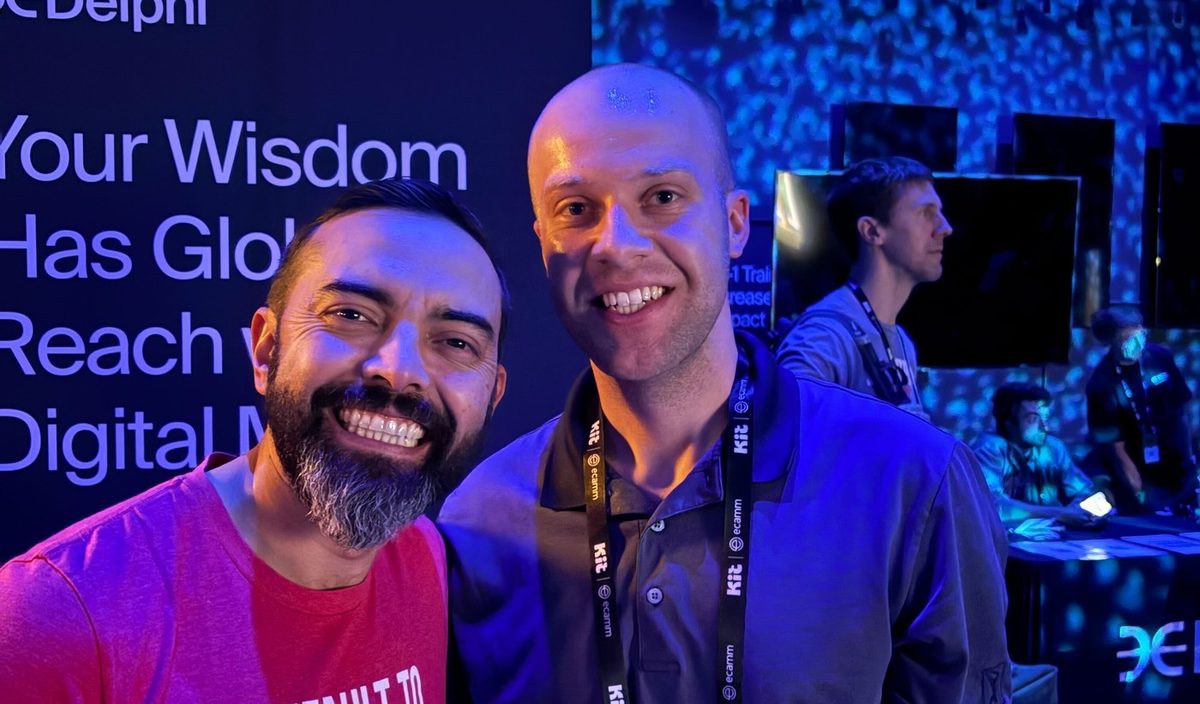
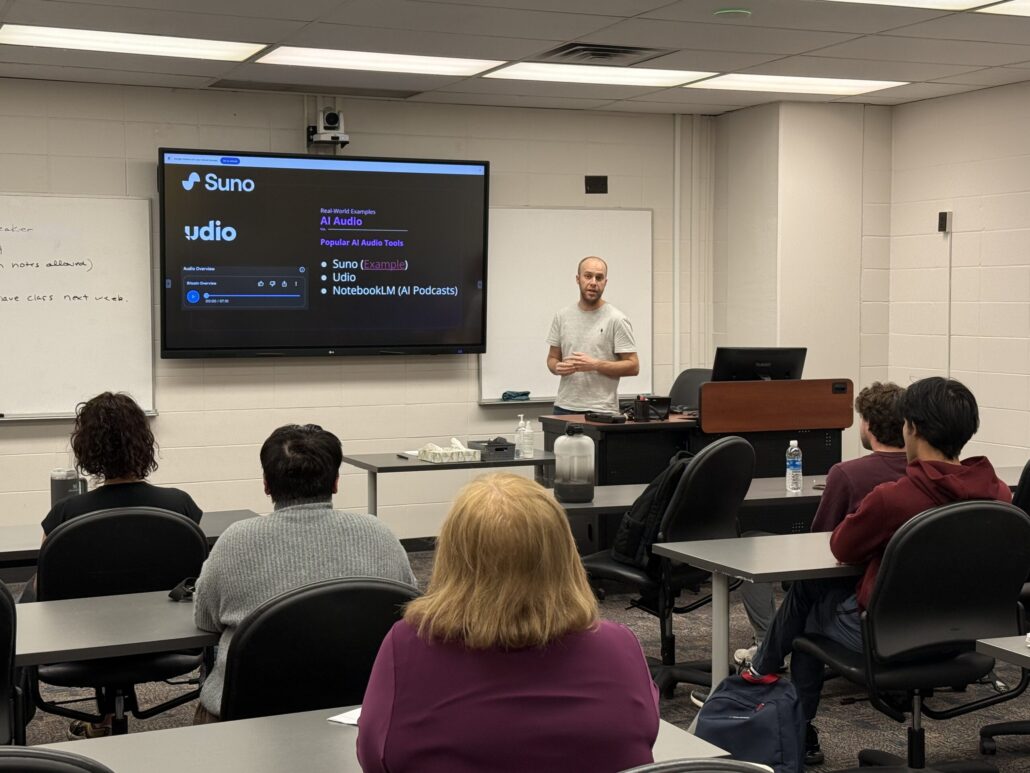
The work has taken him beyond his Des Moines desk. His site shows him teaching at DMACC, joining podcast conversations, appearing on Ticker News, and meeting Pat Flynn at Craft + Commerce. He has spoken with creators and operators about search, automation, and the odd new problem of producing more material than an audience can trust. His own AI Marketing Insiders community had more than 2,000 members by the count on his site. He also reports more than 10,000 newsletter subscribers. These are audiences built around lessons from the same solo operation.
The long middleThe photograph still makes sense
There is a temptation to turn Doser’s story into a simple victory for automation. The July 2019 photograph makes that too easy to resist. Before the reusable skills and the videos, there was a marketer learning from campaigns, a student selling shirts, a new agency owner with a first client, and a desk crowded enough to serve as a biography. The later systems came from that sequence. They have a subject because there was work to do.
His public voice is impatient with flashy AI advice, sometimes funny about it, and firmly attached to practical demonstrations. He told Chia that the early YouTube years required consistency; he tells prospective consulting clients that a search result takes time to change. He is selling a set of services and products, certainly. He is also exposing the method behind them, down to the occasional failed attempt. That candor gives readers a fair chance to judge the work for themselves.
Seven years after the first-day photo, Doser still describes himself as a one-person operator. The room around him is larger now: videos, subscribers, clients, a community, and a library of reusable tools. The original bet has stayed recognizable. He wanted to make a living on work he could stand behind. The software has helped him keep the desk, figuratively at least, to himself.