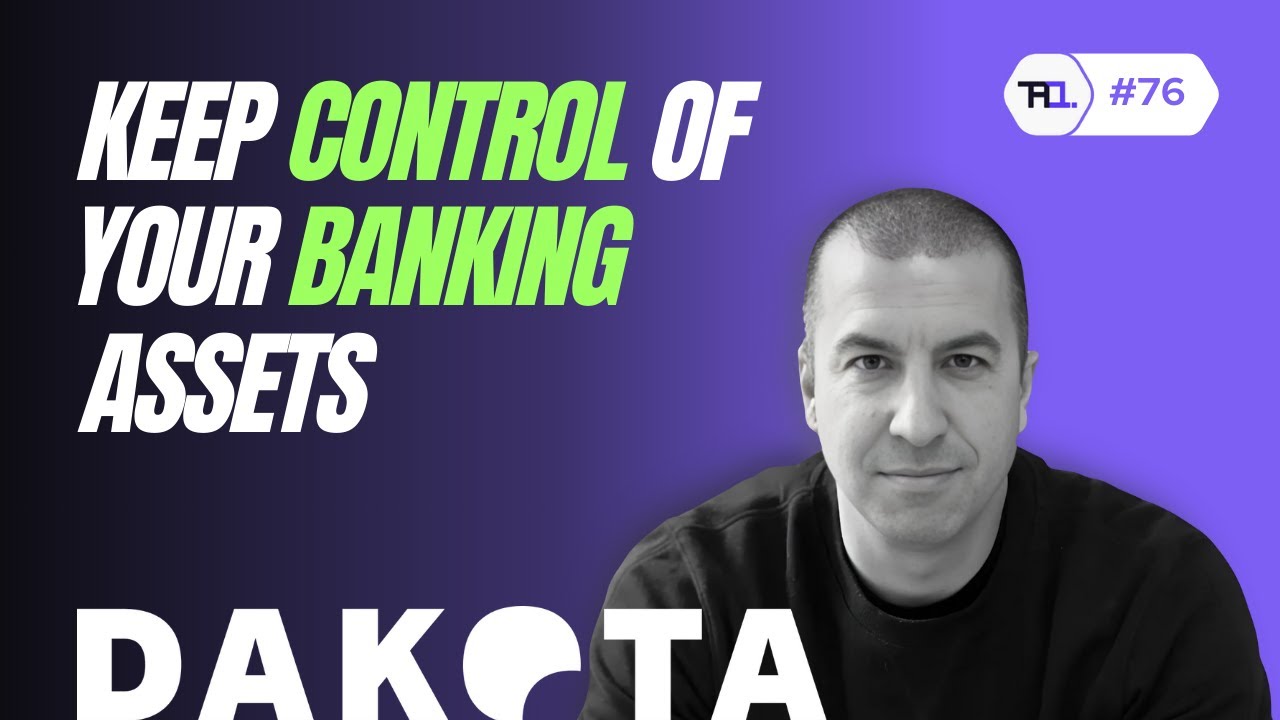
Money is a peculiar traveler. It owns no luggage, complains about no legroom and still manages to spend five days crossing an ocean. Ryan Bozarth has built a career around the suspicion that this is unnecessary. At Dakota, the company he co-founded in 2022, his working question is plain: if information can move around the world in an instant, why does a business payment still behave like a diplomatic pouch?
The answer lies in the plumbing. A cross-border transfer can pass through a procession of banks, ledgers, compliance checks and settlement windows. Each institution keeps its own clock. Each takes another look. The customer sees one button and then waits while an invisible committee considers the matter.
Bozarth's solution is not to ask businesses to become crypto hobbyists. Dakota places stablecoins beside the rails companies already know: ACH, wire transfers, SWIFT, SEPA and local fiat. Its current platform describes itself as a regulated operating system for programmable global money, combining payments, wallets, foreign exchange, stablecoin issuance and compliance in one API. The blockchain may do part of the carrying. The customer should not need to admire the engine.
A career assembled at the seams
Bozarth arrived at this thesis by moving through a useful sequence of companies. He worked at Sony, then held a general manager role at Square as the payments company was teaching small businesses to accept cards with a tiny white reader. He later worked in product at Airbnb, where software had to make an unfamiliar transaction between strangers feel ordinary. Both jobs lived at a seam: technology on one side, trust on the other.
At Airbnb, an employee discussion group called “Block BNB” pulled him deeper into cryptocurrency. The name was a wink; the curiosity was serious. By 2018 he was working full time in the field as Anchorage Digital's first Head of Product. The challenge had changed from helping people trust a home listing to helping institutions trust the custody of digital assets. He later became CEO of Coinbase Custody, overseeing another business built around safeguarding assets that cannot be treated casually.
The route matters because Dakota sits at the intersection of those lessons. Square offered a view of payments as a product. Airbnb sharpened the customer journey. Anchorage made brand, security and institutional confidence unavoidable. Coinbase Custody supplied scale and a close view of how companies actually hold digital assets. Dakota gathers the pieces into a single proposition: regulated financial tools whose newer machinery does not make the interface feel foreign.
The storyboard in the bank
One of Bozarth's most revealing product habits came from a wall at Airbnb. Inspired by the way Disney developed Snow White, the company mapped a guest's journey in frames: searching, booking, arriving and living through the stay. Teams marked moments green, yellow or red according to the quality of the experience. A grand marketplace became a row of very specific human moments.
At Dakota, Bozarth says the team has done something “quite literally” similar. This is a pleasing image: a stablecoin platform, bristling with regulatory and technical machinery, being judged with colored marks on a storyboard. It also reveals a sober view of innovation. A payment is only fast if the onboarding made sense. An account is only global if a legitimate company can actually open it. A programmable wallet is only useful if its controls can be understood by the people accountable for the money.
He carried another lesson from Anchorage. In institutional finance, trust is not a final coat of paint. It is part of the product specification. Behind a tidy interface sit customer verification, sanctions screening, transaction monitoring, reserve attestations and the policies required to satisfy partners and regulators. Bozarth speaks about this machinery with an operator's patience. The button is easy to photograph. The controls behind it are the business.
A bank account becomes an operating layer
Dakota began with language that was easy to picture: a crypto-powered business account. Customers could hold dollars or stablecoins, make traditional payments and access treasury products from one place. Bozarth argued that stablecoins backed by U.S. Treasuries could give companies a more direct form of asset ownership while making international transfers quicker.
By July 2025, the company reported more than 500 business customers and about $1.6 billion processed over the previous year. Most customers were outside the United States. The geographic mix points to the practical demand beneath the crypto vocabulary: access to dollar-denominated accounts and a dependable way to pay across borders can be valuable on their own.
The framing has since widened. Dakota now sells infrastructure to companies building neobanks, contractor payouts, embedded finance products and stablecoins of their own. Its website offers payments, wallets, foreign exchange across 19 currencies, issuance and compliance tools through one platform. The account was a doorway into a deeper business: supplying the regulated stack beneath other financial products.
The abstraction Bozarth is building
and fintech builders
API + compliance
stablecoins · FX · wallets
This shift also changes who can build. Bozarth argues that the previous generation of neobanks took 12 to 18 months and millions of dollars to stand up. With self-service infrastructure, he says, a team can begin in days or weeks for tens of thousands. Dakota dramatized the claim by building a working neobank with real accounts, compliance and an outbound transfer in under nine hours, then opening the prompts and sandbox as a public challenge.
The challenge is a tidy summary of his operating style. Start with a provocative clock, then insist on the unphotogenic parts: real accounts, real compliance and a transfer that reaches a regulated rail. A quick mock-up can flatter the builder. A completed transaction must satisfy every system in its path. By publishing the prompts and leaving the sandbox open, Dakota turned a private demonstration into a repeatable test. Bozarth's point was less about winning a race than changing who gets to enter one.
The economics of an ignored customer
Speed makes good demo material. Bozarth is more interested in what happens to the business case. When every financial product requires a bank partnership, a custom compliance program and a seven-figure build, founders serve large and obvious markets. Reduce the fixed cost and smaller groups begin to make sense. He has suggested products for touring crews with sporadic income, truckers, veterans and other communities whose financial patterns deserve more than a generic account.
This is the humane part of an infrastructure argument. Financial inclusion is often described as a matter of intention. Bozarth recasts it as a matter of unit economics. A founder can sincerely want to serve a narrow market and still be defeated by the cost of assembling the rails. Lower the cost, and conviction has somewhere to go. His compact instruction is “Build for everybody.”
There are limits to the neatness. Money movement carries regulation, fraud risk, sanctions obligations and the possibility of software making a very expensive mistake. Dakota's latest interest in agentic payments therefore comes with human-signed mandates and limits enforced in infrastructure. Programmability without policy would be a clever way to create a crisis. Bozarth's custody background makes the guardrails part of the appeal.
The quiet future of a loud technology
Stablecoins spent their first decade in a noisy neighborhood. Bozarth's aspiration is quieter. He expects them to become standard infrastructure for cross-border transactions and a foundation for new fintech products. In that future, a company need not discuss blockchains at the weekly finance meeting. It chooses a currency, sets a policy and sends the payment. The rail becomes interesting mainly when it fails to work.
His career has prepared him for precisely this kind of disappearing act. Square turned card acceptance into a small object and a clean screen. Airbnb organized a complicated marketplace into a booking flow. Custody businesses made cryptographic key management feel like an institutional service. Dakota wants to compress another pile of difficulty into a reliable interface and an API key.
Bozarth's favorite maxim gives the project its proper scale. Quality is a habit because infrastructure is tested by repetition. The thousandth transfer matters as much as the first. Compliance must work on a tedious Tuesday. A customer journey has no patience for a red square simply because the underlying technology is novel.
Money may never become as light as information. It carries law, ownership and consequence wherever it travels. Bozarth's wager is that it can still learn better manners: fewer unnecessary stops, clearer control and software that respects both speed and responsibility. The pipes can be modern without becoming visible. In fact, invisibility may be the proof that the work is done.