Rosser B. Edwards wanted to run Northern California. More precisely, he wanted to run the Northern California region of Charles Pankow’s construction company. He asked. Pankow declined. Edwards had been talking with two developers about starting a business, and now the conversation acquired a deadline. On January 19, 1971, Edwards, David Boyd, Bill Wilson and Miller Ream incorporated Webcor. An unsuccessful request for a promotion had helped produce a new employer.
It is an agreeable founding story because the ingredients are so ordinary: a colleague, two clients, an ambition and a refusal. There is no garage full of mysterious machinery. There are people who already know how to get a building out of the ground. Edwards’s story turns on what happens to that knowledge: who shares it, who gets to use it, and how it survives the departure of the person who carries it.
Ohio was the place to leave
Edwards grew up in Columbus, Ohio, and enrolled at Purdue University in 1956. His friends were heading to Ohio State; he chose a different route. Construction was already the attraction. He completed his bachelor’s degree in civil engineering in 1960, then stayed for a master’s in construction management and structures. There was a personal reason to remain: Gloria, whom he had met at Purdue and would marry, still had two years of pharmacy studies ahead of her.
The extra degree and the relationship belong in the same sentence. A career chronology can make every move look like an exercise in professional calculation. Here, the timetable included another person. In January 1962, master’s degree completed, Edwards left for California. Los Angeles offered work with Peter Kiewit Sons’, in a building division headed by Charlie Pankow.
His early work included estimating and serving as project engineer on Shorecliff Tower, a 13-story apartment building in Santa Monica. That job placed him alongside superintendent Harold Henderson and slipform foreman Red Metcalf. Engineering school had supplied the formal preparation. The construction site supplied colleagues whose skills had to meet in one finished structure.
A theater built around a pile of earth
Metcalf’s recollection of working with Edwards gives the early career a wonderfully physical detail. After their Santa Monica job, Edwards asked him to work on the Valley Music Theater. They had worked closely together on slipforming, and Edwards wanted him for the next assignment. A relationship formed around one construction method became a reason to assemble another team.
The theater in Woodland Hills involved a concrete dome poured over shaped earth. Once the shell was in place, the earth underneath was removed. Metcalf remembered discussing the dome’s behavior with the structural engineer, particularly the tension ring around its base. The technique required people to understand both the temporary support and the structure that would remain when that support disappeared.
A concertgoer could enter the finished theater without knowing that its construction had depended on an enormous earthen form. That is one of the pleasures of building: a laborious, peculiar process can end in an apparently straightforward room. The audience buys a ticket. The builders remember the dirt. Edwards’s preparation for company leadership included work in which an elegant result required rather inelegant intermediate stages.
Four partners wanted a place to build
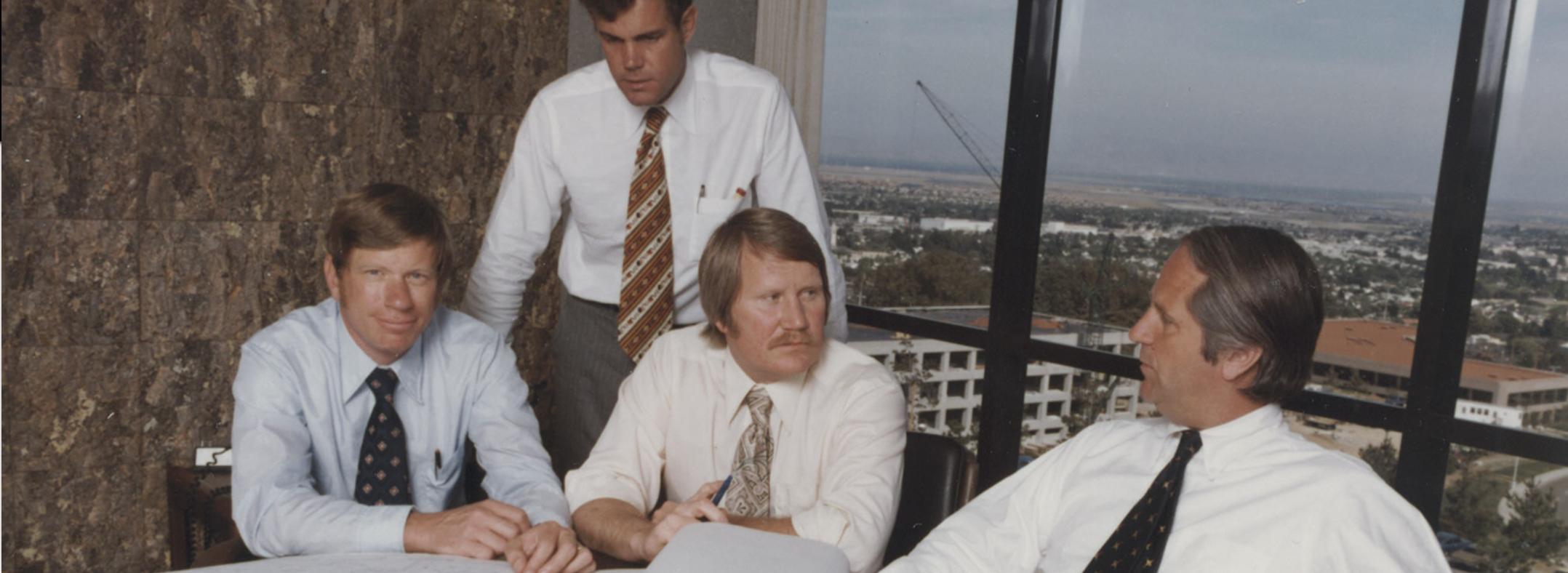
The people who formed Webcor brought different reasons for doing so. For Edwards, the rejected regional leadership request mattered. For Boyd, repeated relocations had become a strain on family life. His work had taken him from Washington State to Toledo, Ohio, on short notice. When Edwards approached him about a company with two developers, the prospect included settling down as well as becoming an owner.
Edwards and Boyd had known each other since Purdue and had worked at both Kiewit and Pankow. Wilson and Ream were developers with whom Edwards had worked at the Borel Estate in San Mateo. The founding group therefore joined construction experience to development experience through existing working relationships. Those relationships had a history before they had a company name.
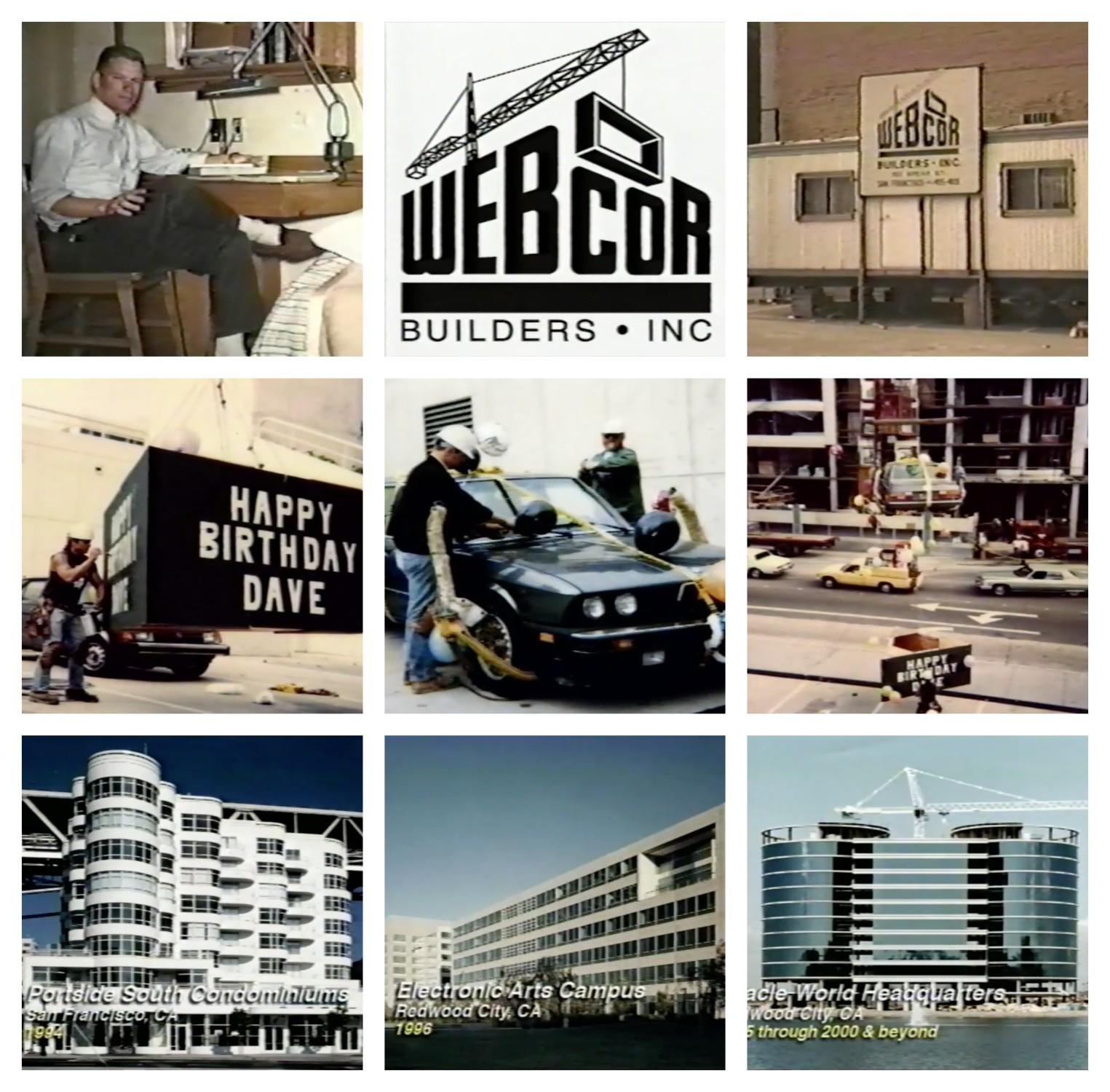
Webcor concentrated on commercial building in Northern California and used design-build, bringing design and construction into a coordinated delivery approach. Its work eventually included headquarters for Electronic Arts, Oracle, Siebel Systems and Sun Microsystems. The geography that appealed to Boyd became fertile ground for a contractor: technology businesses needed actual places in which to put their people.
The name carried a little of the partnership on its face. The E stood for Edwards; Wilson and Boyd supplied the W and B, while the CO came from “company.” A contractor named with pieces of its founders’ names has made at least one early design decision. Everyone has to agree where the letters go.
The company grew hands
Webcor’s development also depended on people beyond the original four. In 1985, Rich Lamb was hired to direct its self-performed interior construction operation. Keeping skilled work inside the company became part of its identity. In construction, a corporate organization chart eventually has to connect with someone installing, forming or finishing something. The distance between those two worlds can be expensive.
At Webcor’s fiftieth anniversary in 2021, executive Matt Rossie described a culture oriented toward building, solving problems and being hands-on. That retrospective matters because it describes an expectation that had continued through successive leaders. The founders’ names remained in the origin story, while the daily work belonged to a much larger cast.
Company milestones supply a sense of pace. Webcor completed its first project, POP1 in San Mateo, in 1972. Its first high-rise, Museum Parc in San Francisco, followed in 1987. Those fifteen years are worth leaving visible. Corporate histories often stack finished buildings so neatly that the years between them disappear. Edwards’s company moved from an initial project to a high-rise over a substantial span of working life.
Leaving took a plan
In 1994, Webcor absorbed A. J. Ball Construction. Andy Ball became central to the next generation of leadership. Edwards and Boyd retired in 2000. The handoff, as Edwards described it later, had involved a gradual arrangement between the older company and a new construction company, with the division of profits shifting toward the younger group over time.
He recalled roughly fifty stockholders, including key employees, and a desire to transition the business rather than simply sell it. By around 2000, he remembered the split reaching approximately 30 percent for the old company and 70 percent for the new one. Those are his retrospective figures, and they describe a process rather than an overnight exit.
A building company must plan for a day when its founders stop arriving at the office. The handoff has its own construction problem: experience, ownership and authority have to move without bringing the enterprise to a halt. Edwards’s account gives that problem a timetable and a financial mechanism. Retirement appears here as something assembled over years.
Obayashi took a controlling interest in Webcor in 2007, after the founders’ retirement. The later company would build projects far removed in scale from its beginnings. That subsequent history belongs to the teams who delivered it. Edwards’s place in the story is specific: he helped create the business and helped arrange its passage to other hands.
The founders returned with the horror stories
Retirement did not end the exchange of practical knowledge. Edwards and Boyd initiated the Webcor Founders Series, a fifteen-session program for younger engineers and project managers. The sessions moved from foundations through other building design elements, explaining how the plans employees used had come into being.
Boyd said employees particularly liked hearing stories about things that had gone wrong, including mistakes involving soil engineering and foundation work. There is a useful modesty in that choice of teaching material. A completed building can suggest inevitability. A story about a mistake restores the decisions, assumptions and consequences that came before it.
The classroom gave the founders another way to remain useful without remaining in charge. A younger project manager could inherit the lesson without inheriting the original mishap. The company had already transferred leadership; now two people who had helped start it were transferring explanations. The unpleasant episode becomes valuable twice: once when it is corrected, and again when someone learns enough to avoid repeating it.
A Saturday with forty-five volunteers
In 1999, Edwards brought forty-five Webcor workers to a volunteer building effort for Bayshore Christian Ministries in East Palo Alto. The organization was getting a 10,000-square-foot classroom and headquarters building. The crew erected walls and beams in a Saturday effort Edwards compared with roughly two weeks of conventional work.
“Even the crane time was donated,” he said. He estimated more than $200,000 in in-kind contributions overall. Plumbing and air conditioning came through donations, and a carpeting mix-up at another Webcor job supplied flooring. Construction expertise included knowing whom to call and recognizing when an otherwise inconvenient surplus could become useful somewhere else.
Edwards also chaired the board of Holt International Children’s Services. In that period, he spoke about easing back at Webcor and applying his building experience to nonprofit ventures. The classroom project gives that aspiration a concrete shape: skilled colleagues, donated systems and a usable building. Generosity arrived with a work schedule.
“Even the crane time was donated.”
Ross Edwards, discussing the 1999 volunteer building effort
Knowledge has somewhere else to go
Edwards and Gloria also appear among donors to Purdue’s Bowen Laboratory for large-scale civil engineering research, in its $25,000 to $99,999 giving category. Webcor and Boyd appear on the donor list too. An engineering education had helped connect the founders; support for engineering research put resources back into a setting where structures could be tested and understood.
The Edwards Family Foundation’s 2025 return lists Rosser Edwards Sr. as CFO, Gloria as secretary and treasurer, and Rosser B. Edwards Jr. as CEO. It records $166,500 in charitable disbursements for that year. These are foundation figures, belonging to a separate organization and purpose from the construction business.
In January 2021, Edwards joined Tom Soohoo for a Webcor anniversary podcast conversation. Nearly fifty years after incorporation, the founder was again passing along the beginnings. His career leaves several things available to other people: a company to run, buildings to use, construction lessons to teach and resources to put to work. The handoff keeps finding another form.