David R. Boyd was in Toledo when the telephone kept ringing late at night. On the other end was Ross Edwards, his friend from Purdue, calling from California with a proposition. There were developers, there was land, and there was a chance to start a construction company. The three-hour time difference was apparently a detail Edwards considered less important than the opportunity.
Boyd had spent a decade going where the work required him to go. He had learned to run jobs, buy subcontract work and turn drawings into buildings. He had also learned what a project assignment could do to a household. Children started school. A family bought a home. Then another building somewhere else needed him.
The attraction of Webcor began with something smaller and more personal than the skyline: staying in one place. For an engineer who made a living constructing permanent things, permanence had been surprisingly difficult to arrange.
A garage with three floors too many
Before Webcor, there was the Holiday Inn in Toledo, a project Boyd worked on for Charles Pankow, Inc. He later recalled a design discussion involving Pankow, an architect and a bar napkin. The hotel and its parking garage had different floor heights. The question was where to put a bridge between them.
As Boyd remembered it, the garage was supposed to have ten stories. The sketch had thirteen lines. The architectural plans followed the sketch, the approved drawings showed thirteen floors, and Boyd built what the drawings specified. The discrepancy finally emerged when an engineer billed for the additional design work.
Russ Osterman, who had handled some of the contracts, could scarcely believe the garage had grown by three floors. Boyd recalled that Osterman flew out and counted them from the street. The extra parking was needed and, in Boyd’s telling, the contractor eventually got paid.
It is an excellent builder’s anecdote because the joke has a physical address. A misunderstanding in a conversation became a stack of concrete you could stand beneath. Anyone tempted to dismiss paperwork as a dreary interruption might spend a useful minute considering those three floors.
Indiana, then the open road
Boyd’s first memorable encounter with Purdue came through basketball. In 1955, he accompanied his high school team to the state tournament semifinals in West Lafayette. He was a junior, caught up in Indiana’s basketball enthusiasm, getting a first look at a university he would later attend.
He earned his civil engineering degree in 1960. Construction appealed to him as a career with demanding problems and time outdoors. California offered the work. It also required leaving the familiar geography of Indiana for a place where he knew nobody.
Peter Kiewit Sons’ became his first employer. Pankow headed its Southern California building operation and helped recruit him. Boyd’s recollection of that first move has the ordinary furniture of a young person’s departure: graduation, a car his father helped him buy, belongings packed inside, and a drive west.
The education continued on jobsites. When Pankow and several colleagues left to establish their own company, Boyd initially stayed with Kiewit. On a San Diego building he took over a departing superintendent’s responsibilities. Opportunity arrived because somebody else had left; he still had to finish the building.
The cost of another address
Boyd eventually joined Pankow’s company. His assignments included work in San Francisco and San Jose, then an office building in Renton, Washington, and the hotel in Toledo. The projects offered experience. They also supplied a succession of moving dates.
A purchased home in Washington did not settle the matter. Roughly a year later, he was told to report to Ohio within a week. By then, his children were in school. A new job location meant reorganizing more lives than the contractor’s schedule showed.
Edwards understood the professional side of the proposal. He and Boyd had met in engineering classes at Purdue in 1957 and subsequently worked at both Kiewit and Pankow. Their friendship preceded their partnership by years. Each knew the other’s training and the kind of work he could undertake.
Boyd’s wife supported the move into business. He later emphasized how much that mattered. The decision belonged to a family as well as to an engineer. There is something wonderfully practical about the ambition: enough independence to choose the work, and enough continuity to stop packing the household.
Four founders, one patch of California
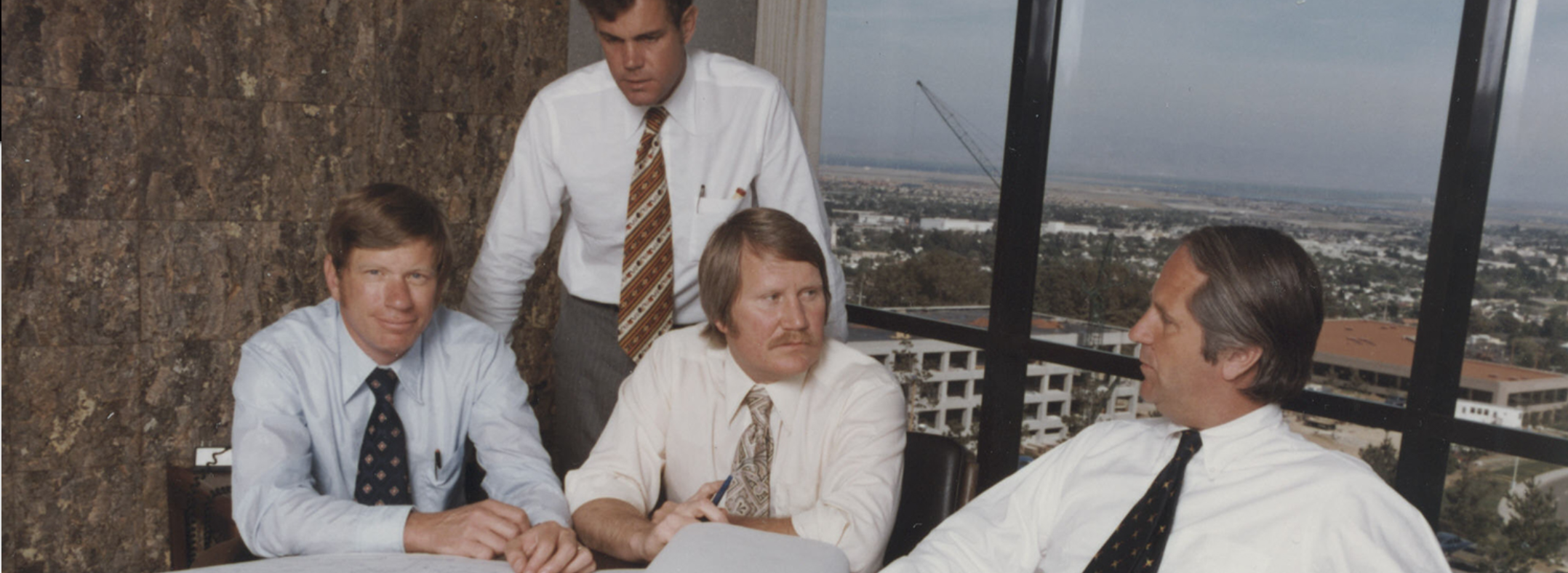
On January 19, 1971, Boyd, Edwards, William Wilson III and Miller Ream incorporated Webcor. The business began in San Mateo. Wilson and Ream brought development experience; Boyd and Edwards brought construction experience. The arrangement put people who could generate projects beside people who could deliver them.
Edwards had worked on the Borel Estate in San Mateo for the developers. His attempt to secure a regional leadership role at Pankow had been rebuffed. Starting a company offered a different route. For Boyd, that same opening answered the question of where his family could settle.
The new company concentrated on commercial construction in Northern California and used design-build. In that approach, decisions about design and construction are brought into a shared delivery arrangement. A contractor’s understanding of materials, sequencing and cost can influence a project before those choices become expensive to change.
The founders’ reasons were distinct, which makes the partnership more interesting. A shared enterprise does not require identical biographies. Here, a friendship, a frustrated promotion, a development business and a desire for a stable home met in the same incorporation papers.
The building starts before the building
Boyd described Webcor’s approach in terms of practical involvement with architects, engineers and private clients. Builders could examine a proposed structure early and suggest ways to make it more efficient and less costly. The work began while choices were still available, rather than waiting for a finished plan to arrive.
That perspective puts a different emphasis on expertise. Knowing how to pour concrete is useful. Knowing which design decision makes the concrete harder to place, or which sequence complicates the next trade’s work, gives that knowledge an earlier and potentially more valuable use.
Webcor’s history during the founders’ tenure records several expansions of that capability. In 1985, Rich Lamb joined to lead self-performed interior construction. Museum Parc marked its move into residential high-rise work in 1987. The 1994 combination with A. J. Ball Construction broadened the business again.
The company built for Silicon Valley firms including Oracle, Electronic Arts, Siebel Systems and Sun Microsystems. Those names belong to Webcor’s record as a company. Boyd’s place in that record is as one of the partners who established and led the builder through its first decades.
Planning the founders’ departure
A construction company needs a plan for what happens after its founders leave. Boyd and Edwards faced that question while they still had time to answer it. In his later account, Boyd explained that they had not identified someone inside the business who could simply take over.
They sought advice and brought in Andy Ball and members of his team. The transition gave younger managers a chance to own shares in a new operating company. Profits were shared between the existing business and the successor, with the successor’s share increasing as it accumulated earnings.
The mechanism deserves attention because it treated succession as a process. The incoming team gained an economic interest and room to grow. The founders could reduce their involvement as the new business became able to stand on its own. A departure date alone would have accomplished much less.
Boyd and Edwards retired in 2000, with Ball taking charge. Obayashi acquired a controlling interest in 2007, years after their retirement. Webcor’s subsequent growth belongs to later leadership. The handover was itself part of the founders’ work: building an enterprise that other people could continue.
Retirement came with a syllabus
Leaving daily management did not end Boyd’s interest in how buildings were made. He and Edwards developed the Webcor Founders Series, a fifteen-session program for engineers and project managers. It began with foundations and worked through the elements of building design.
The point was to help younger employees understand the reasoning behind the drawings they would use. A plan tells a builder what to construct. Understanding how it came about helps the builder ask better questions when conditions, costs or practical constraints demand attention.
The founders brought stories of things that had gone wrong. Errors involving foundations and fieldwork made lively classroom material. Experience had supplied both the lesson and the punch line, although the punch line generally improved with distance from the original invoice.
Purdue recognized Boyd with its Civil Engineering Alumni Achievement Award in 1998 and included him among its Distinguished Engineering Alumni in 2006. The teaching gives those honors a human scale. Years of work were being converted into explanations that another engineer could carry onto a jobsite.
Foundations first. Then the rest of the building.
“In business always fulfill your promises. It’s all about integrity.”David R. Boyd
What the family carried forward
Boyd’s daughter Kerry described another part of his example: giving back. In a Pets In Need account, she credited her father with making philanthropy part of his business and teaching her that everyone could contribute. Her own support for the animal shelter carried that lesson into a different setting.
The connection is modest and revealing. A building company leaves visible things behind. A parent’s habits travel less visibly, through what a child decides to support and what she remembers being taught. Both can outlast the daily work that first established them.
Boyd’s career began with a willingness to leave Indiana. Its decisive turn came when he wanted to stop moving. In between were jobsite lessons, a persistent friend and a family willing to try ownership. Afterward came the equally practical task of handing knowledge and responsibility to others.
The late-night calls from California offered him a way to stay. He accepted, helped build Webcor, and eventually made room for its next builders. For someone who wanted a settled address, it was a considerable amount of construction.