Rosa Whitaker has an unusual unit of time. Asked how she stayed with the African Growth and Opportunity Act through nearly three decades of political weather, she gave an answer that would make a quarterly earnings call go very quiet: “I think in 30-year intervals.” In March 2026, she announced that she was stepping down as co-chair of the AGOA Alliance. The trade law she had helped build would pass to other advocates. Her work in African business would continue.
A handover is a revealing place to begin a life story. It asks what survives when the person who made the introductions, negotiated the compromises and remembered the previous arguments takes a different seat. For Whitaker, the answer reaches beyond a piece of legislation. It includes an investment firm, a television business and women she wants to see lead. The itinerary runs from Washington to Africa, but the original question is close to home: how does someone get a fair chance to earn a living?
The household before the hearing room
Whitaker grew up in Washington, D.C. Her father carried mail; her mother sorted it. Work was familiar, and money was tight. She recalls beginning paid work at fourteen and helping support her parents by sixteen. College required a plan for scholarships. She eventually earned both a bachelor’s and a master’s degree at American University, in the city where she had grown up, and pursued further studies in Europe and at the U.S. Foreign Service Institute.
Another part of her education took place on Capitol Hill. She went to hearings to watch Barbara Jordan, the Texas congresswoman whose presence offered a young Black woman a model of authority. Washington can make power seem like a private club with an exceptionally confusing entrance policy. Watching someone exercise it changes the picture. Whitaker had an example she could return to, rather than an abstract instruction to be ambitious.
Her mother’s advice was brisk: “be unstoppable” and “dream big.” It had to coexist with everyday obligations. There is no need to turn a teenage job into a prophecy. What matters is that responsibility arrived early, alongside the idea that public institutions might be places where she could act.
Africa gets a place at the trade table
Whitaker’s professional life took her into diplomacy and then into the machinery of trade. She became the first Assistant U.S. Trade Representative for Africa, serving under Presidents Bill Clinton and George W. Bush. The role itself was part of a change in how Washington organized its relationship with the continent: African commerce had an official responsible for it at the trade agency.
She understood the burden of being first. She later recalled a New York Times reporter arriving on her second day to ask what she intended to deliver. A new office comes with a desk; it also comes with a record waiting to be made. Her account of the moment conveys the pressure of creating something other people would inherit.
Before that executive-branch work, she had helped co-draft the African Growth and Opportunity Act as a senior trade advisor to Congressman Charles Rangel. Enacted in 2000, AGOA established preferential access to the American market for eligible exports from eligible sub-Saharan African countries. Whitaker worked on securing passage and implementing it. The practical ambition was to give trade a larger role in a relationship so often discussed through aid and diplomacy.
AGOA becomes law
The Whitaker Group begins
TWG invests in Dominion TV
AGOA advocacy handover
The distinction has consequences. A tariff preference changes the terms on which goods can enter a market. Producers still need buyers, financing, capacity and dependable execution. In her 2015 writing about AGOA, Whitaker framed the law as a shift toward partnership and market-based routes out of poverty. African leaders had participated in making the initiative, rather than simply receiving a policy designed elsewhere. That participation was part of the point.
The less photogenic work of agreement
Trade laws acquire neat names after a great deal of untidy work. Whitaker’s AGOA story involves Rangel, Republican Jack Kemp, Mike Williams, African ambassadors and a coalition extending across governments, business and civil society. It required people with different constituencies to find enough common ground to keep going. A coalition is a social achievement before it becomes a legislative one.
That helps explain the importance of Rangel in her life. In her recollections, his example joined compromise with the ability to hold a principle. Those skills have to operate together. Refusing every concession can strand an idea; accepting every concession can leave it unrecognizable. The person helping build an agreement has to decide which is which, often while everyone else has a different opinion.
Whitaker stayed involved long after the original law passed. By the time she announced her handover, AGOA had become a career-long commitment. The sustained organizing behind that commitment is easy to miss when a biography lists only offices and awards. Legislation does not attend its own meetings. Somebody has to keep the relationships alive.
“I think in 30-year intervals.”
Rosa Whitaker, March 2026
Turning permission into a business
In 2003, Whitaker founded The Whitaker Group. The move took her from government policy into advising companies on African trade, investment and project development. She had worked on the framework; now she would work with businesses deciding how to operate within the opportunity it created. The legal opening and the commercial decision belonged to the same story.
The firm’s work has since expanded into equity partnerships and direct investment. Its operations span Northern Virginia, Accra and Dubai. Its current account of its business emphasizes fintech, creative industries and digital infrastructure, alongside strategy and the practical work of developing ventures. The company reports a project track record exceeding $4 billion. That is its stated measure of activity, rather than a measure of Whitaker’s personal wealth.
A company activity figure. The work spans advisory services, partnerships and project execution.
A useful way to understand her career is to follow the sequence of problems it addresses. Public policy can improve access. Advice can help a business navigate an unfamiliar market. Ownership brings responsibility for what the business actually does. Moving through those stages changes the job, even when the geographical focus stays consistent. It also means that a former negotiator eventually has to answer questions that a signed agreement cannot settle.
The television turn
The move into media makes the sequence tangible. In 2017, TWG acquired shares and management control in Dominion Television. The network had been founded in Ghana by Archbishop Nicholas Duncan-Williams, Whitaker’s husband. The investment helped move it from a ministry network toward a commercial, pan-African Christian media business.
Television introduced a different kind of market access: reaching an audience with stories, entertainment and ideas. Faith is central to Whitaker’s account of her life, so the investment also brought a personal commitment into her professional work. She has described wanting a legacy that continues beyond her lifetime and sees media as one means of carrying it.
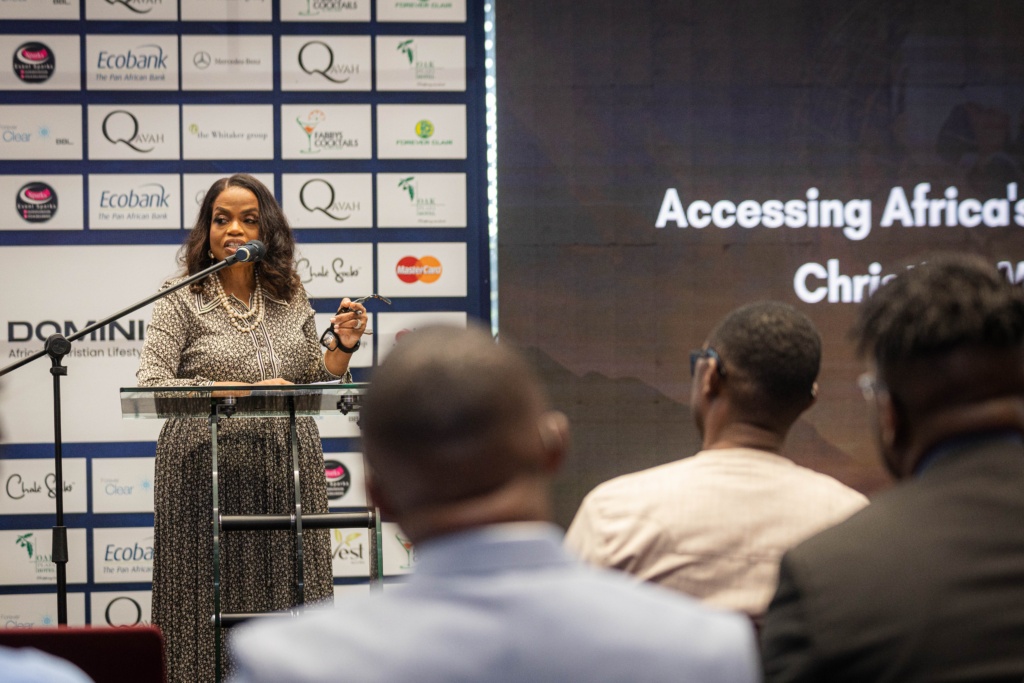
At a forum held at Ecobank’s head office in Accra on October 13, 2023, Dominion explored its Christian audience with advertising agencies and market influencers. The event included the announcement of Proudly Me TV, a block of children’s programming, and the network’s film A Taste of Sin, featuring Jackie Appiah and Majid Michel. These were concrete creative products behind the investment thesis. Understanding an audience has to lead somewhere: a schedule, a production, a story someone chooses to watch.
Making room for the next decision-makers
Women’s opportunity runs through Whitaker’s descriptions of her business. In 2022, she described TWG’s team at that time as entirely women, multilingual and multidisciplinary. She also discussed incorporating women’s empowerment into client strategies. At Dominion, she highlighted women in leadership, training and the network’s supply chain. The concern appeared in decisions about who worked and learned inside the enterprises.
Her advice to women emphasizes the opportunities earlier women helped make possible. Success carries an obligation to create openings for others. She also stresses preparation, organized around five Cs: character, commitment, courage, competence and confidence. The list leaves very little room for waiting to be discovered. Confidence comes last, after several demanding items of homework.
Recognition has followed the work. Foreign Policy included her among its Top 100 Global Thinkers in 2010, alongside investor Miles Morland, for their view of Africa as a place of economic opportunity. Face2Face Africa honored her with its Trailblazer Award in 2016. The Association of Women in International Trade gave her its Business Legacy Award in 2021, a category that explicitly recognizes experience and the inspiration or mentoring of women in trade.
A different seat, the same horizon
Whitaker’s current work reaches into the financial systems that connect people and markets. Her company biography describes interests in mobile money, digital banking and cross-border payment infrastructure. A December 2025 account also discussed a planned Ghana-based fintech venture aimed at underbanked communities. Her service on the board of Afreximbank’s Fund for Export Development in Africa places her alongside an institution concerned with mobilizing investment across the continent.
Her March 2026 announcement kept TWG, board service and mentoring in view while handing AGOA advocacy to others. The distinction gives the long career a useful shape. One role can end without requiring every concern behind it to end as well.
The young woman who watched Barbara Jordan now has younger women watching her. That is a quieter measure than an investment total, but it belongs in the reckoning. A thirty-year interval has room for the people who inherit the work. Whitaker is making plans for them, too.
Continue the conversation
Writing, interviews & public profiles
- The Whitaker Group · Dominion Television
- Whitaker’s March 2026 AGOA handover essay
- Her 2022 conversation with the U.S. Chamber
- The 2021 interview about her upbringing and career
- The ESSENCE feature on purpose and influence
- Watch: U.S.-Africa relations at Bloomberg Live
- Watch: her AGOA interview with Just The News
- LinkedIn · Instagram · Medium
- TWG on X · TWG on YouTube · TWG on Facebook