In Copenhagen, Morten Meisner-Jensen used to take work calls outside. The open office gave him no privacy; the Danish winter supplied plenty of fresh air. When he and Brian Chen tried building a private phone booth themselves, they solved one problem and invented another. The enclosure grew so warm that they named it “the sweatbox.” A room, it turned out, needs more than walls and a door.
- ROOM sells movable, acoustic office spaces, from a solo Phone Booth to meeting pods for six.
- Its flat-packed products are designed to add privacy without a permanent build-out.
- A Phone Booth starts at $6,495 on ROOM's U.S. shop; larger formats start at $16,995.
- OFS acquired the company in 2024 and now pairs the pods with a wider furniture range.
The failed prototype is a better introduction to ROOM than a polished showroom photograph. It reveals the awkward bargain at the center of open-plan work. People need to hear one another sometimes. They also need to speak without making the whole floor listen. Put a worker in a sealed box, though, and acoustics quickly becomes an air-conditioning question. The final product had to answer both.
A small room for an obvious problem
Chen and Meisner-Jensen launched ROOM's first Phone Booth in 2018, after the company was founded in 2017. The commercial booth added ventilation, a light, power outlets, a desk and sound insulation. It ships flat, plugs into an ordinary outlet and can be assembled where a call needs to happen. That last detail matters: the customer buys the room as a product, rather than commissioning a new room as a building project.
ROOM's direct-from-factory sales pitch is unusually plain for the furniture business. The buyer can see starting prices online, choose a finish, add assembly or seek a proposal for a bigger project. The company also offers 36-month financing. It says the products are for purchase, not rental. This is equipment for an office that may change again, and the ability to move it is part of the price.
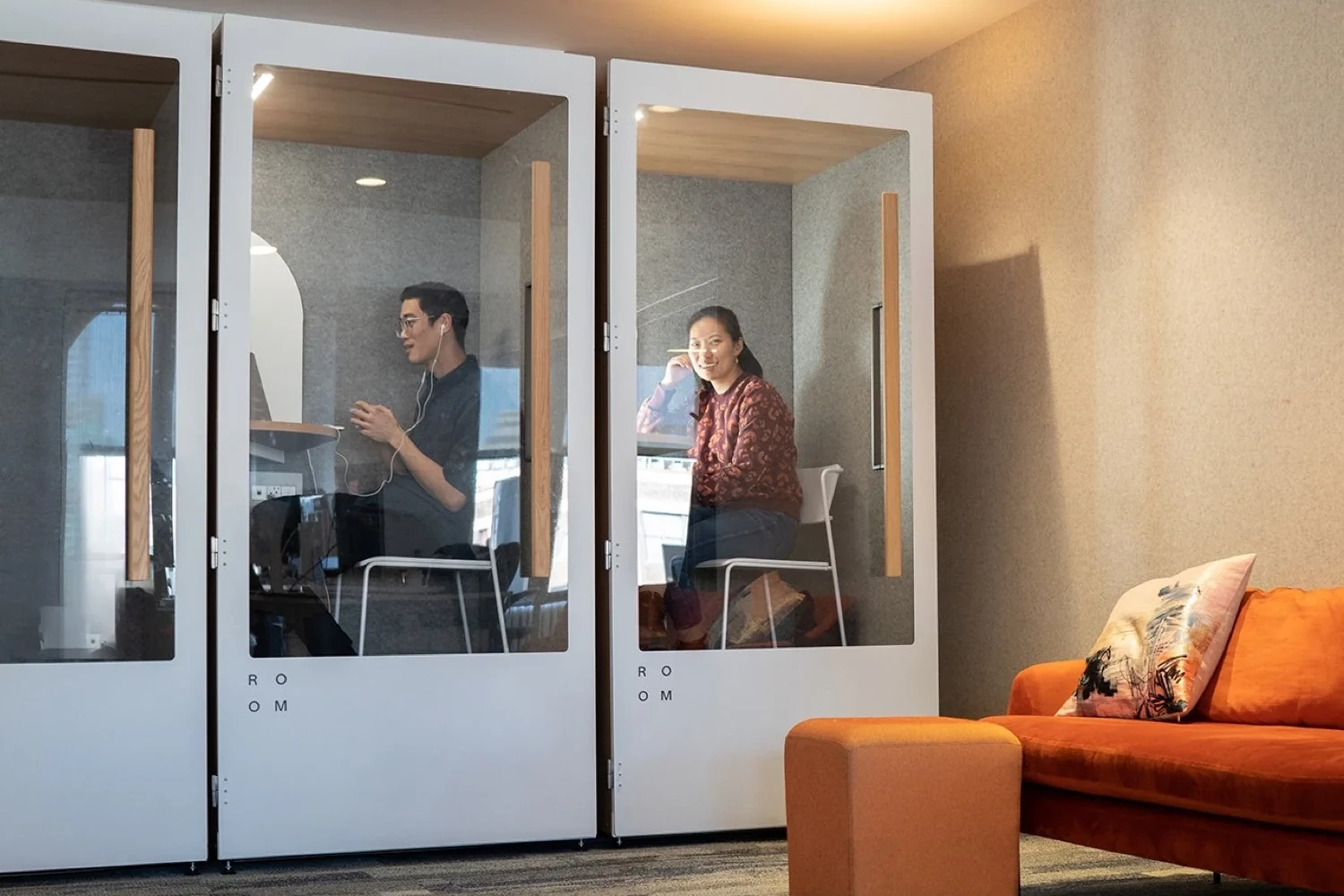
Braze offers a useful test of the idea. Its New York headquarters had more than 40 conference rooms across three floors, yet staff still struggled to find a place for individual calls and video meetings. Large rooms were being spent on small conversations. ROOM helped place 17 booths around the floor, considering departments, traffic and nearby private spaces. Braze says the installation took one day. It later ordered 20 more.
That example makes the category clearer. ROOM is not selling silence in the abstract. It is selling the right-sized place for a task. A private recruiting call should not occupy a six-person meeting room. A meeting room should not be replaced by a single-person phone booth. Planning becomes a matter of matching the supply of spaces to the work happening in them.
The booth grows up
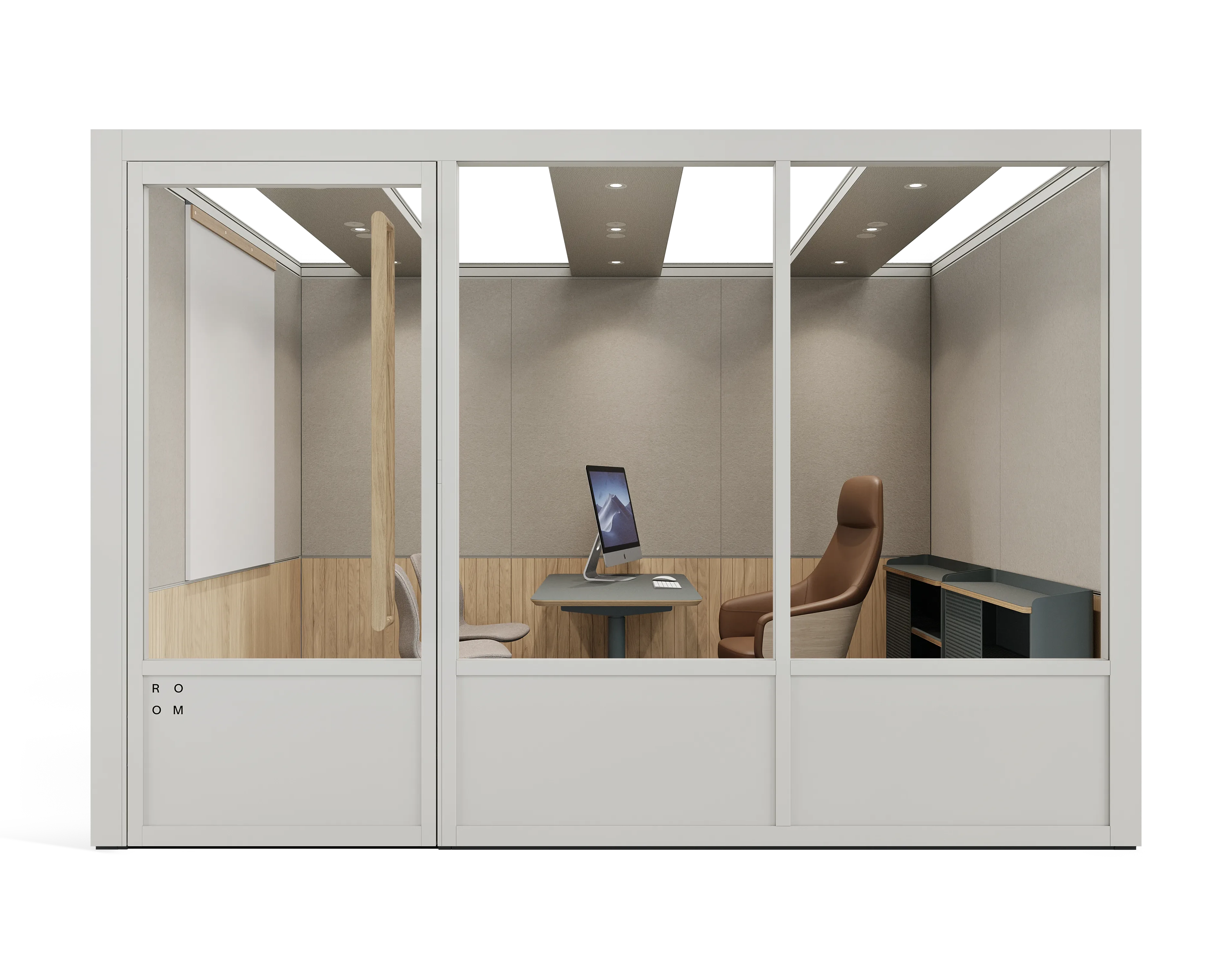
The Phone Booth was only the opening move. ROOM now sells the Room S, M and L series in Frame, Focus and Meeting formats. Room S begins at $16,995; Room M at $22,995; Room L at $29,995. The largest Meeting Room seats up to six people. There is also an Acoustic Lounge line of partially enclosed seats for short calls and informal conversations. These are not interchangeable products. One offers a closed door; another offers a bit of acoustic shelter without cutting its occupant off from the room.
Listed U.S. starting prices. Configuration, shipping and assembly may change the total.
The choice is a market position as much as a catalogue. ROOM competes with other pod makers, including Framery, PoppinPod and Zenbooth, but its larger argument is with fixed construction. A built-in meeting room can be excellent, provided the team knows exactly where it will need that room for years. A modular pod is more attractive when headcount, lease terms or the daily pattern of meetings is unsettled. Flexibility costs money too; it simply buys the buyer a different kind of certainty.
The pandemic complicated ROOM's original case. Offices emptied just as a company selling office privacy was expanding. In 2020, after raising a $12.5 million Series A led by Slow Ventures, ROOM spoke of broadening its product line. When offices filled again, the soundtrack had changed: video calls had become ordinary desk work. A worker on a headset could bring a meeting into every neighboring workstation. The old demand for privacy returned with a new device attached.
“We didn't quite understand the specifics of air ventilation or acoustics at the time, so the booth got quite warm.”Morten Meisner-Jensen, on the first prototype
ROOM's answer was to keep widening the range of work its spaces could hold. Meeting configurations offer power and optional video equipment. Focus formats put a more conventional private office inside the open floor. The company's 2021 Workspace Galleries with coworking operator Industrious let people try booths and meeting rooms in working offices, beginning at Chicago's Willis Tower. A showroom asks visitors to imagine their own floor; a coworking gallery lets them watch the product survive a Tuesday.
A room should leave when you do
Sustainability is part of ROOM's pitch, with recycled PET in its acoustic panels and flat-pack shipping that reduces packaging volume. Its product guide says it has repurposed nearly 38 million bottles. The stronger environmental idea, however, concerns the next renovation. A pod designed to move and reassemble can outlast one office plan. That claim depends on the product being kept, used and moved, of course; a seldom-used booth is still a costly object occupying floor space.
There are practical limits. A Phone Booth suits a call, not a department meeting. A large pod needs enough floor area, access for delivery and a layout that respects circulation. Acoustic reduction is not total silence. ROOM's own Braze example began with a count of calls, departments and existing rooms, not a guess about how many booths would look good in a rendering. The copyable part is that audit: find the repeated mismatch between task and space, then buy for it.
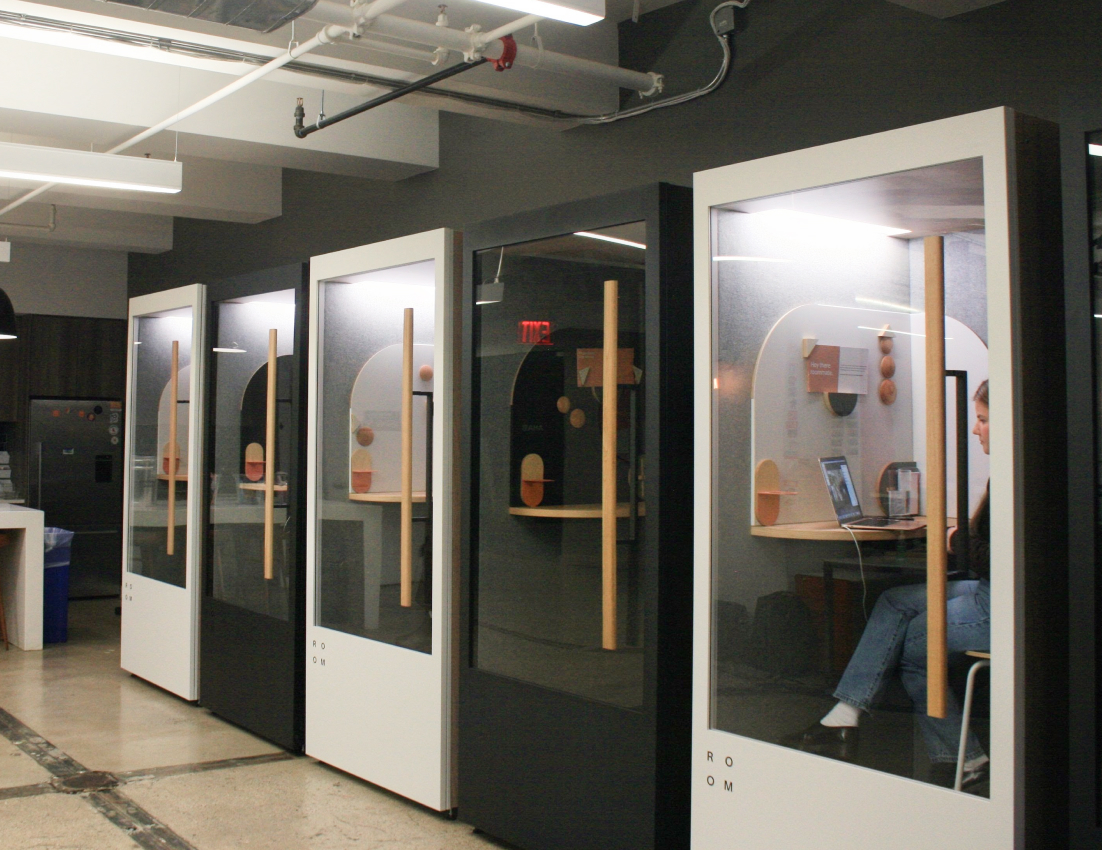
OFS acquired ROOM in January 2024, joining a young modular architecture brand to a furniture manufacturer with a much broader commercial reach. Their 5,000-square-foot SoHo showroom puts ROOM pods alongside OFS furniture in a building from 1883: an old shell displaying a changeable interior. The combined portfolio has since produced a ROOM x Carolina Phone Booth with wipeable materials for healthcare and other high-traffic settings. It is a neat extension of the first lesson. A booth succeeds only when the person inside can actually use it.
There is a touch of comedy in the journey from “sweatbox” to architectural system. The founders wanted one quiet place to take a call. They ended up selling a more flexible way to divide a workplace. The useful question for any buyer is smaller and sharper: which activity has no proper room today, and how certain are you that its location should be permanent?