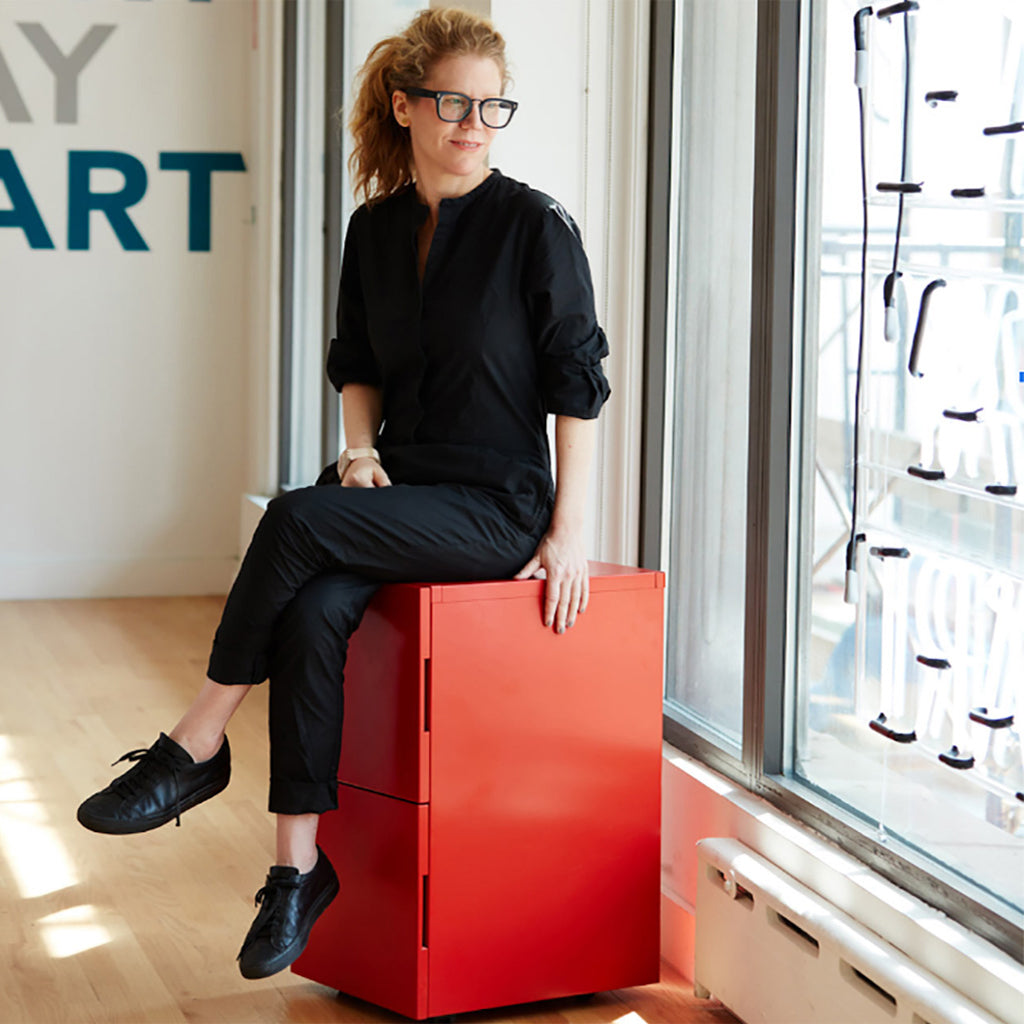
She builds the furniture nobody notices - on purpose.
Walk into most offices and the storage disappears. Gray towers, beige cabinets, a wall of identical lockers the color of a rainy Tuesday. Karen John spent a stretch inside the technology world staring at exactly that, and she came to a conclusion most people never bother to have: the dullest object in the room is the one with the most untapped power. She founded Heartwork in September 2012 to act on it.
Heartwork designs and manufactures furniture and smart lockers for workplaces - desks, storage systems, and steel cabinetry built domestically and engineered to last. The category John chose is the unglamorous middle of the office: the things people lean on, lock their bags in, walk past a hundred times a day without a glance. Her bet is that those objects are quietly setting the tone of a whole company, and that color, craft, and durability can change the tone for the better.
"The design of a space is the fastest way to create a culture," she told Metropolis when Heartwork opened its Manhattan showroom. It is the kind of line that sounds like marketing until you notice she has built an entire manufacturing operation around believing it literally.
The credentials are almost suspiciously well-rounded. John trained in industrial design at the Domus Academy in Milan and worked in a furniture design studio there, learning from Italian masters whose studios refused to separate product from environment from brand from strategy. Then she went the other direction entirely and took a master's in Manufacturing Systems Engineering at Stanford - the factory side, the part most designers never touch. An MBA from INSEAD followed. So did a tour through Design Within Reach, where she founded and led product development before being promoted to VP of Merchandising, and consulting work with startups and Fortune 500 companies on design and product strategy.
That combination is the whole point. John can sketch a cabinet, engineer the steel that holds it, price the merchandising, and pitch the brand - usually in the same meeting. The conventional U.S. furniture model, where a design sketch shuttles between distant strangers and loses a little life at every stop, struck her as a slow way to make dull things. Heartwork collapses the distance. Designers sit closer to the people who actually bend the metal.
Then there is the color. Early on, a vendor sent over a finish PDF that the team nicknamed "50 shades of gray" - a joke about how monotonous storage options had become. The punchline became a turning point. John partnered with color strategist Laura Guido-Clark and went to war with the monochrome, arguing that "color shapes energy, belonging, and wayfinding." A locker bank in the right palette stops being a wall of identical doors and starts telling you where you are and that you belong there.
None of this is precious. John is blunt about the economics, summarizing what her largest clients actually demand as: "don't overpay, but don't replace in six months." Durability, in her framing, is not the opposite of design - it is part of it, and part of sustainability too. Furniture that survives a decade is a better environmental story than furniture that looks clever and ends up in a landfill by the next reorg.
Ask her what she is proudest of and the answer is not a product. It is the team and the partners she assembled, all aligned on quality. She talks about manufacturing proximity, design integrity, and installation simplicity - the idea that a beautiful piece nobody can assemble is a failed piece. For a founder who could lead with awards or specs, leading with the people is telling.
She is also clear-eyed about how hard the early years of a manufacturing brand are. External validation is scarce at the start, she has said, even from well-meaning family. Her advice to other founders is unusually practical: notice what actually energizes you after a task is finished, and choose the path that matches the work you will do most days - rather than falling in love with a business idea that traps you in daily work you quietly hate. Joy and success, she insists, are not opposites.
Her formation was geographically restless before it ever became a company. Northern California, UCLA, Florence, Milan - a path that crossed art, engineering, and business before settling on the unfashionable intersection of all three. By the time she reached Design Within Reach, she had already absorbed the lesson that would define Heartwork: that the conventional American furniture market dulls innovation by keeping the people who imagine a piece far away from the people who build it. Her whole company is a correction to that distance.
The Manhattan showroom captures the philosophy in physical form. When Heartwork opened the 2,200-square-foot NoMad space in October 2017, it wasn't only a place to display the Sawhorse desk collection or the steel storage lines. It was a working laboratory - a room where new pieces get tested, prototyped, and pressure-checked in front of the people who might buy them. The signature steel is produced domestically, a deliberate choice in an industry that mostly chases the lowest overseas bid.
The smart lockers are where the design thesis meets the hybrid-work moment. As offices emptied and refilled on unpredictable schedules, the humble locker quietly became infrastructure - the place a hot-desking workforce stashes its stuff. Heartwork's Base Camp lockers fold smart-lock technology into furniture that doesn't announce itself as technology, prioritizing security and convenience without surrendering the color and finish John refuses to compromise. It is a neat encapsulation of her entire pitch: the boring object, taken seriously, becomes the useful and beautiful one.
Lately she has been optimistic about a tool most designers eye warily. John thinks AI's real gift to design is compressing the rounds of rework - stress-testing layouts, reconciling program and circulation and budget - so that human teams can spend their hours on insight and craft instead of redrawing. It is a characteristically John position: embrace the machine that does the boring part so people can do the part worth doing. Which, when you think about it, is the same move she has been making with furniture all along.