The most intriguing choice Rondo Therapeutics made was to reject the loudest molecule in the room. In a series of lab tests, its scientists built versions of an antibody that could press the immune system's CD28 switch with different strengths. Some seemed too faint. Others worked powerfully, but might leave less room between an effective dose and an unsafe one. The candidate they carried forward, RNDO-564, sat in the middle. For a drug developer, restraint can be an unusually expensive act of ambition.
The short version
- The product: RNDO-564, an investigational antibody that binds Nectin-4 on tumor cells and CD28 on T cells.
- The bet: Deliver a second activation signal where a tumor is, with enough control to widen the usable dose range.
- The proof still needed: A Phase 1/1b trial is measuring human safety, dose and early activity; no Rondo medicine is approved.
- The business: A $67 million Series A financed the company, and Lilly licensed a separate CD28 program on undisclosed financial terms.
Rondo is a Hayward, California, biotech founded by Shelley Force Aldred and Nathan Trinklein, two scientists who had already built companies together. They helped create SwitchGear Genomics, then worked at Teneobio on T-cell engagers. That experience gave them a useful disappointment. The earlier class of CD3-focused molecules had made a mark in blood cancers, but solid tumors remained stubborn. Aldred later said their earlier lessons and molecules could not “make a dent” in solid tumors. They started Rondo around that unsolved problem.
A T cell wants two signals
Think of a T cell as a concert pianist who has seen the score but cannot quite hear the conductor. Signal 1 comes through the T-cell receptor and tells it what to recognize. Signal 2, delivered through a co-stimulatory receptor such as CD28, can help the response persist. Many immune-engaging medicines concentrate on the first signal. Rondo's central idea is to supply a measured second one in the tumor's neighborhood.
RNDO-564 has two binding arms. One recognizes Nectin-4, a protein found on several solid tumors and already familiar to bladder-cancer specialists because an approved antibody-drug conjugate targets it. The other engages CD28 on T cells. If both the tumor address and the first immune signal are present, Rondo hopes its antibody will strengthen the attack locally. It is a plan, rather than a demonstrated patient benefit. In September 2026, the company is still testing that distinction in humans.
A T-cell receptor receives its first activation cue.
RNDO-564 links tumor Nectin-4 to CD28 co-stimulation.
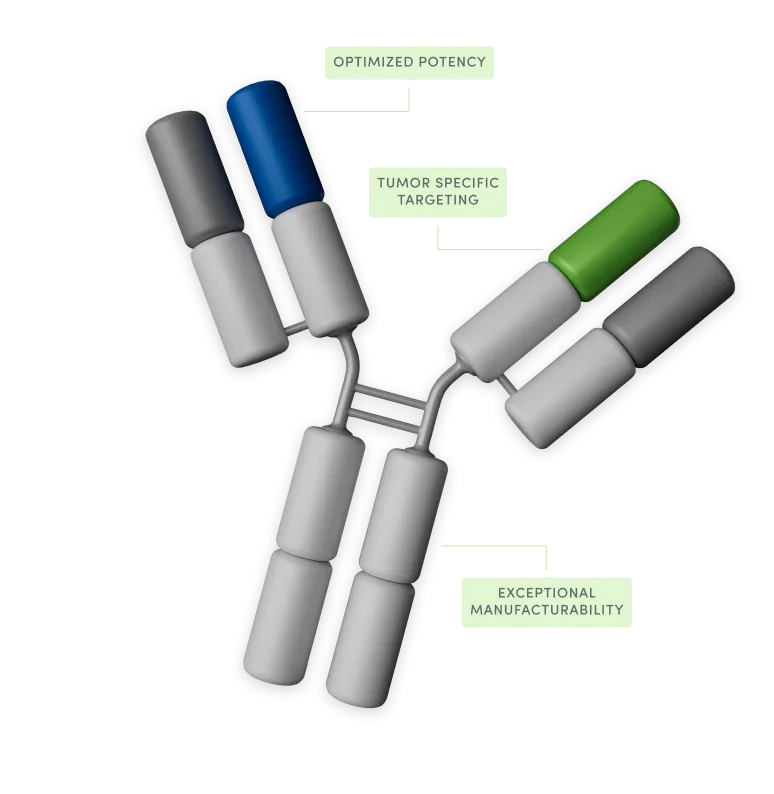
The safety issue is no academic footnote. Systemic CD28 stimulation can be dangerous. Rondo's team did not merely choose a tumor marker and attach an immune switch; it made a panel of CD28 binders, changed their affinities, tested activity and then chose a version with moderated potency. In the published work, lower-potency candidates sometimes lost too much cell-killing activity under demanding conditions. The selected candidate kept a similar maximum response to stronger versions in several assays, though it needed a higher dose to get there. That is the particular compromise Rondo is trying to turn into a therapeutic window.
“What we have a reputation for and are really good at is tuning and finding the Goldilocks zone.”Shelley Force Aldred, 2024 founder interview
What the laboratory proved - and what it didn't
Rondo's peer-reviewed preclinical paper offers a carefully bounded case. RNDO-564 boosted T-cell function in cell experiments when the first activation signal was present. In an immune-primed mouse model engineered with human CD28 and Nectin-4, it shrank tumors as a single agent; the high-dose group had complete tumor responses by day 45. A separate combination experiment suggested activity alongside PD-1 blockade. Cynomolgus-monkey tests found no significant systemic T-cell activation in the measured groups. None of those observations is a human response rate or a promise of human safety.
The company also tested a problem that makes a neat diagram less neat in a patient: tumors do not display their markers uniformly. Across seven dissociated bladder-tumor samples in the paper, the Nectin-4-positive fraction ranged from 9% to 51%. In mixed-cell experiments, the antibody increased killing of both marker-positive and marker-negative cells when paired with a CD3 bispecific, though the effect weakened as the marker-negative share grew. The implication is interesting: neighboring cells may benefit from an immune response started elsewhere. The limit is just as interesting: if the tumor offers too little Nectin-4, or a T cell lacks the first signal, Rondo's second-signal logic may have too little to work with.
The bill, the partner, the patients
The publicly disclosed price of this experiment is financing, not a treatment bill. Rondo closed a $67 million Series A in March 2022, co-led by Red Tree Venture Capital and Canaan Partners, with Johnson & Johnson Innovation, Novo Holdings and SV Health Investors participating. That sum is capital raised; Rondo has not published an itemized cost to develop RNDO-564. No drug price exists because there is no approved Rondo drug.
In December 2024, Eli Lilly took exclusive worldwide rights to develop a CD28 co-stimulatory therapy for a defined cancer target under a research and license deal. Rondo received upfront cash and became eligible for development and commercial milestones plus tiered royalties. The amount was undisclosed. This is the company's business model in miniature: build a finely adjustable antibody platform, carry selected medicines forward itself, and let a larger partner pursue another target.
Its immediate users are trial investigators and eligible adults with relapsed or refractory advanced urothelial cancer or other Nectin-4-associated solid tumors. The Phase 1/1b study tests RNDO-564 alone and with pembrolizumab, seeking a tolerable dose and early signs of activity. Sarah Cannon Research Institute dosed the first participant in December 2025. For oncologists and patients, the practical route today is a clinical trial, where eligibility and locations are set by the study record. A public product catalog would be premature.
The useful lesson in the middle
This is a crowded neighborhood. Nectin-4-directed antibody-drug conjugates already treat urothelial cancer, and other companies are trying immune engagers against the same marker. Rondo's distinction is the mechanism: a tumor-addressed CD28 co-stimulatory signal, with potency tuned in hopes of protecting the dose range. Its strategy does not erase the value of existing drugs. It is directed at a patient population where relapse and treatment toxicity still leave room for another idea.
The copyable part of Rondo's approach is a research habit. Build several versions of the molecule, measure both peak activity and the cost of reaching it, test what happens when the target is scarce, and make the clinical trial ask the question the laboratory cannot answer. The business habit is similar: keep a lead program, keep backup targets, and use a partnership to extend a platform without pretending every candidate is already a medicine. In a founder interview, Aldred described keeping multiple targets in play because a target can go cold quickly when another company's clinical results arrive.
For all the elegance of the design, RNDO-564 still has to earn its place at a bedside. A patient may not have enough Nectin-4 on a tumor, may not have the right immune first signal, or may experience side effects that lab systems could not predict. That is why the early study is measuring safety, dose and biological activity before anyone can claim a durable benefit. Rondo's best decision so far may have been to make that uncertainty the experiment.