Ron Nelson arrived at K. Hovnanian Homes with a customer history that most chief marketing officers cannot claim. He had bought three of the company's homes in New Jersey. When a colleague introduced that fact during an internal video conversation, Nelson quickly added a dry correction: he did not own any of them anymore. The line landed because it collapsed the usual distance between marketer and buyer. Before he was responsible for the story of the product, he had lived inside it.
By then, Nelson had spent more than three decades in advertising, largely around New York real estate. He began as an account executive at Pace Advertising in the mid-1980s, then joined Sherman Advertising Associates in 1987. Over roughly 26 years there, he became a creative director and partner. The work included the odd theater of New York property marketing: trophy towers, new condominiums, rentals and campaigns designed to make an address feel inevitable.
In 2013, Nelson and longtime colleague Debbi Melman put their initials into a new name. Sherman became RODE Advertising, pronounced like the ordinary verb but assembled from Ron and Debbi. The agency kept its real estate focus and talked about a future built around creativity, service and new technology. Four years later, Nelson crossed the table. He joined one of the industry's national builders in 2017, trading the agency's collection of clients for one sprawling operating problem.
The brand was living in 14 places
K. Hovnanian was founded in 1959 and sells homes across a set of distinct regional markets. That geography matters. A consumer-products company can run one national campaign and find customers almost anywhere. A homebuilder has communities only where it owns land, has approvals and is actively building. Even the same promotion must speak to different inventory, prices, weather, architecture and local competition.
When Nelson arrived, about 14 divisions were largely handling marketing for themselves. One might buy digital media well. Another might have a strong designer. A third might hire an outside agency. Visual inconsistency was easy to see. The larger cost was hidden: each division was buying its own lessons, and many of those lessons stopped at the regional border.
Nelson's favorite illustration is knowingly absurd. Imagine a July Fourth sale. California chooses fireworks, Texas chooses flags and Florida chooses a bald eagle. Three groups pay three agencies to create three expressions of the same basic idea. The details sound local, but the duplication is expensive and the brand never quite learns how to speak in one voice.
The operating idea
The response was a center of excellence. Specialist teams in digital media, graphic design and social media served the divisions from the center. The rollout began in 2018 and was complete by late 2019. The gains reached beyond consistent graphics. Central buying helped reduce some media costs, and a working tactic in one division could be duplicated elsewhere. Creative production stopped being a repeated local expense and became a shared capability.
“Every dollar that we spend is to try to get a digital lead.”Ron Nelson, K. Hovnanian Coffee Chat
The creative director meets the spreadsheet
Nelson's public explanations are notably short on mystique. He likes brand, but he gives it a job. In his internal presentation, that job was lead acquisition: persuade someone to visit the website, then call, text or email, or walk into a sales office. Brand media still has value, especially the impressions created when a person scrolls past a social ad. Yet a channel has to prove that it can also generate inquiries before it earns a place in the mix.
The constraint is financial as much as geographic. Nelson compared K. Hovnanian's roughly $18 million annual marketing spend at the time of his presentation with the much larger budgets of consumer names such as Peloton, Casper and Ring. Every brand dollar had to carry performance weight too. A broad national campaign reaching states where the company did not build made little sense.
This is the operator inside the advertising veteran. Nelson talks about creative work in the language of inventory, conversion and handoffs. He also talks about people. In the same presentation, he repeatedly credited colleagues who led digital, design and other parts of the system. His version of centralization puts specialists where their skill can compound while regional teams retain the local context.
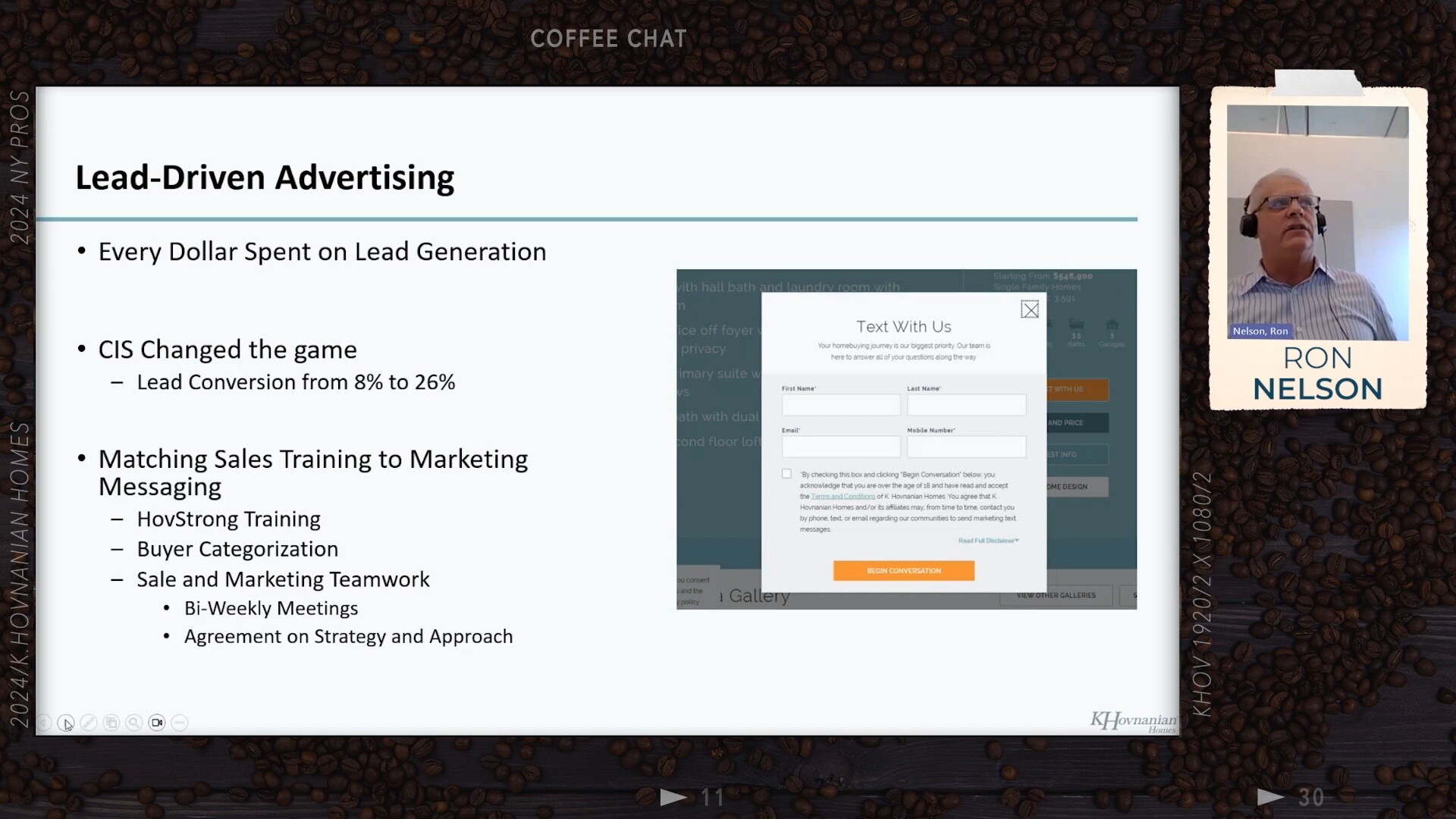
The accompanying sales system gave those leads somewhere more consistent to go. K. Hovnanian reported that conversion moved from 8 percent to 26 percent after centralizing the follow-up operation. Nelson did not claim the improvement as a solo marketing victory. He framed it as a joint system, one in which marketing language, sales training and buyer categorization had to line up.
Fewer choices, more confidence
The next brand problem sat inside the house. New construction promises personalization, but the design-center ritual can become a burden: cabinet doors, tiles, counters, handles, flooring and fixtures, each selected separately, each nudging the total price. The freedom to choose can feel like unpaid design work.
K. Hovnanian's answer is called Looks. Four designer-curated systems, Loft, Farmhouse, Classic and Elements, organize coordinated finishes into clear paths. Buyers can use a Design and Price tool to select a palette, see upgrades and understand cost. The company describes the proposition with three adjectives: beautiful, simple and honest.
Nelson saw Looks as something rare for the builder, a genuine brand differentiator rather than another way to adapt a home to a local parcel. The idea also fits his wider operating logic. Central expertise does the difficult coordination once, then buyers make a smaller number of meaningful decisions. The system preserves expression while removing the most punishing part of choice.
In 2019, creative director Eva Plainer joined the company and worked with Nelson and Alexander Hovnanian to build an art department serving 13 divisions. That team of art directors, creatives, photographers and videographers gave the new proposition a visual grammar. The work made an organizational change visible: one company could present a consistent point of view without pretending every buyer wanted the same room.
A career built around the market's mood
Nelson's instinct for relevance predates the current digital apparatus. In 2009, when New York developers were rewriting campaigns amid a property downturn, he observed that tighter markets produced fewer “spoil-yourself” messages. Buyers focused on value and product. The language is dated; the diagnosis holds. A campaign must meet the economic emotion of its moment.
That instinct appeared again at the Builder 100 conference in 2025. The industry was adjusting to new rules and incentives around real estate agents, while builders were leaning harder on quick move-in homes. Nelson said co-broker participation had risen to about 75 percent of K. Hovnanian sales. His summary was blunt: “We court the brokers.” Agents created velocity. The company was willing to exchange some profitability through commissions for faster inventory turn.
It is an unusually concrete statement from someone whose earlier title was creative director. Yet it connects the whole career. The product has to move. The message has to respond to the buyer's situation. The beautiful work earns its keep by helping the business through the market it actually has, rather than the market it wishes it had.
“When the market is tighter, there are less spoil-yourself type of messages and people are focused on value and product.”Ron Nelson, speaking to The Real Deal in 2009
What travels
There is no single Ron Nelson manifesto, but his public record offers a set of working principles. Put expensive expertise where everyone can use it. Let local teams supply context. Make a successful experiment travel. Give brand work a measurable task. Match the sales response to the buyer's stage. Reduce choices when curation creates more confidence than abundance.
None of these ideas requires a national homebuilder. A software company with regional sales teams, a retailer with local operators or a services business with scattered agencies can recognize the same problem. A useful center preserves the edge's local judgment and helps it learn faster.
Nelson's career has moved from crafting ads for individual buildings to designing the machinery behind a builder's entire customer journey. The scale changed, but the subject stayed constant: how people decide where to live, what they need to believe, and which details make a costly commitment feel like their own. The work is still creative. It simply has more plumbing now.